Home

Advent Hope: Images of Emmanuel

1 Comment

The most popular advent hymn is probably “O Come, O Come Emmanuel.”  I wish we would sing it every Sunday in Advent, since it is only appropriate on those four Sundays.  There are as many as eight verses, depending on your tradition.  These verses are a compendium of metaphors, different images added one to another to try to convey the qualities and importance of the Awaited One, the savior and healer who is to come.

To emphasize this abundance I am numbering the themes, although they do not appear in all versions in the same order.

1.  In the first verse, also often sung at the end, Emmanual will ransom Israel, which mourns in lonely exile.  This echoes both the Exodus from Egypt and the return of the Israelites from Babylon.  It can also remind us, in our present time, that mourning feels like exile.

2.  Emmanuel is “Wisdom from on high.”  Wisdom is sometimes presented as an assistant to God.  Here Wisdom will teach us.

3.  Emmanuel is the mighty Lord who gave Israel the law.  He is thus the God who will judge all.

4. Emmanuel is the Branch (or Rod depending on the version) of Jesse.  Jesse is the father of David and therefore Emmanuel is in the line of Israelite kings.  This Branch will rescue people and “give them victory over the grave.”

5.  Some traditions also have a verse describing Emmanuel as the Root of Jesse’s tree.  This suggests that the Awaited One is in the lineage of David and at the same time was before David. (As described in one of Jesus’ discussions with the Pharisees in the gospels.)

6.  As Key of David, Emmanuel opens the way to heaven and closes the path to misery. Though no door is mentioned, the image is of an actual key which can lock and unlock.

7.  Emmanuel is the Dayspring, which is to say the sun, which disperses the clouds of night.  This is in turn a metaphor for removing the dark shadow of death.

8.  As King of nations, Emmanuel will restore what is broken, bringing peace.

9.  This King is also called Cornerstone, the stone which binds a building into one.

The original combiner of these metaphors, back in the eleventh or twelfth century, knew the scriptures well.  All of these images circle around the hope for healing, for safety and for peace, that very human longing which is the underlying theme of Advent.
Poetry Reflections: Scraps of memory and “The Second Coming”

2 Comments

Have you ever had a scrap of poetry come to mind and been totally blank on where it came from?  That happened to me recently when, in the middle of working on a poem about decay (it started out as a fall poem and went down into dissolution from there) the phrase “the center will not hold” came to mind.  Thank goodness for Google which can turn that into “the centre cannot hold.” and then give me the whole poem it came from, William Butler Yeats’ “The Second Coming.”  I didn’t remember Yeats had a poem with that title.  I didn’t remember the rest of the poem when I read it, until I got to the last line, “slouching toward Bethlehem to be born.”  Then I knew I had read it, but when, where, or how long ago is a mystery.  It was not in school.  I have not had a class in poetry since seventh grade, when we were required to memorize a poem every week.  There were Wordsworth’s daffodils, and “Flanders Field” and some I haven’t seen since, like Byron’s “The Destruction of Sennacherib”:

The Assyrian came down like the wolf on the fold
and his cohorts were gleaming in purple and gold.

The object was to memorize, not to understand.

Yeats’s poem is a different matter.  It begins with lovely language about a desperate time.

Turning and turning in the widening gyre
The falcon cannot hear the falconer;
Things fall apart; the centre cannot hold;
Mere anarchy is loosed upon the world,
The blood-dimmed tide is loosed, and everywhere
The ceremony of innocence is drowned;
The best lack all conviction, while the worst
Are full of passionate intensity.

There seems to be some dispute as to whether this refers specifically to Irish issues or to the conditions everywhere after World War I.  I think it would fit today, this year, this decade also very well.

Then the poem turns, as the title warned us it would.  “Second Coming”?  Who expects that today?  The Seventh Day Adventists and Jehovah’s Witnesses and other such apocalyptic groups still talk of a return of the Savior.  None of them, however, use Yeats’ language.  “A lion body and the head of a man” is Biblical enough, but “slow things” “shadows of indignant desert birds”?

The final scene comes with a shock to one who knows a little Biblical reference and expects a Biblical kind of hope. Yeats is against the religious history altogether.  “twenty centuries of stony sleep/were vexed to nightmare by a rocking cradle.” The church’s history is a nightmare.   Can we get a little comfort in a period of “anarchy” and “blood-doused tide”? Yeats offers none.  There is an end coming, but there is no hope:

And what rough beast, its hour come round at last,
Slouches towards Bethlehem to be born?

Interacting with this powerful piece of writing. I am now so far from the poem I was writing, the one that brought the phrase to mind and sent me to Google, that I cannot find my way back.

The only thing I am sure of about this poem is that I totally failed to understand it when I read it in years past.


Seasonal Work and a Poem

1 Comment

The shipping companies are looking for workers this month because an increase in internet orders means an increase in deliveries.  For wives and mothers the seasonal work of this time has another dimension.  A set of extra tasks are added to an already full schedule.   Shopping to do, packages to wrap and mail, cards to prepare, all this has to be fitted in.

For me, the most important seasonal task is baking.  The other tasks will get done, but cookies mark the progress of advent..  I stock special ingredients to make certain special cookies, the recipes all handed down from somewhere.  For a time, when our boys were young, I was baking three different kinds of cookies; the recipes came from my family, my husband’s family, and their favorite babysitter.  These days I only do one or two – all the recipes are so large there aren’t enough people around to eat all I can make.

While setting out molasses, flour, spices and so on for the German cookies from my mother’s family today, I remembered how baking works as a metaphor for other kinds of creativity.  The combination of elements becomes something more than the sum of the ingredients.  The following poem uses the image of a pie rather than cookies.  I don’t make many pies during December, but I must not forget the Christmas breakfast coffee cake!

Baking

The fingers that curl
around my pencil
knead butter in a bowl:
flour sprays onto the counter.

Butter’s a better
conductor than graphite.
Words slide down
the greased slope.  Rolling pin
presses them in.  I crimp
the edge in even meter.

When I give you a slice
of this pie, you will be
eating my words.

“Baking” was first published in Rockhurst Review # 23, Spring 2010.

Recommendation: Deborah Cummins’ “Counting the Waves”

2 Comments

Deborah Cummins, author of Counting the Waves (Word Press, 2006), summers in the same area I do, on Deer Isle in Maine, so I expected to find things I like in her poems.  There are a few local references, such as to folks at the town dump, but much of her material could be in many places; she has been in many places, and has given them all the same careful attention.  The title poem plays off an overheard conversation:

Child” “I’m bored.”
Mother: “Go count the waves”

Cummins imagines that the child who tried this impossible challenge would discover, “as he loses count, the waves’ myriad glittery eyes.”  “Counting the Waves” is a good title for the book, because while Cummins doesn’t do much counting, she uses close observation to bring out the details of what is immediately at hand on a walk along the shore, or out a window, or while she reads on her deck.  The opening poem tells us to expect this: “Inheritance” describes how fortunate she feels on an “about-to-be-golden” morning and her relationship to the world around her:

For now, I embark into the day,
my luggage light―some nouns,
a peppering of verbs―all I need.
And the landscape too lacks nothing.

Except for, with me in it, my responsibility―
ah, here’s the obligation―
to look and look.

The book is a gathering of scenes described through her eyes.  Odd things, like an old apple tree being moved on a flatbed truck.  Gentle things, like a swallowtail that comes right up to her or the luminous glow in a parking lot at sunset.  There are forty poems, divided into three sections.  The reader becomes comfortable with this detailed seeing in the first section, and then it is a shock when she turns in Section II to serious issues of relationships: difficulties with her mother, troubled neighbors where she grew up, a woman walking the shore who cannot recover from the loss of her husband.  All of these she treats with clear sighted compassion.  In the third section she turns back closer to her own life, but includes issues like losing keys and the way the body betrays us.  The poem “Keys” turns from the frustration of the lost keys to this:

Who would like the day of dog or wren,
days undifferentiated by yesterday or tomorrow?
No before-the-keys, no after-I-find-them.
Those places in between here and there,
between lost and gone.

As a sample of a full poem, one which focuses on the near at hand, here is

The Season’s First Apples

At the farmstand, among the crates
of late tomatoes and corn, the season’s
first apples blush at their debut―

smooth, unmottled beauties too pretty to eat.
For days, the ones I choose
adorn my kitchen shelf, their stout stems

like perky caps, tams, perhaps,
the kind without protective earflaps.
At the open window, wind is disguised

in the stillness of trees, the luffing
sails in the harbor.  Nowhere
in my radio’s broadcast is there a forecast

of snow.  I have no need
for socks or a sweater.  But at the sound
of my first bite of the season’s first apples,

boots crunch through icy layers.
Frozen tree limbs stutter
against the roof and gutters.

And the stove gapes open, ready
to make of another cord of wood
ash.  How solitary

the flame of a single struck match
that on certain cold nights
seems like the only salvation.

I like the word play.  Any apples might blush, but these “blush at their debut” and I see debutantes being presented.  Apples may crunch, but here it is boots that crunch and we are in a new scene entirely.  The music of these lines, with their rhymes, usually not end rhymes, and enjambments (as in wood/ash. How solitary/ for instance) is typical of Cummins’ work. It is a pleasure to read.  You can find it at: http://www.word-press.com/cummins.html

Accidents for Sale

Leave a comment

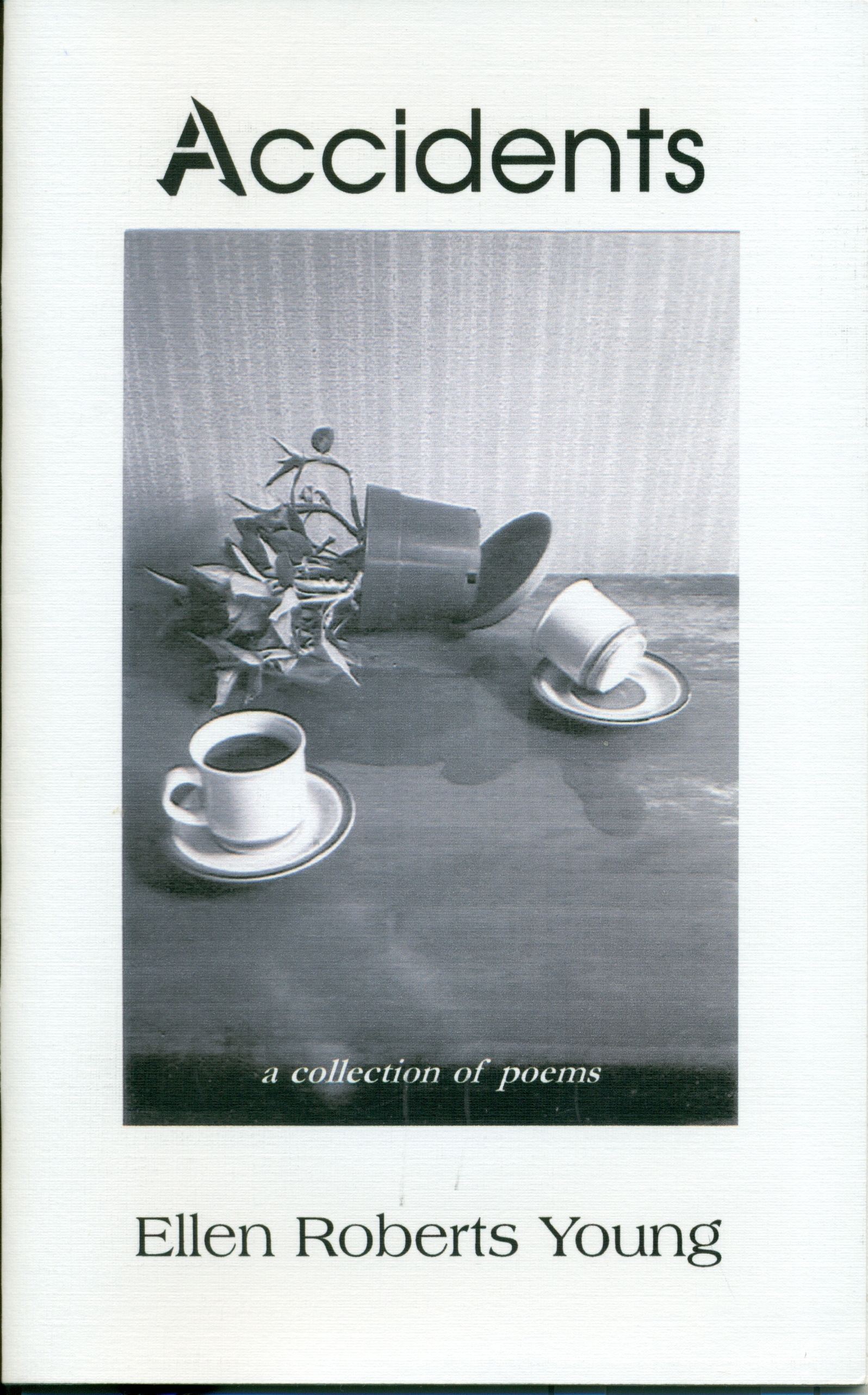
 I inventoried my storage closet recently and discovered that I have a huge box of copies of my first chapbook.  Accidents was published by Finishing Line Press in 2004.  I bought out their supply of the book because then I felt better about submitting again.  I think my second chapbook is even better than my first, but I’m still happy with the way the first came out.

The title refers to the small upsets of the domestic sphere.  I created the cover picture of a spilled coffee cup and tipped house plant to suggest those little crises.

I have already published one poem from this chapbook on this blog. “Decaf Please” on October 3.  Today I’m offering another example, the title piece, called “Accidents Will Happen.”

Accidents Will Happen

A spill on the stove.
Wiping up is holding action:
minimize the damage.

To empty the pot, replace
the cooktop is too much
lost: the moment.

Repair, reuse,
mend the frayed edges
of a day in tatters.

The world still rocks
on its axis like the cap
on a pressure cooker.

Yes there are days when I’ve felt like this.  Perhaps you have too.  There are twenty-one poems in the chapbook.  I am now offering copies of Accidents at $5.00 each, including postage.  Use the contact page to get my email and address.  They could make good Christmas gifts for your reading friends, and you won’t have to tell them about the bargain price.  Or you could boast about it at a $5.00 gift exchange event.

Parley of Instruments: A Tale

3 Comments

“I’m feeling off, and achy,” complains the watch as his band stretches around the boy’s hand.  “I’ve been reset so often my knob’s worn down.”

“My time is right,” the clock on the stove calls out.

“So is mine,” the clock on the radio mutters.

“B-bong, b-bong,” the windup clock on the wall begins to chime the hour.

“You’re two minutes early,” stove clock declares.

“Close enough.  I don’t run on current like you.”

“At least we agree,” stove clock assures radio clock.

“Of course!  We run on the same power!”

“You’re grumpy this morning, radio clock,” wall clock says.

“Stove clock’s acting like she’s in charge – again.”

The boy looks at his watch, which is running five minutes slow.  “I’ve still got five minutes,” he says to himself.

“You’re reading the wrong timepiece!” the others cry together, but to the boy they are as silent as the lights flashing at the school crossing, where five minutes is enough to mark him tardy.

“He didn’t look at any of us,” stove clock sighs as the door closes.


This little story was a side trip in my journey with William Paley’s Natural Theology.  The image of the watch which opens Paley’s argument is so strong that it took me a while to realize that Paley is not really interested in what watches do, that is, tell time.  He is interested in the watch as a mechanism which must have had a designer.  It is a parallel to the eye, ear, and all the other parts of the body which, it is his project to demonstrate, must have been designed.  Paley’s world view is a topic for another time,. as is our contemporary bondage to clocks and the minutes they represent.

Daily Horoscope

1 Comment

I read my horoscope regularly―it’s on the same page with the word puzzles―but I usually take it lightly. I am a Scorpio and I know that is a deep water sign, which suggests depth of all kinds, deep thoughts or deeply hidden emotions.  I’ve been accused of both.  Lately the horoscope page has been telling me that with the sun now coming into my sign I have lots of energy.

aster in sand, Ghost Ranch

Some days I do have lots of energy, but I prefer to attribute it to the weather.  I am like the purple aster which blooms best in the fall and continues until the frost.

One time my horoscope went way too far, promising that I can do it all. “You will with joy accomplish every item on today’s list.”

“This is a trap!” I declare to the newspaper page.  Yes I could do it all, but I would have to spend tomorrow, or maybe two tomorrows, recovering.  I’d be back where I started then, if not worse, since the to-do list would pile up while I returned to normal.

“This must be a message for another Scorpio,” I argue.  “One who’s more organized, more disciplined.”  I am actually quite disciplined about writing.  The horoscope writer doesn’t know where my focus has to be.  My to-do list is all the other, smaller things I ought to do, the ones I will forget if I don’t write them down.

It’s silly to be talking back to the newspaper horoscope.  An artist coach whose work I read somewhere suggested that one shouldn’t worry about one’s list, because half of it won’t matter in the long run.  Which half would that be?  The glasses that need adjusting?  The socks that are due for replacement?  Triage itself takes time and attention.  Meanwhile the list gets longer.  That coach is right on the principle, however.  A focus on to-do lists is a drain on creativity.

Would it be accurate to say that we all have more important things to do than the things on our lists?  It all depends, of course, on what we put on those lists.  I never put “write” on the list.  I just do it.  I don’t put “love” on a list either.  We don’t need lists for the really important things.

Halloween and Other Ghosts

2 Comments

We’ve reached another cross-quarter day, the midpoint between the fall equinox and the winter solstice, better known as Halloween.  It is interesting that this day gets so much attention.  Many believe it has no connection with religion.  They celebrate it with fun and costumes in the early dark.  A significant minority in this country knows that it has religious origins and prohibits it as satanic.  In its early form it was a time of religious ritual, particularly rituals of purification through fire, and of moving to winter quarters.  In some places it was also the start of a new year

I’ve always thought it would be an awkward day for a birthday.  How special would you feel if everyone else was getting candy too?  A friend born on this day, however, told a story about a time in elementary school when birthday parties were forbidden.  The teacher worked her birthday into the Halloween festivities.  That would make a person feel special.

Another person who was born on this day was my mother-in-law, Jane.  Her sons would have no excuse for forgetting their mother’s special day.

I’ve not been impressed with the recent focus on zombies.  I don’t believe in them.  Ghosts, however, are real, in a number of ways.  A woman from New Orleans told me, “Home is where you listen to the ghosts.”  I picture her attending to voices of her―and her community’s―past now that she has returned home, voices she could not hear properly when she lived elsewhere.

My own ancestor research has been work with ghosts, a crowd of people clamoring to be remembered.  They have sometimes weighted on me as an obligation.  At other times they are more like sprites, delightful wisps teasing me into the past.

One of the special things about my mother-in-law was an uncanny ability to find a parking place just where she needed one, no matter how crowded the situation.  To this day, when my husband and I find a space like that we say, “That’s Jane’s space.”  It’s as if she has found and held it for us.  She’s a good ghost; we’ll have her with us as long as we remember.  The parts of our past we’ve neglected may come back to haunt us.  Those we’ve cherished will remain in our hearts, connecting us to our heritage.  Perhaps you’d rather call them something else than ghosts.  Any metaphor will do, as long as we remain mindful of this phenomenon, that we continue to be connected to those who are gone.

A New “Church”: From the Biography

Leave a comment

John Emerson Roberts’s contacts with Robert Ingersoll, described in my blog of October 6, bore fruit in the fall of 1897.  From my biography of Roberts, here is a description of Roberts’s independent “Church” and how it operated:

The Church of This World held its first service in the Coates Opera House on September 12, 1897. In addition to Roberts’s lecture, which he still called a sermon, music was provided by Carl Busch. The service apparently consisted only of this music and the sermon with no offering, no hymnody, and certainly no prayer. It is interesting that the organization was called a church, given the comments Roberts made in the spring about the negative connotations of that term. The phrase “this world” was evidently taken from Ingersoll’s letter praising Roberts’s sermon about the boy who died in jail: “You are preaching a religion for this world.”

Carl Busch was a major figure in the music world of Kansas City.  Born in Denmark in 1862, he studied in various institutions in Europe.  In 1887, Busch was working in Paris, playing in orchestras conducted by Camille Saint Saens and Charles Gounod. The Danish vice-consul in Kansas City invited Busch to organize a string quartet and bring it to America. Busch did so, and spent the rest of his life based in Kansas City. Times were not easy for the arts. Busch organized a series of orchestras and programs, but between the economic troubles of the late 1880s and the 1890s, and the lack of developed musical taste among the well-to-do business class who were the city’s elite, support was not always sufficient. The position as music director for the Church of This World was at least steady work, though very part time; Busch was still employed there when his biography was written for Whitney’s Kansas City, Missouri, in 1908.

The Church of This World was set up with a board of trustees just as the Unitarian Society had been. The names of the earliest set of trustees are not known. The trustees are listed in the newspapers only in later years when there were stories of development or decline to report. The funding for the church was provided by supporters who paid for their seats; the cost ranged from $5 to $25 per year. This practice is comparable to the idea of pew rentals, which many churches used to provide a base of income; the theater seats were no doubt more comfortable than typical pews. Seats for those who just came in were free.

The sermons Roberts gave in that first year are lost.  In the fall of his second year, however, Roberts published a series of sermons as a hardbound book.  A few copies have survived.

These sermons show how his preaching and views had evolved. The first sermon was titled “The Imperial Demands of Progress.” The word progress had become a highly resonant term for Roberts. He begins with the idea that one has an obligation to participate in progress:
“Deeper upon enlightened minds grows the conviction that progress is the world’s supreme law. To contribute to that progress, to obey that law, is the cosmic business of everyone and of everything that is.”
While he sees this as a human undertaking, however, he has not become a true Ingersollian; he has not given up talking of God, of spirit and of the divine. He concludes this first sermon by saying,
“Let us trust the old, the common, the misunderstood earth. Let us hail the dawn of the day coming fast and sure, when all men everywhere shall see that the earth is divine, man is divine and God is all in all.”
Though “thought” and “reason” are among his favorite themes, Roberts also holds on to the idea that religion, as opposed to specific religions, is an element of life that will endure.

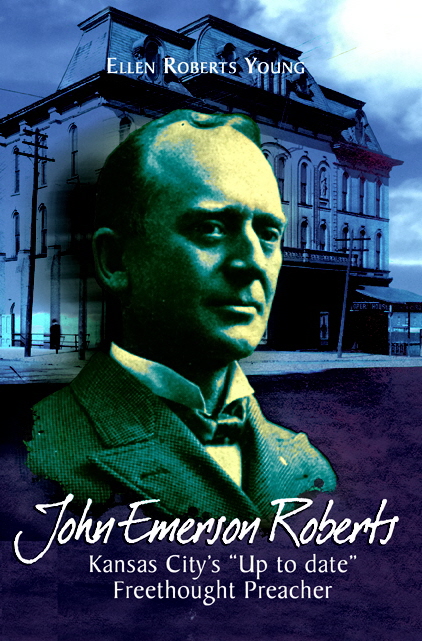
There’s that dawn metaphor again in the second quotation, an image Roberts used often.  Read more about his most unusual institution in John Emerson Roberts: Kansas City’s “Up-to-date” Freethought Preacher, available through Amazon from ERYBooks (or use the contact page).

The Map of Longing: Poem and Chapbook

4 Comments

How shall I properly introduce my chapbook The Map of Longing now that it has snuck into my blog entries through a poem called to mind be recent experience?  It is my second chapbook with Finishing Line Press, published in 2009.  It is a collection of poems about loss and longing within the ordinary phases of life.  I had the fun of working with a friend who is a photographer to choose the cover picture, which shows a road leading to some unknown place through overhanging trees.  The fact that it is a scene from my home state, California, was an incidental plus.


My mother, Emily, in her prime

Many of the poems in this collection relate to my mother, including some about the last months of her lifeand clearing outher house.  Others refer to my own move from Pennsylvania to New Mexico, which happened the same year as my mother’s death.  Is it any wonder the two themes are intertwined?

There are several poems, however, which attempt to capture the feeling of being lost, disoriented, out of touch, as a general human condition, not connected to any specific circumstances.  One of these is the title poem, which expresses the mood of distraction and disorientation by the very number of its metaphoric images.

The Map of Longing

The express train
knows where it’s headed.

I zigzag,
a squirrel before cool weather
signals gathering,

no pattern tidy
as trimming for a skirt,

no purpose,
like switchbacks
up a mountain.

My turns random as leafing
through a dictionary,

I skid like a getaway car
within a movie frame,
constricted by the tracks of time,

direction inescapable
as A to Z.

The Map of Longing is available through Amazon.  You can get a signed copy from me via ERYBooks.

Older Entries Newer Entries