Home

September Revisited II

3 Comments

No pictures this time.  I shared pictures from an afternoon reading I did for my new book soon after it happened in September (see “We Had A Party” posted September 28).  There was also an evening reading, which was not so well suited to photographs.  Instead, I got a poem out of it.

The poem is in a form developed by Allison Joseph. She calls it a sweetelle.  The form is ten lines of fourteen syllables each, with the first, fifth and tenth lines identical.

Introduction

Thank you for this fine occasion to read from my new book
though this is a dark corner and the microphone will not
stay put.  I’m stalling in the hope that others will appear.
Vain hope, false promises; it’s past the time we should begin:
Thank you for this fine occasion to read from my new book.
But it’s not new to me.  More than a year in production
since I signed that contract.  No additions since.  Take a look
at the cover, another’s work.  Inside, it comes to this:
I’d like to introduce you to some friends from former years.
Thank you for this fine occasion to read from my new book.

At first, I thought the name “sweetelle” meant that the subject should be sweet – something I’m not very good at. It has since occurred to me that the name may have been chosen to point out that this is a form with repeated lines which is not to be confused with the “villa(i)nelle.”

I learned about this form through a post which Joseph mistakenly posted on her CRWROPPS list, and then explained. The acronym stands for Creative Writers Opportunities list, which can be found at: https://groups.yahoo.com/neo/groups/CRWROPPS-B. If you are a writer, especially a poet or short fiction writer, you will find this a great resource.

Launching My New Book

3 Comments

Paley front coverMy first full-length poetry book is out! I will be giving readings from it locally at the following locations:

Palacio Bar, Mesilla
Tuesday, September 16
7:30 p.m.

This is the regular monthly SPLAT open reading night, the third Tuesday of the month.  I will be featured at the beginning of the readings at 8:00 p.m.  (Come at 7:30 to get your beverage and/or sign up to read after my presentation.

Café de Mesilla
2190 Ave. de Mesilla
Saturday, September 20
3:00 p.m.

I will be reading shortly after 3:00 p.m., so be on time!  I will read a different set of poems, so if you’d like to come both times just to support me, I certainly wouldn’t mind.  I will have plenty of copies available at both events.

For those of you who aren’t in the area, I have a give-away going on Goodreads:

https://www.goodreads.com/giveaway/enter_choose_address/107114-made-and-remade

It runs from now until September 20.  And you can also use the contact page here to get in touch with me about getting a copy in the mail.

I would like to schedule other readings in partnership with other poets.  They will be listed here when/if they happen.

Napa 3: Yes, There Was Writing Too

1 Comment

P1000198My back yard has acquired its post-rain carpet of green.  When it first appears I can’t tell which plants will be weeds and which will be wildflowers.  I feel a bit that way about the results of my participation in the Napa Valley Writers’ Conference.  I’m sorting out my drafts of poems and my new ideas and deciding which pieces have most potential.

Many of my poems centered on the past.  Perhaps this was because I was back in California where I grew up, though the Napa Valley wasn’t part of my home turf.  Perhaps it was because when one has 20 hours to produce a poem, one goes back to basics.  Here’s one piece which may be complete in itself, having taken the shape of a tanka.  The assignment was to show passage of time:

Almond blossoms in spring,
tiger lilies in summer.  Our height
marked on the door post.
Before my brother grows tall,
the house is no longer ours.

Another piece is too short for a tanka, too long for haiku.  Perhaps it is the beginning or end of a longer poem, though right now the rest isn’t working.

Prunes, apricots,
cannery by the tracks.  I bury questions
in my grandfather’s orchard.

Since I’ve been working on a different poem about trying to put my ancestors behind me, I may put this aside for a while.  I have researched all the main lines of my ancestry and after writing John Emerson Roberts: Kansas City’s “Up-to-date” Freethought Preacher (see Books page) I thought I was done.  But here is my grandfather and his orchard once again.P1000200

Meanwhile, in a corner of my yard not as covered in new green shoots, a little clump of purple mat, my favorite local wildflower, is flourishing.  It didn’t have to wait for the rain to get started.  And I have lots of other material to work with while I decide what to do with my new pieces from Napa..

Recommendation: Eliza Griswold

1 Comment

Eliza Griswold’s book Wideawake Field is not new.  It was published in 2005, but it describes conditions that are as much with us nine years later as they were then.  Many of her poems are poems of witness; she is a journalist who has worked in many difficult locations.  Other poems focus on relationships, primarily their ending.  Here is one of the poems describing a harsh world:

Monkey

The soldiers are children and the monkey’s young.
He clings to my leg, heart against calf―
a throat filling, refilling with blood.
Last week, the children ate his mother―
dashed her head against the breadfruit.
A young girl soldier laughs,
tears the baby from my leg
and hurls him toward the tree.
See, she says, you have to be rough.
When she was taken, the girl’s
heart too pulsed in her throat.

This poem combines a relationship and her work context:

Hi-Lo Country

Only today did I think of your gear:
chalk bags, cam lube, harness, friends―
all lying about taking care.  You play
with death up there; the good kid’s hit,
risk’s cheap high, like whippets,
ve never done whippets,
and neither have I.  You gasp at the welts
on my back left by Congolese fleas
as if my job were an affliction.
Look at yourself on your knees
in the most beautiful place in the world,
craving fear.  That’s addiction.

She leaves it open which, the speaker or the addressee, is the more addicted.  It seems ― and is certainly appropriate ― that Griswold turned to poetry to help her work through some of the ambiguities of what she has done and what she has seen.  “Authority” describes some of these ambiguities, in remembering a past incident:

The flaming city makes it rain.
The siege has changed the weather.
We lie together on the luggage:
the generator that won’t work,
a poisoned rice sack.
This is so many years ago
and fifteen seconds.
I’m embarrassed to remember
the time before I grew
uncertain about you,
or that I had a right to say
where I had been
and what I saw there.

Griswold says a lot in short, tight poems.  I recommend this book because these poems make vivid some of the situations in the world which flood our news, yet are kept at a distance by the television or computer screen.  This is important work for poetry to do.


A Few Thoughts on Poetry and Science

1 Comment

Galileo is said to have muttered when he was forced to recant the heresy that the earth was not the center of an Aristotelian universe, “E pur si muove.” – “And yet, it moves.”

Muriel Rukeyser, in her essay “The Life of Poetry’ asks the reader, “What is our ‘E pur si muove?’”

This question is in the context of her conviction that poetry and science are similar processes, in which we seek to learn the true relations of things.  And in both cases, she believes that the answers come in the form of questions.

Science is not static; the universe is not static: poetry is not static.  Each moves. And the motion of a poem is motion in time, like music.  Science is not, properly speaking, a study of objects.  The poem is not words or images, which can be separated for study; it is a series of relationships between words and images.

These are a few of the stimulating ideas from Rukeyser’s “The Life of Poetry” first published in 1949 and reprinted in 1996.  By her title she suggests that poetry is living, organic.  Poems do something in the world.

The poet and the scientist are on parallel paths.  I think Rukeyser’s ideas are supported by some of the developments in science since she wrote; the poets may be having trouble keeping up.

Giveaway on Goodreads Ends Soon

Leave a comment

Paley front coverJust a reminder that I am giving away two copies of my book, Made and Remade on Goodreads.  This pre-launch giveaway closes on July 20.

Of course, if you don’t win, you can buy a copy from me by using the contact page.

Here’s a sample from the book.  I’ve organized the poems in six sections, responding to different statements by William Paley.  One is this:

I know no better method of introducing so large a subject, than that of comparing a single thing with a single thing; an eye, for example, with a telescope. As far as the examination of the instrument goes, there is precisely the same proof that the eye was made for vision, as there is that the telescope was made for assisting it.
Natural Theology, 16

And one of my responses to that text is:

Analogies

Treasured image: curved back
of a worker bent in concentration,
watchmaker with tiny tools,

magnifying eyepiece,
or potter with clay-covered hands:
e
ach has a skill prized in its time.

When human minds are
compared to computers, no one calls
God a computer nerd, and though

bodies are treated like machines,
repaired, regulated, no one says,
We are watches.”

We break, are mended
like serviceable jars, more kin to
vulnerable clay than clipped metal.

Paul wrote “earthen
vessels” and it stuck.

Goodreads Giveaway for Made and Remade

1 Comment

Paley front coverI am offering two copies of my book Made and Remade in a pre-launch giveaway on Goodreads.  Go to https://www.goodreads.com/book/show/22163304-made-and-remade if you’d like to sign up.

The proper launch for the book will be in September, with readings in Las Cruces.  If you’d like to invite me to come to your area and share a reading with someone, I can do that too!  I’ll be lining things up soon.

If you don’t win the giveaway, which ends July 20, use the contact page if you’d like to get a book.


This is the opening poem in the collection:

Obsession

for Polly

I’m fixed on this book
like a three-year-old on trucks,
a five-year-old on dinosaurs.  You could
make it my motif, were I young
enough for birthday parties.

Language to sift and savor
artfully, skillfully portrays
a world of fixed order, art
and skilled contrivance.
This balance
wavers as I wonder
at that world’s collapse in
swings, cycles, evolving
life, shifting earth.

Mechanistic views dissolve in
reality’s wash and rub.  I
turn and read again for fragments,
museum quality gems of evidence
for a long dead argument, a fresh fix
of fine writing, proceeding
from a fine mind.


Thinking About Line Breaks

1 Comment

Poets talk a lot about line breaks.  There is even a site called linebreak.org, as if that were a synonym for poem.  We need synonyms for “poem” because there is so much debate about what counts as a poem.

James Longenbach takes a different view.  Lines don’t break, he insists.  They just end.  It is the sentence structure that may or may not be broken by the end of the line.

Some lines are end-stopped, when a sentence ends where the line ends.  Where the line ends with the end of a phrase, Longenbach calls it “parsing.”  Where the meaning goes right past the end of the line and into the next in order to make sense, Longenbach calls it “annotating” – a term from a Milton scholar.  Milton did a lot of this.  Often in these lines the sense appears to end but doesn’t – the meaning is changed by what comes in the next line.

This play with terminology is a good reminder not to get stuck in habitual patterns, whether in writing poems or talking about them.  Labels are a hindrance to thinking new thoughts and seeing things in new ways.

“The music of the poem,” Longenbach reminds us, “”depends on what the syntax is doing when the line ends.”  There is no better or worse in the ways the syntax can be broken – or not.  Variety is what makes the poem effective.

Going to the other extreme, in Made and Remade I included two poems which have no line breaks: where the line as you see it ends is merely a function of where the margin is.  Here is one of them:

Perspectives

Walking in this desert I can picture you at work in your study because I have also walked on cobbled streets by Independence Hall, seen portrayed the men who met there, your contemporaries.  Your manse in a northern town at a river’s mouth calls to mind rocky shores I’ve walked on, their ten foot tides; I can see you there.  Yet, walking on sand I too easily picture your heath as always yellow, forget your concrete details do not become sidewalks, driveways alongside asphalt roads.  You have no need to bind with cement, build on your discrete images; all point in the same direction, while my direction shifts with desert winds.

Check out http://www.linebreak.org.  They publish a poem every week, written by one poet and read by another.

James Longenbach’s book is The Art of the Poetic Line (Graywolf Press, 2008).  It is a very small book rich with examples of good poems.

See the Books page for Made and Remade and use the Contact page if you’d like to get a copy directly from me.

How One Poem Came to Be

1 Comment

Reading Bruce Holsapple’s new book, Wayward Shadow, I was struck by the line “It’s the way you fix yourself in place.” It made me stop to think about how each of us does that. I thought, I’d like to explore that idea in a poem of my own.

It seemed an idea that would benefit from repetition, which led me to consider using the villanelle form, which led me to looking through Holsapple’s book for a possible second line. Instead I found two fragments.

I still thought I would be writing a poem about myself, but I began to see in the lines that came to mind echoes of the ideas that permeate Wayward Shadow. It may be that the way I “fix myself in place” happens to be similar to Bruce’s. In the end, I felt I had captured something of the persona in his book. So this is now a villanelle for Bruce Holsapple.

In Place

Using lines from Wayward Shadow

Climb a mountain, formulate a phrase:
you settled on these deeds because you knew
it’s the way you fix yourself in place.

Life has taught you this. There will be days
when energy is slow to waken to
climb a mountain, formulate a phrase.

Outside and in you need to claim your space.
Shop, fill the fridge, set simmering a stew,
it’s the way you fix yourself in place.

Record the colors on the high rock’s face.
It’s a sure antidote for feeling blue
to climb a mountain, formulate a phrase.

A sentence to rewrite, steps to retrace?
What circles is the animal in you:
it’s the way you fix yourself in place.

As these familiar actions work to raise
your spirits, you may wonder why so few
climb a mountain, formulate a phrase.
It’s the way you fix yourself in place.

If you’d like to get to know the real Bruce Holsapple, Wayward Shadow is available on Amazon.


What’s There to Say About Coffee?

2 Comments

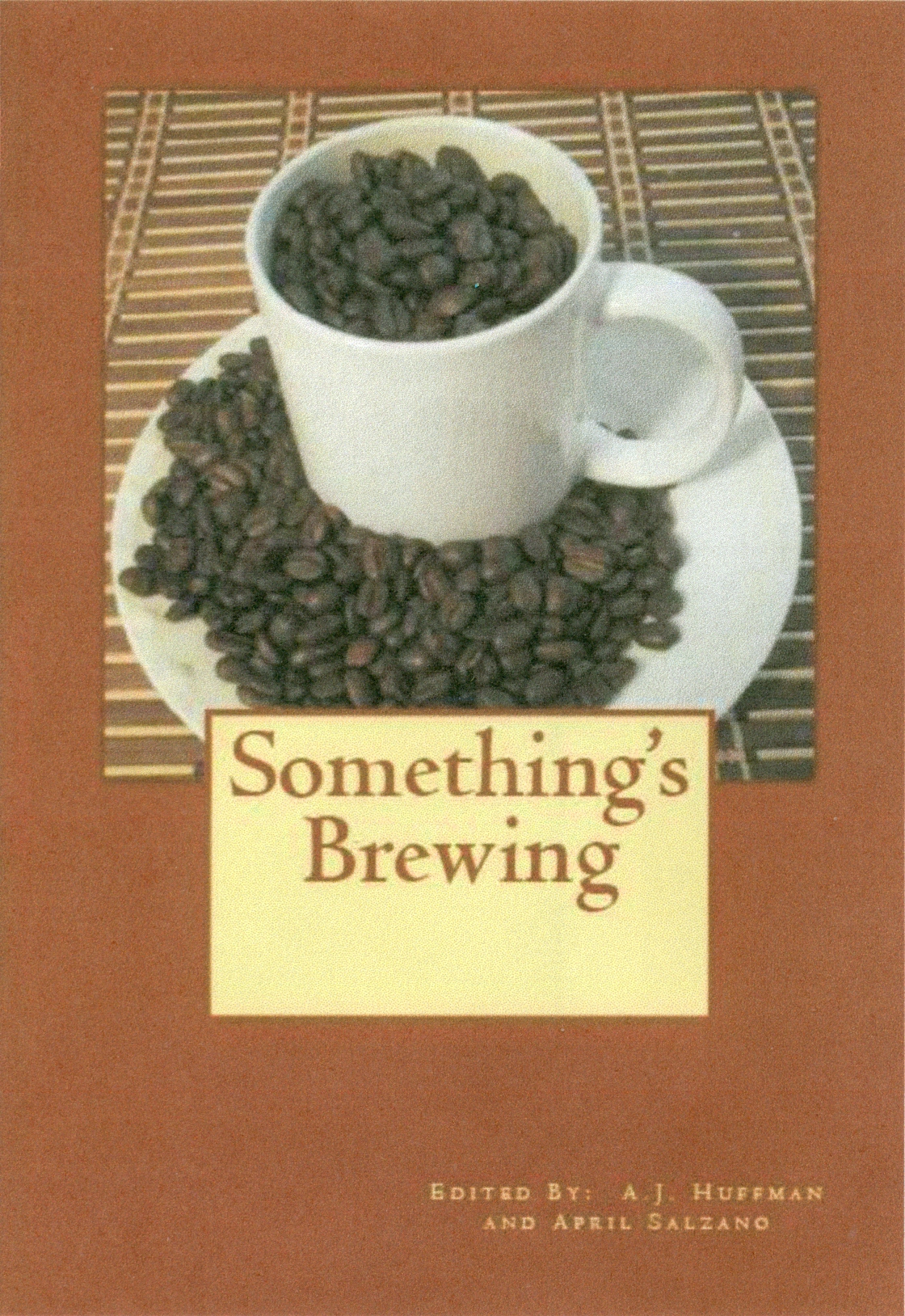
Coffee0001Quite a lot, it turns out. Kind of a Hurricane Press has just come out with a 200 page anthology on the subject. 86 writers, plus the editors, are represented. Coffee has a lot to do with daily life and relationships, and there are many ways to talk about it.

A poem of mine, “Coffee in the Cup” is included. My poem is about colors. Have you ever tried to name the color of coffee with skim milk?   I came up with “French beige,” a new term for me this past year, or “taupe.” But is either quite right? It’s a very muted, dull color, distinctly different from coffee with cream.

The anthology, titled Something’s Brewing, is available from Amazon for $8.50, which is a good price for a 200 page book. Kind of a Hurricane Press has anthologies planned to come out about every two months. Submissions for the theme “Candy” are due May 31, for “Amusement Parks” July 31. and there are more to come. Check out: http://www.kindofahurricanepress.com/ for more on submissions or about the coffee anthology.

Older Entries Newer Entries