Home

Not Just the Groundhog

4 Comments

There’s more to say about Thomas Paine, but today is another cross-quarter day, the midpoint between the winter solstice and the spring equinox.  It’s an appropriate time to pause and appreciate the cycle of the year which shapes our lives, whether we admit it or not.

The Wheel of the Year

The Wheel of the Year

February 2 did not always belong to the groundhog.  In Christian tradition this is candlemas.  The name comes from the blessing of candles.  The day also marks the 40th day after Christmas, which was a day for purification of the mother after giving birth in Jewish tradition.

The association of this day with light goes back before Christianity.  And with light goes fire.  The tradition I like best associates this day with Brigid, either a saint or a goddess depending on your beliefs, who is the patroness of poets and blacksmiths.

Why this combination of poets and blacksmiths?  I think it is because they both deal with fire, although one is literal and the other metaphorical.  They both are makers, crafters, one in matter and one in language.  I don’t recall where I learned of Brigid and her support of this particular pair.  Other sources assign additional causes to her, but I prefer to stick with these two.

I learned of Brigid in Pennsylvania, not too far from the site of Punxatawny Phil, that obnoxious groundhog who gets most of the attention on Groundhog Day.  In that part of the country it is a given that there will be six more weeks of winter whether he sees his shadow or not.  In contrast to his big show (I wonder how many groundhogs have played the role) I light a candle and celebrate the returning light, the lengthening days, and the fact that this old earth has still not been thrown off its axis by the follies of human beings.

Illusions, or It’s All In How You Look at It

2 Comments

I had a professor in a religious studies class on Zen Buddhism who was fond of saying, “It’s all in how you look at it.”  Here are two examples of looking.

In the back yard

In the back yard

The early sun shining through the bushes makes splotches on the wall which look, from the window by my writing desk, like a bouquet.  A pleasant illusion.  It reminds me how much of art, including poetry, is a matter of illusions.  Illusions which convey truth, we want to be believe.  This is what we artists strive for.

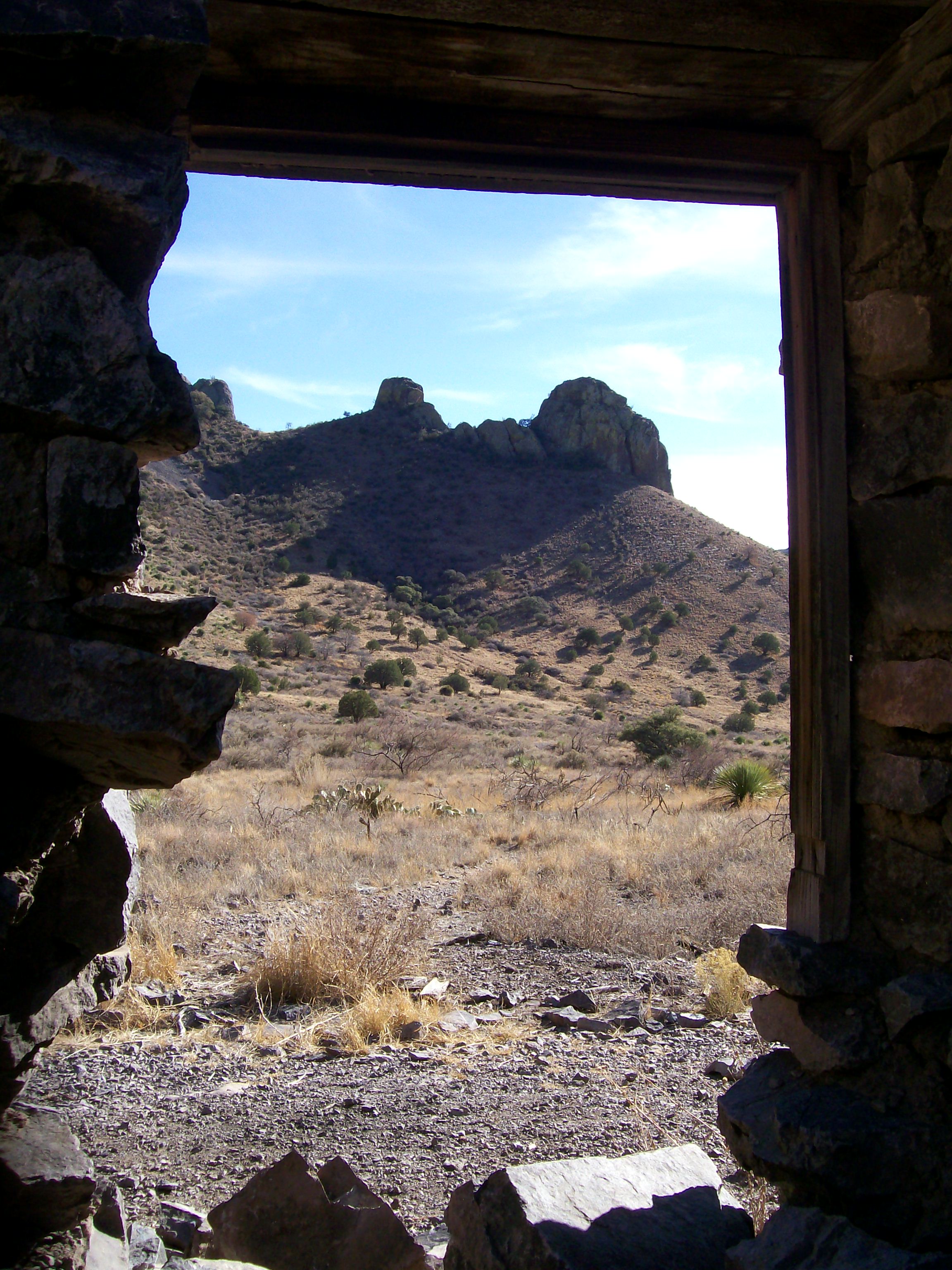
Bar Canyon View

Bar Canyon View

One of the hikes in my area leads to the ruin of an abandoned house.  Here I’m looking out from the house, and thinking about frames.  Did the people who lived in this house see what I see?  The way we frame a subject affects what we see.

Two pictures from southern New Mexico and a few thoughts for your enjoyment.

Coping with the Critic

4 Comments

I have read many books on writing and creativity.  I’ve probably reached the point of diminishing returns, but I keep picking them up, especially when I can get them second hand, because I’ve learned a lot from some of them.  Almost all of these books talk about “the critic.”  This critic may be the internalized voice of others who’ve told you you’re not competent to do what you set out to do.  Or it may be a voice all your own, telling you that nothing you do is measuring up to your own standard.  In either case, one of the early lessons in creativity books is the importance of shutting this voice out when you sit down to write.  There are various methods suggested: breathing meditation, write a letter, . . . .

I have found a different solution.  I promoted my critic to editor.  An editor must have something to criticize, so my critic now happily goes away until I have a draft to share: usually my first typed draft.  Then he comes running in.

At first he didn’t do very well at describing what he saw.  “Humph!” he might say, or “Boring!!”  Bit by bit, he’s picked up useful terms.

“Cliché!”  he says.  I underline the phrase he’s pointed to.

“Action verbs!” he cries.  I circle the “is.”

After such obvious points, he slows down, ponders.  “Why is this in such regular stanzas?” he asks after a bit.  “That’s your default form.  Does that really enact the feeling of the poem?”  My critic has been very pleased with himself since he learned the word “enact.”

“I was resisting it,” I say, noncommittally. “Form can pull against content.”  But I know he won’t accept my argument.

“It’s not strong enough,” he says.

“I’ll try it another way.  Just to see what happens,” I say.  I settle down to revision, and my critic goes off to look for another new term he can use at the next editorial session.  I can work alone now ―at least until he hears the printer start up.

Poetry and History: A Recommendation

1 Comment

Eve Rifkah’s book Outcasts is a book of poetry which doubles as a history lesson.  The subtitle describes what the book is about: The Penikese Island Leper Hospital 1905-1921.  This hospital, really a kind of imprisonment on a deserted island, was an effort of the State of Massachusetts to deal with the problem of leprosy.  It involved a total of 36 patients in its sixteen years of existence, fourteen of whom died and were buried there.  Rifkah recreates twenty of the patients, who were of many different cultures and ethnicities.

Rifkah uses historical documents, including the journal of Dr. Parker, who ran the institution, as well as newspaper clippings and other records collected by Mrs. Parker.  To these she adds a large dose of sympathetic imagination.  The desolate island, the smallest of the Elizabeth Islands south of Cape Cod, is vividly portrayed, echoing the desolation of the residents.

Each of the characters has a history and a role on the island.  Willie does the laundry, Archie runs the wireless telegraph, and so on.  Some are characterized further by their religion: Isabelle and Flavia pray to Mary, Solomon laments in verses from the Psalms, Iwa speaks to the Buddha, whose statue is his one possession.

The title page, below the subtitle, describes this collection as “A docu-drama in verse” and the sections are called Acts.  This is misleading, there is very little drama.  The poems are mostly soliloquies or descriptions of an individual.  The sort of tensions that would surely exist in such a situation are scarcely referred to.  Those few interactions which are portrayed  are largely between a patient and Dr. or Mrs. Parker, who are presented as loving, highly competent and inventive people.  I would describe this book as elegy, not drama.  One moment of group activity is portrayed in the following poem:

Here We Are Safe

huddled around Lucy reading the news
between songs on the Victrola
Till We Meet Again
our eyes look away
at the floor      the windows   nowhere
goodbye means the birth of a tear drop
and the singer talks about love
in A-flat

I remember hearing how the Shakers
called all outside their home the World
wind-up songs and newsprint all we have from that
place

the farther shores

out there          war      the reporters now call
the Great War             the war to end
war
we look at each other              imagine
exploding buildings                men ripped apart
in the World                the place we left
as though waking or entering dreams

Rifkah does not tell us who the “I” in this poem is.  The lack of punctuation and irregular line lengths are typical of most of the poems in the collection.

The language of most of the poems is tight, often fragmented, and does not rely on images outside the barren landscape and experience of the people.  This helps to build the feeling of lament which runs through the collection.  An example of such lament is “Frank Counts the Waves”.  Frank had been a fisherman.  Rifkah uses this history to inform the poem.

Frank Counts the Waves

high tides follow a blind moon
storm from the west blows
spray to walls              salt
seasoned crust on my lips
shattered shuttered shake

white roughed waves
roll and heave              break and break
one two three four
daylong nightlong

I sit back to cabin wall
hear Iwa praying to his Buddha
his language hard as the wind
I look to the cross my wife sent with me
hanging over my narrow bed
Why hast thou forsaken me
who am I to turn to.

all the world comes in goes out

no return passage
I said when leaving Cabo Verde,
the flowering islands,
in New Bedford fished cold water
fed my laughing children
named my first born Isaac, to laugh
I have passed into uncharted seas
breath in out as waves counting

years roll the sun summer high winter low
still counting
one two three four
ready or not.

As here, the other patients are usually peripheral to each person’s personal laments. It is a sad world, yet only rarely an ugly one.  Rifkah’s compassion permeates the book.

A listing of the actual patients whom she has lovingly brought to life is included in the back of the book; the summaries look oddly like contributors’ biographies in the back of a journal.  Rifkah has also written an Author’s Note giving the historical background.  Those who still lived when the institution was closed in 1921 were transferred to a federal leprosarium in Carville, Louisiana.  There, she writes “they experienced conditions even more horrific than those on the barren island.”

Overall, a harsh history has been softened by carefully chosen, crisp language.  It is an excellent way to tell the story.  It is a story worth knowing.

Outcasts was published by Little Pear Press in 2010.  It is available on Amazon.com.

A Different Kind of Christmas Poem

3 Comments

George Washington Crossing the Delaware

by Wayne Crawford

I have never crossed the Delaware River nor stood in a row-boat. while crossing any other river. If I were crossing a river in a rowboat, I would never stand with one foot propped on the edge of the boat, especially an overcrowded boat. I imag- ine that if I were to cross a river in a boat, I might cross the Delaware River, and the waves of the river would rise and chop against my boat like those in this painting of “George Washington Crossing the Delaware” by Emanuel Leutze. In this painting, General Washington is crossing the Delaware on Christmas day. It is a windy, overcast day. Clumps of ice, the height of many of the people in the overcrowded boat, float on the surface of the river. A couple of men must use their oars to push these islands of ice out of the way so that the boat can move forward, so that the Colonists can surprise the English and Hessians and win the Battle of Trenton. It is Wednesday, almost 69 degrees where I live in New Mexico. On Wednesdays, I don’t cross rivers, not even the Rio Grande, which is a mile away and mostly dry this time of year. It’s the Christmas season here too. I’ve been looking in an art book, viewing all these paintings with water in them-slots of seaside scenes, picnics along the river, lovers caught in a rain shower, couples silhouetted against the ocean or dangling their legs in a pond. Today, I crossed the Delaware River. I could drown on a Wednesday afternoon and never leave my study.

Wayne Crawford was a poet and promoter of poetry in Las Cruces for many years until his death in 2011.  He worked to bring young poets and older poets together and was encouraging to all.  I feel that I made significant advances in my work due to the confidence I gained from his enthusiasm and support.

This prose poem, “George Washington Crossing the Delaware,” is from Wayne’s last book, Sugar Trail, published by Sin Fronteras/Writers Without Borders Press in 2007.  It is available on amazon.com

Poetry Reflections: Scraps of memory and “The Second Coming”

2 Comments

Have you ever had a scrap of poetry come to mind and been totally blank on where it came from?  That happened to me recently when, in the middle of working on a poem about decay (it started out as a fall poem and went down into dissolution from there) the phrase “the center will not hold” came to mind.  Thank goodness for Google which can turn that into “the centre cannot hold.” and then give me the whole poem it came from, William Butler Yeats’ “The Second Coming.”  I didn’t remember Yeats had a poem with that title.  I didn’t remember the rest of the poem when I read it, until I got to the last line, “slouching toward Bethlehem to be born.”  Then I knew I had read it, but when, where, or how long ago is a mystery.  It was not in school.  I have not had a class in poetry since seventh grade, when we were required to memorize a poem every week.  There were Wordsworth’s daffodils, and “Flanders Field” and some I haven’t seen since, like Byron’s “The Destruction of Sennacherib”:

The Assyrian came down like the wolf on the fold
and his cohorts were gleaming in purple and gold.

The object was to memorize, not to understand.

Yeats’s poem is a different matter.  It begins with lovely language about a desperate time.

Turning and turning in the widening gyre
The falcon cannot hear the falconer;
Things fall apart; the centre cannot hold;
Mere anarchy is loosed upon the world,
The blood-dimmed tide is loosed, and everywhere
The ceremony of innocence is drowned;
The best lack all conviction, while the worst
Are full of passionate intensity.

There seems to be some dispute as to whether this refers specifically to Irish issues or to the conditions everywhere after World War I.  I think it would fit today, this year, this decade also very well.

Then the poem turns, as the title warned us it would.  “Second Coming”?  Who expects that today?  The Seventh Day Adventists and Jehovah’s Witnesses and other such apocalyptic groups still talk of a return of the Savior.  None of them, however, use Yeats’ language.  “A lion body and the head of a man” is Biblical enough, but “slow things” “shadows of indignant desert birds”?

The final scene comes with a shock to one who knows a little Biblical reference and expects a Biblical kind of hope. Yeats is against the religious history altogether.  “twenty centuries of stony sleep/were vexed to nightmare by a rocking cradle.” The church’s history is a nightmare.   Can we get a little comfort in a period of “anarchy” and “blood-doused tide”? Yeats offers none.  There is an end coming, but there is no hope:

And what rough beast, its hour come round at last,
Slouches towards Bethlehem to be born?

Interacting with this powerful piece of writing. I am now so far from the poem I was writing, the one that brought the phrase to mind and sent me to Google, that I cannot find my way back.

The only thing I am sure of about this poem is that I totally failed to understand it when I read it in years past.


Recommendation: Deborah Cummins’ “Counting the Waves”

2 Comments

Deborah Cummins, author of Counting the Waves (Word Press, 2006), summers in the same area I do, on Deer Isle in Maine, so I expected to find things I like in her poems.  There are a few local references, such as to folks at the town dump, but much of her material could be in many places; she has been in many places, and has given them all the same careful attention.  The title poem plays off an overheard conversation:

Child” “I’m bored.”
Mother: “Go count the waves”

Cummins imagines that the child who tried this impossible challenge would discover, “as he loses count, the waves’ myriad glittery eyes.”  “Counting the Waves” is a good title for the book, because while Cummins doesn’t do much counting, she uses close observation to bring out the details of what is immediately at hand on a walk along the shore, or out a window, or while she reads on her deck.  The opening poem tells us to expect this: “Inheritance” describes how fortunate she feels on an “about-to-be-golden” morning and her relationship to the world around her:

For now, I embark into the day,
my luggage light―some nouns,
a peppering of verbs―all I need.
And the landscape too lacks nothing.

Except for, with me in it, my responsibility―
ah, here’s the obligation―
to look and look.

The book is a gathering of scenes described through her eyes.  Odd things, like an old apple tree being moved on a flatbed truck.  Gentle things, like a swallowtail that comes right up to her or the luminous glow in a parking lot at sunset.  There are forty poems, divided into three sections.  The reader becomes comfortable with this detailed seeing in the first section, and then it is a shock when she turns in Section II to serious issues of relationships: difficulties with her mother, troubled neighbors where she grew up, a woman walking the shore who cannot recover from the loss of her husband.  All of these she treats with clear sighted compassion.  In the third section she turns back closer to her own life, but includes issues like losing keys and the way the body betrays us.  The poem “Keys” turns from the frustration of the lost keys to this:

Who would like the day of dog or wren,
days undifferentiated by yesterday or tomorrow?
No before-the-keys, no after-I-find-them.
Those places in between here and there,
between lost and gone.

As a sample of a full poem, one which focuses on the near at hand, here is

The Season’s First Apples

At the farmstand, among the crates
of late tomatoes and corn, the season’s
first apples blush at their debut―

smooth, unmottled beauties too pretty to eat.
For days, the ones I choose
adorn my kitchen shelf, their stout stems

like perky caps, tams, perhaps,
the kind without protective earflaps.
At the open window, wind is disguised

in the stillness of trees, the luffing
sails in the harbor.  Nowhere
in my radio’s broadcast is there a forecast

of snow.  I have no need
for socks or a sweater.  But at the sound
of my first bite of the season’s first apples,

boots crunch through icy layers.
Frozen tree limbs stutter
against the roof and gutters.

And the stove gapes open, ready
to make of another cord of wood
ash.  How solitary

the flame of a single struck match
that on certain cold nights
seems like the only salvation.

I like the word play.  Any apples might blush, but these “blush at their debut” and I see debutantes being presented.  Apples may crunch, but here it is boots that crunch and we are in a new scene entirely.  The music of these lines, with their rhymes, usually not end rhymes, and enjambments (as in wood/ash. How solitary/ for instance) is typical of Cummins’ work. It is a pleasure to read.  You can find it at: http://www.word-press.com/cummins.html

Accidents for Sale

Leave a comment

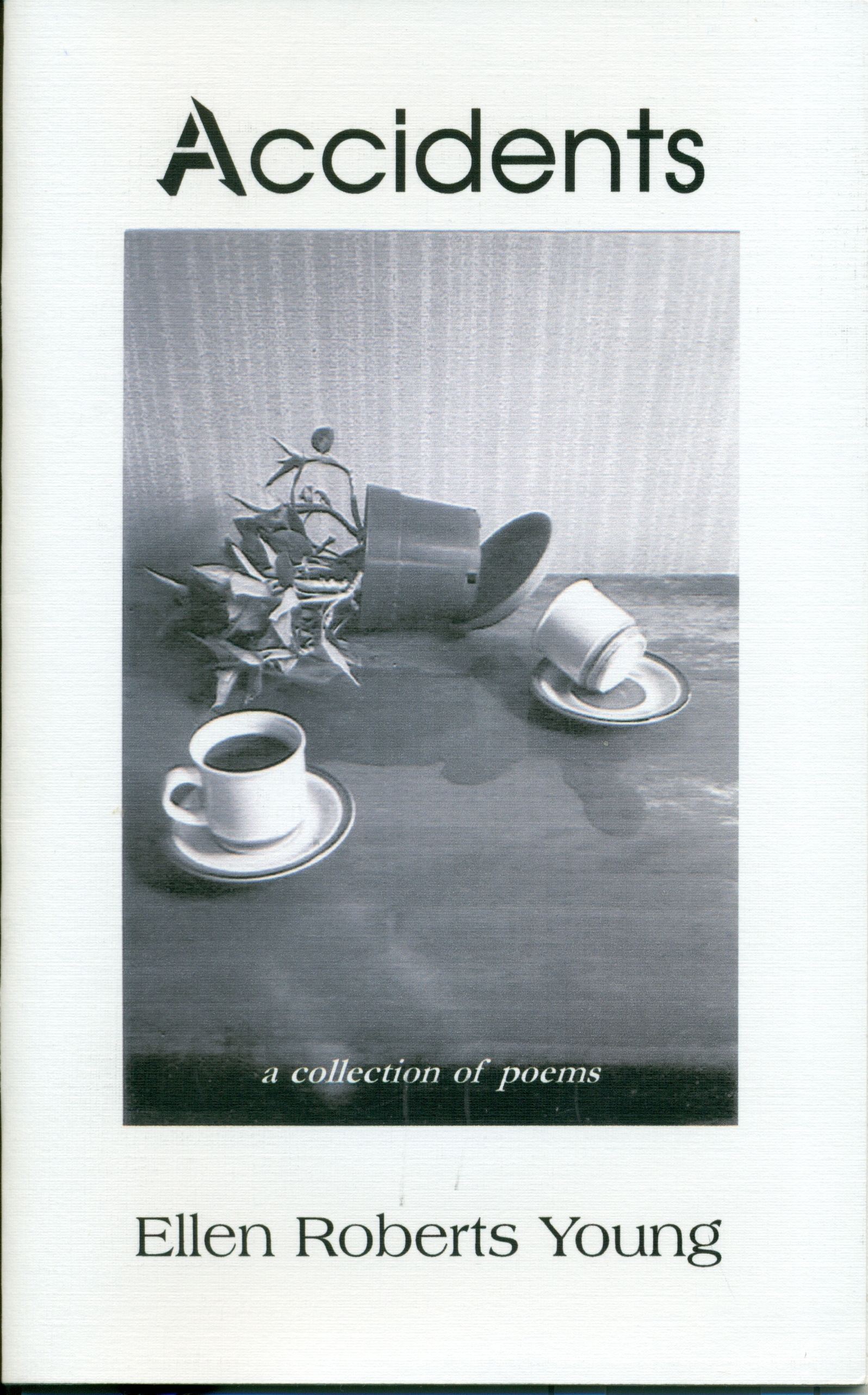
 I inventoried my storage closet recently and discovered that I have a huge box of copies of my first chapbook.  Accidents was published by Finishing Line Press in 2004.  I bought out their supply of the book because then I felt better about submitting again.  I think my second chapbook is even better than my first, but I’m still happy with the way the first came out.

The title refers to the small upsets of the domestic sphere.  I created the cover picture of a spilled coffee cup and tipped house plant to suggest those little crises.

I have already published one poem from this chapbook on this blog. “Decaf Please” on October 3.  Today I’m offering another example, the title piece, called “Accidents Will Happen.”

Accidents Will Happen

A spill on the stove.
Wiping up is holding action:
minimize the damage.

To empty the pot, replace
the cooktop is too much
lost: the moment.

Repair, reuse,
mend the frayed edges
of a day in tatters.

The world still rocks
on its axis like the cap
on a pressure cooker.

Yes there are days when I’ve felt like this.  Perhaps you have too.  There are twenty-one poems in the chapbook.  I am now offering copies of Accidents at $5.00 each, including postage.  Use the contact page to get my email and address.  They could make good Christmas gifts for your reading friends, and you won’t have to tell them about the bargain price.  Or you could boast about it at a $5.00 gift exchange event.

Reflections on Contemporary Travel, with a Poem

1 Comment

When my husband and I travel, we usually use one motel chain, one which claims, and usually provides, certain amenities such as a decent breakfast, thick towels and internet service.  This practice also enables us to build up points toward a free stay once or twice a year.

There is one problem with having a “rewards card” however.  It means they have our email address.  After each stay we get a request to fill out a survey.  There is no “I choose not to” option at this point – if we don’t answer it we’ll get a “friendly reminder.”  Part of the survey includes “when did you last stay in a motel?”  “Which brand was it?” and “Did the brand name influence your choice?”  By this time I want to scream “Yes!  Of course the name influenced us!  We have a rewards card!  Aren’t you paying attention?”  But they are not paying attention.  They offer no place to make a comment to the organization, instead of to the individual hotel.

But the question which gives me the most trouble is “Was this trip for business or pleasure?”  If I have to get across the country to visit family, there ought to be a third category.  Would it be both?  Neither?  This became an acute issue for me when I was travelling to visit my mother because she was ill.  The culprit that time was an airline, but the reaction was the same.  Is it business or pleasure?  It’s both.  it’s neither.

My chapbook The Map of Longing includes a number of poems related to my mother’s last months.  The fact that it happened at the same time we were preparing to move made everything sharper and more complicated.  In the poem below I tried to express some of my frustration.

Choice

The form asks, “business or pleasure?”
No “other” category for this trip
which is neither―or both:
my mother’s business,
her pleasure in our visit,
our pain in the strained connection,
spoiled arm, scattered mind.

The web of family combines
what marketers want to segment,
as if pain and pleasure could
be wrapped separately, like
the chocolates she loves, as if
“all of the above” were an option
one could choose not to check.

The Map of Longing is available through Amazon.  You can get a signed copy from me via ERYBooks.

Recommendation: A Wonderful Writing Workshop

2 Comments

View from the Mesa

I have just returned from a week-long workshop at Ghost Ranch.  It was both stimulating and relaxing and full of kindred spirits in a spirit-filled place.  “The Ranch” has a long history, going back to a small dinosaur whose bones have been found there, the Coelophysis.  The name “Ghost Ranch” goes back to the Archuleta brothers, who told any would-be thieves or cattle rustlers the place was haunted―and no nefarious person ever came out alive to contradict them.  Ghost Ranch is connected to the Presbyterian Church but funded separately.  It offers a wide variety of classes from spring into fall, as well as a January term for students.

Anita Skeen is the organizer of, as well as one of the teachers in, the Fall Writing Workshop at Ghost Ranch.  Anita has put this together for the second week in October for something like fifteen years and has taught at the ranch for many years before that.

This year there were four classes.  While Anita taught one on The Writer’s Notebook, Ina Hughs taught Creative Nonfiction, Catherine Watson taught Travel Writing, and Jane Taylor led a workshop in poetry focusing on shape and voice.  Each teacher gave a reading, so that all participants could hear the work of all of them.  At the end, a joint reading of all the students gave an overview of the class approaches and assignments.

One afternoon, each teacher gave a short workshop.  It may be no surprise that the basic rules of good writing in all genres are much the same: details, emotion, a good beginning, middle and end, etc.,  but it is great reinforcement to hear this told in different ways for different kinds of writing.  Reminders are often as good as new material for encouraging the artistic process.  All of the teachers were entertaining as well as informative.

Our cozy classroom

The writing was all fresh work.  There were exercises and assignments, with freedom to interpret or adapt them to whatever flowed from the pen.  In my small class of three students, the variety produced from one assignment was a delight.  The mutual support and good spirits made everything seem even better than it was – at least in the case of my own efforts.  I came home with a batch of new bits and pieces to pursue, and new ideas about how to approach them.

There are a lot of different housing options.  I chose the cheapest, which were located up on the mesa, units of simple rooms with shared bathrooms.  This turned out to be a good choice in two ways.  First, the walk up and down the hill was good exercise to stir the writing muscles as well as the physical ones, and second, the mesa has the best cell phone service, the main part of the ranch being in a valley.

Will I go back next year?  Maybe.  Do I plan to go back before very many years go by?  Definitely.  Maybe next time I’ll find the words to describe the colors of the turning cottonwoods against the pines and junipers.  Watch for next year’s schedule to appear at www.ghostranch.org.

Juniper

Older Entries Newer Entries