In the National Park Service shop I was puzzled by black tee shirts with GUMO in large letters on the front. Goo-moh? How was I supposed to know it should be pronounced Gwa-moh? It took me a moment or two to make the translation. The Park Service’s standard use of two letters of two words coding for the parks does not work when U is functioning as a consonant. I was at the Guadalupe Mountains National Park.
The park was crowded. The clerk said it was spring break, but I saw many older couples too. The date was March 9, just before the reality of the coronavirus epidemic hit us all. That morning in the busy little shop will remain my “before” image; so much we did not know.

Fortunately, our national monuments, landscapes and parks will be here to come back to. This park has one unusual historical landmark, the remains of buildings from a stop on the Butterfield Stage Route.
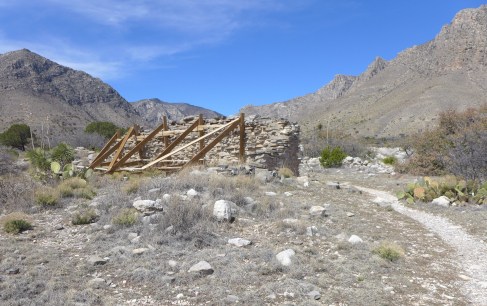
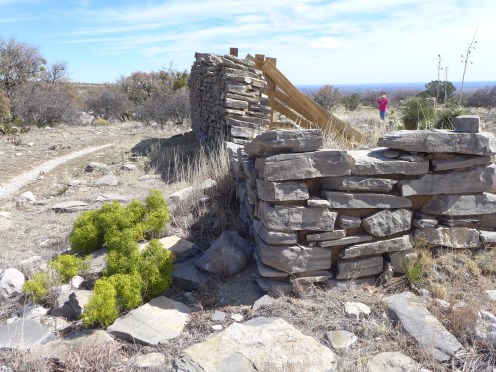
The Butterfield mail route ran through these mountains from 1851 to 1859, when a safer route was chosen. Then in 1861 the Civil War interrupted it. For a business that only lasted ten years, the Butterfield Stage has a big place in southwestern lore. Since they needed to change horses every twenty miles there are many ruins across the southwest, but few are as easy to get to as this one.

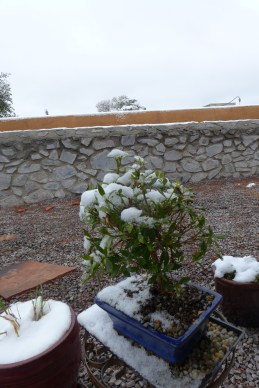
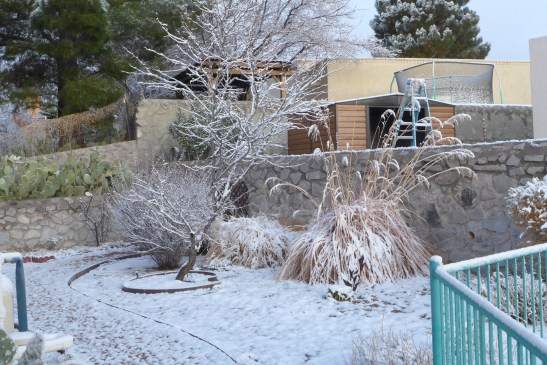 The first made a lovely covering, for the short time it lasted. Here is the view through my study window.

 Last fall the News Hour had an interview with Twyla Tharp celebrating her new book, Keep It Moving. Its subject is the importance of keeping yourself moving as you age. When I went to order it I discovered that she also has done a book called The .Creative Habit: Learn it and Use It for Life. I go for creative coaching books, so I ordered that one too.

 The reason is that two sets have been combined, one we had in my childhood at home, and a second smaller one my mother got when we found ourselves in Rome for most of a year when I was twelve.
 So there are not only extra kings, there are two Marys and two Josephs. It’s interesting to note the fixed iconography of these figures. Though their poses differ, their clothes match: Joseph in white and brown, Mary in pink and blue, with a white head covering. And all the figures are on green bases, as if they were out in a field.
 The proper question then, should not be “Why are there five kings” but “Why aren’t there six?” How did one get lost? I have no idea. And I wonder if anyone has ever done a story about a king getting lost (not, like Monty Python, sending them all to the wrong house). What would become of the astrologer who read the stars differently and went off in another direction? What might he discover?
 This poem is included in my book, Made and Remade, which has a whole section on the theme of time, as is fitting for a collection that starts with a text 200 years old. (More info on the Books page.)
 freethoughtandmetaphor