Home

Reflections on Contemporary Travel, with a Poem

1 Comment

When my husband and I travel, we usually use one motel chain, one which claims, and usually provides, certain amenities such as a decent breakfast, thick towels and internet service.  This practice also enables us to build up points toward a free stay once or twice a year.

There is one problem with having a “rewards card” however.  It means they have our email address.  After each stay we get a request to fill out a survey.  There is no “I choose not to” option at this point – if we don’t answer it we’ll get a “friendly reminder.”  Part of the survey includes “when did you last stay in a motel?”  “Which brand was it?” and “Did the brand name influence your choice?”  By this time I want to scream “Yes!  Of course the name influenced us!  We have a rewards card!  Aren’t you paying attention?”  But they are not paying attention.  They offer no place to make a comment to the organization, instead of to the individual hotel.

But the question which gives me the most trouble is “Was this trip for business or pleasure?”  If I have to get across the country to visit family, there ought to be a third category.  Would it be both?  Neither?  This became an acute issue for me when I was travelling to visit my mother because she was ill.  The culprit that time was an airline, but the reaction was the same.  Is it business or pleasure?  It’s both.  it’s neither.

My chapbook The Map of Longing includes a number of poems related to my mother’s last months.  The fact that it happened at the same time we were preparing to move made everything sharper and more complicated.  In the poem below I tried to express some of my frustration.

Choice

The form asks, “business or pleasure?”
No “other” category for this trip
which is neither―or both:
my mother’s business,
her pleasure in our visit,
our pain in the strained connection,
spoiled arm, scattered mind.

The web of family combines
what marketers want to segment,
as if pain and pleasure could
be wrapped separately, like
the chocolates she loves, as if
“all of the above” were an option
one could choose not to check.

The Map of Longing is available through Amazon.  You can get a signed copy from me via ERYBooks.

Recommendation: A Wonderful Writing Workshop

2 Comments

View from the Mesa

I have just returned from a week-long workshop at Ghost Ranch.  It was both stimulating and relaxing and full of kindred spirits in a spirit-filled place.  “The Ranch” has a long history, going back to a small dinosaur whose bones have been found there, the Coelophysis.  The name “Ghost Ranch” goes back to the Archuleta brothers, who told any would-be thieves or cattle rustlers the place was haunted―and no nefarious person ever came out alive to contradict them.  Ghost Ranch is connected to the Presbyterian Church but funded separately.  It offers a wide variety of classes from spring into fall, as well as a January term for students.

Anita Skeen is the organizer of, as well as one of the teachers in, the Fall Writing Workshop at Ghost Ranch.  Anita has put this together for the second week in October for something like fifteen years and has taught at the ranch for many years before that.

This year there were four classes.  While Anita taught one on The Writer’s Notebook, Ina Hughs taught Creative Nonfiction, Catherine Watson taught Travel Writing, and Jane Taylor led a workshop in poetry focusing on shape and voice.  Each teacher gave a reading, so that all participants could hear the work of all of them.  At the end, a joint reading of all the students gave an overview of the class approaches and assignments.

One afternoon, each teacher gave a short workshop.  It may be no surprise that the basic rules of good writing in all genres are much the same: details, emotion, a good beginning, middle and end, etc.,  but it is great reinforcement to hear this told in different ways for different kinds of writing.  Reminders are often as good as new material for encouraging the artistic process.  All of the teachers were entertaining as well as informative.

Our cozy classroom

The writing was all fresh work.  There were exercises and assignments, with freedom to interpret or adapt them to whatever flowed from the pen.  In my small class of three students, the variety produced from one assignment was a delight.  The mutual support and good spirits made everything seem even better than it was – at least in the case of my own efforts.  I came home with a batch of new bits and pieces to pursue, and new ideas about how to approach them.

There are a lot of different housing options.  I chose the cheapest, which were located up on the mesa, units of simple rooms with shared bathrooms.  This turned out to be a good choice in two ways.  First, the walk up and down the hill was good exercise to stir the writing muscles as well as the physical ones, and second, the mesa has the best cell phone service, the main part of the ranch being in a valley.

Will I go back next year?  Maybe.  Do I plan to go back before very many years go by?  Definitely.  Maybe next time I’ll find the words to describe the colors of the turning cottonwoods against the pines and junipers.  Watch for next year’s schedule to appear at www.ghostranch.org.

Juniper

Ghost Ranch, Abiquiu, New Mexico

1 Comment

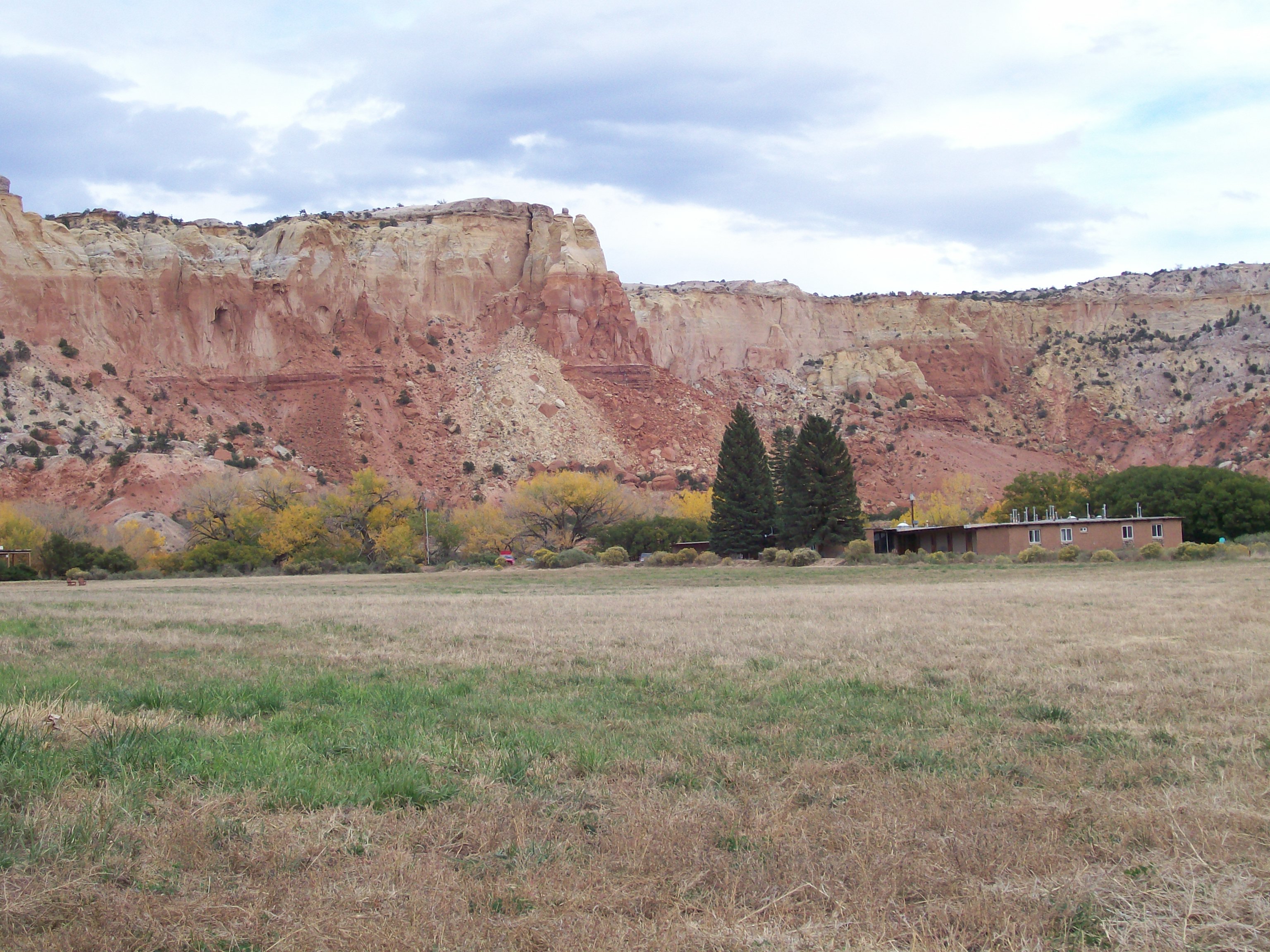
Cliffs at Ghost Ranch

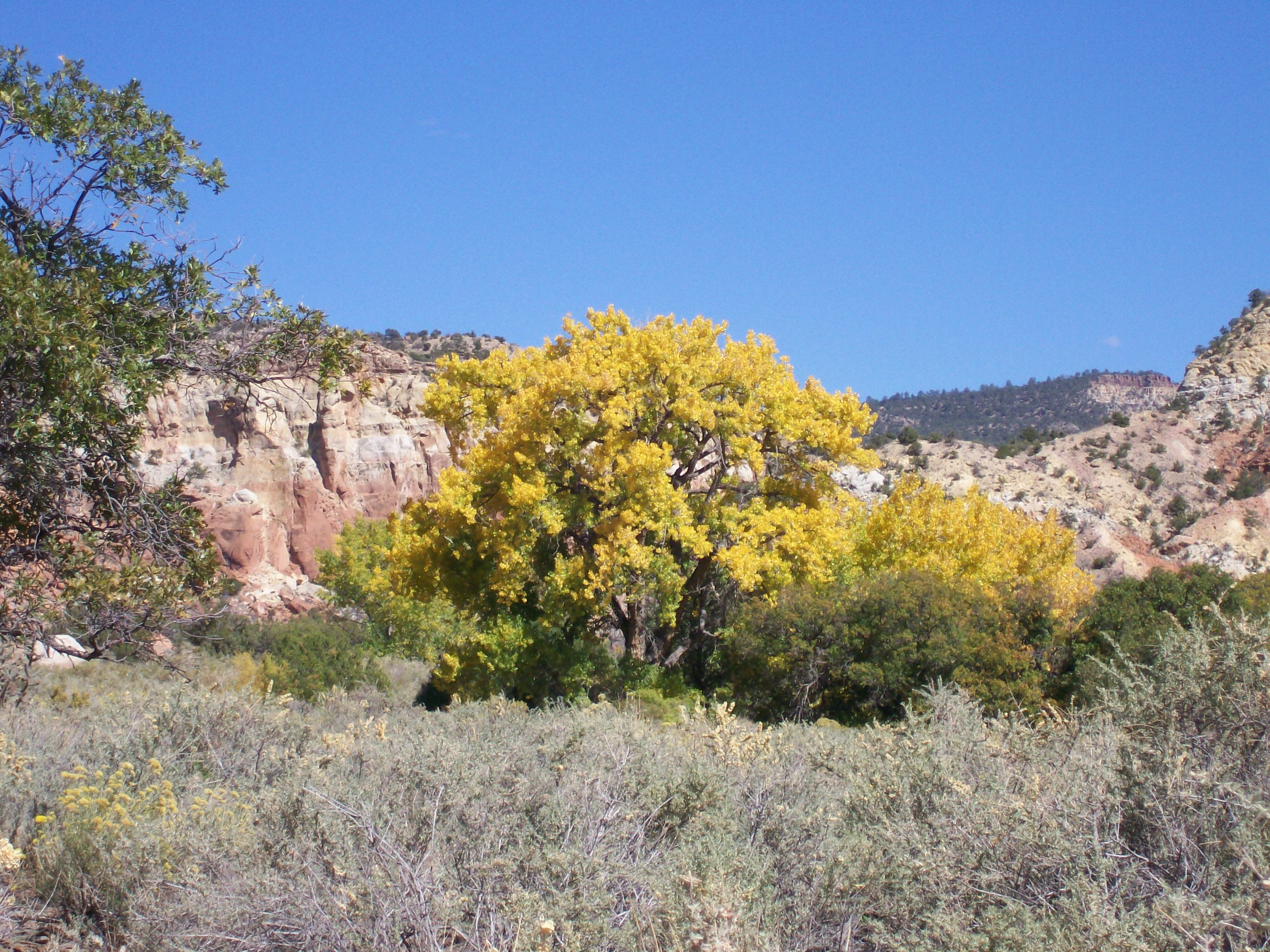
Ghost Ranch is a feast for the eyes, a wonderful place for a photography or painting class.  I was there to write.  All week, I tried to find words to describe the turning cottonwoods, yellow, gold, against the evergreens of pine and juniper.  I failed.  But I came away with many words on other subjects: new material to work with.  More on the people, the place and the class in a future post.

Cottonwoods at Ghost Ranch

Viva New Mexico

2 Comments

This desert globemallow is a southwestern native plant growing in my yard.  This one grew from a seed dropped by a plant I dug out of the sand in the arroyo near our house and transplanted several years ago.  Transplanting from the desert is tricky because the plants very quickly send their roots down deep for water.  If you cut the root the plant most likely won’t survive. Desert globemallow is a short-lived perennial, so I was pleased when two new plants arose to replace the old one.

I am setting up this post to go public while I am at a writing workshop at Ghost Ranch in Abiquiu, New Mexico.  That’s Georgia O’Keeffe country.  I hope to see, and photograph, some beautiful rocks, and perhaps some New Mexico native plants that don’t grow in the desert.

To experience more of New Mexico, click on 200 New Mexico Poems in the side bar.  This site has poems relating to many areas, landscapes and cultures of new Mexico.  New poems are being posted almost every day, growing toward the promised 200 poems.  It’s worthy of frequent visits.

Mutual Admiration: From the Biography

Leave a comment

John Emerson Roberts did not always preach on “orthodoxy” and theology.  One sermon he gave in November, 1895, was very topical: it concerned the death of an African American boy in the county jail.

Titling his sermon “Dead in Cell No. 5, Fourth Tier East” Roberts first relays the story in considerable detail.  Three boys had been caught stealing from a house they’d broken into.  Known to the police as troublemakers, they were sentenced to ten months to a year in the county jail.  Three months into the sentence, Willie MacManamy, age 11, died of pneumonia.  The arguments among those in charge following this event, which had taken place the Monday before Roberts spoke on the issue, were over who had to pay how much to whom to care for the body and release it for burial.

Roberts asserts, in spite of the volume of newspaper coverage, that “Society did not feel even a momentary acceleration in its modulated pulse-beats.”  Calling a child of the streets the “abridged edition of the people,” Roberts suggests that the child has great potential if only good seed can be sown on “the waiting soil of his virgin heart.”  But the time for such intervention is very short, and society fails to sow the seed because society itself is immature.  The philanthropic activity that exists is mostly selfish, an effort to keep the needs of others at a distance.  Roberts concludes by using the motif “if Christ came to Kansas City.”  He contrasts the number of well-appointed churches with the problems of street children and overcrowded jails.  The churches are no better than society as a whole.

The progressives who were beginning to seek to reform cities across the nation would agree with the way Roberts laid out the social problem.  Roberts, however, was not a reformer.  He was content to watch and wait, confident that society would in time grow up.

Roberts’s sermon was published in a local magazine called “Humanity.”  Robert Ingersoll was in Kansas City in May, 1896; while there he picked up a copy of the magazine.  After he got home he wrote to Roberts:

Rev. J. E. Roberts,

My dear Friend:

On my way home I read in “Humanity” – a sermon of yours in which you tell of the death of the child in jail.

The climate of that sermon is like a perfect day in June, and I write simply to thank you for delivering it.  No one can read it without having his heart touched and softened. —

You are preaching a religion for this world – for the living while they are alive and by all odds you are the best, the most enlightened, the most liberal, the most intelligent, the most eloquent minister, so far as I know, in the whole world.

With the greatest admiration, I remain

Yours always, R. G. Ingersoll.

“The climate of that sermon is like a perfect day in June.”  Roberts remembered this praise, long afterward referring to it as “that sermon has the breath of a day in June.”  It was a metaphor that stuck with him. “You are preaching a religion for this world” pleased Roberts too.  He knew now that Ingersoll understood that he, John Emerson Roberts, was on the same wave length – I shouldn’t put it that way, because “wave length” is an anachronistic term neither man would have understood, but it suggests a resonance between the two men.  They understood each other and admired each other to the end of Ingersoll’s life, which unfortunately was only a few years later.

Quotations are from John Emerson Roberts: Kansas City’s “Up-to-date” Freethought Preacher.  For more information see the Books page.  Ingersoll’s letter is one of four to Roberts included by Eva Ingersoll Wakefield in The Letters of Robert G. Ingersoll (Philosophical Library, 1951).

One for Fun

3 Comments

I’m sharing a poem today of which I am particularly fond because it was one of those rare ones that just came.  There’s nothing factual in it―perhaps it has the truth of a good story, flash fiction in poetic form.  Enjoy!

Decaf, Please

An old car knocks,
and an old man, thin hair
slicked like the teenager
he once was, asks me
to go with him,
leave the museum,
grab some grub, or a latte
(we’ve given up smoking).
Seize the day, he begs me,
a seizure might interrupt.

The era of ambience
is over – dimmed lights,
candles, appearances
that mattered in the eighties.
We pass up Starbucks
for a booth at the diner:
when the nineties’ bubble
burst we were thrown
back to essentials:
a man, a woman, a drink.

“Decaf, Please” was first published in Into the Teeth of the Wind and is included in my collection Accidents (Finishing Line Press, 2004).

Rereading Sacred Text, With a Poem

2 Comments

In my last post I mentioned in passing the feminist interpretation of the Biblical record.  There have been many kinds and layers of this.  I was involved in a number of them.  I attended meetings of the Evangelical Women’s Caucus.  I read Daughters of Sarah and Free Indeed, two periodicals produced by women seeking to reinterpret what they had been taught.  Both survived only for a time, which is typical of small magazines of all kinds. Free Indeed took its name from the passage from John, “If the Son makes you free, you are free indeed.”  Daughters of Sarah published a few of my poems.

I learned to think for myself through looking at the many different women’s approaches to scripture.  I had gotten through college as a very good student who believed what I read, whether it agreed with my own experience or not.  Amid all the women’s perspectives, it was necessary to make choices, and one of the keys to those choices was “does it fit with my experience” instead of “does it fit with what I’ve been taught.”  This approach was the gift, for me, of feminist interpretation.

There are many stories about women in the Bible.  Some are extensive, some seem to be only fragments.  At one time I concluded, “The named woman is the one who got into trouble.”  Here is a poem I wrote during this period.

Sirens

As I circle stony islands
where ten foot tides turn ledges
into granite waves,
threats to an outboard propeller,
I hear Delilah sing
with Jael and Judith.

On a bluff of ragged rock
these three women, servants
to god and country, sing by turns
of Sisera, Holophernes, Samson,
of tent peg, sword, and scissors.
The song repeats like blues,
like scissors, rock, paper,
break, cover, or cut
to the next story,
the next severed head
served up on a fine platter.

The trays have corroded
on which the tribes they served
once served them empty honors.
Their hungry song blends
with calls of cormorants and gulls.
From such contagious sorrow
I flee to deeper water.

Among other things, this poem is meant to suggest that the situation for women is similar on both sides of the conflict; Delilah was, in the history, an enemy of Jael and Judith, yet I imagine their stories were similar.  I’ve placed them not in the Mediterranean but on the Maine shore, which I know, can describe more vividly, and have used to reflect their mood and situation.

Many of the women whose work I was reading in those days gave up on the patriarchy of Christianity, and Judaism as well, altogether; some became Wiccan.  I stayed in my tradition, but continued to rethink the reading of Scripture.  Now I look at my sacred texts from many points of view.  Some days I take the words quite literally, but I am convinced that, however much inspired, they were written down by people who could only communicate in the language of their time.  Other times I am struck by how much of our God language is, and has to be, metaphor.  Always I find it a rich source of story, language and reflection on the human condition.

“Sirens” was published in Daughters of Sarah in 1990.

A Pure Beginning: Reflections and Poem

2 Comments

In the nineteenth century, when John Emerson Roberts was a liberal preacher, there were many people who believed in an original “pure” Christianity, before things got messed up with doctrines and debates and rules.  One such person was Alexander Campbell, whose follower were first called “Campbellites.” They eventually became the denomination Christian Church/Disciples of Christ.  Another case was that of Joseph Smith; he  avoided creating one more denomination among many by developing a whole new Church, the Church of Jesus Christ of Latter Day Saints.

In the twentieth century there was another kind of belief in an original Christianity as feminist scholars like Elizabeth Schussler Fiorenza gathered together clues of the roles of women in early Church communities, before the bishops made them second class members.

Current scholars recognize plenty of evidence that there was no original “pure” Christianity.  The letters of Paul reflect lots of discord: “You shouldn’t eat that!”  “You shouldn’t do that!”  “My way or the highway!”  In fact, the writer of the Acts of the Apostleswhom we call Luke may have been the first to imagine a state that never existed, one of harmony and agreement among all.

What I imagine in the early church is a stronger fellowship.  But it may be that strong fellowship requires a common danger.  Those who see “true Christianity” as beleaguered in today’s “secular” culture, probably are able to build such fellowship more easily than others.  Here’s my image of then and now:

Twilight

The half-light of half-learned lessons
cuts us off from elders
of the sharp-edged pagan years.
Outlined by evening sky
they walk toward prayer,
leaning over their lamps.
By flickering light they stand
in corners cut in damp earth
holding each other tall.

Old story told once more,
we rise from cushioned pews,
let fall each other, uninstructed
in the catch of shifting weight.
Shadows of wistful wishes wax
in failing light.   The dark
is out there.  Who can teach
the bending into it?

I don’t recall what darkness concerned me when I wrote this poem.  Perhaps I was just discovering that darkness is a part of life, not to be avoided.  I learned through dance that catching one who falls can be taught; we were also taught how to allow ourselves to be caught.  It’s the same with emotional support – we can learn to give and to receive, but it is something we do need to learn.

Thanks to Allen Matlins for returning this poem to the light by posting it on his blog last November.  It was published in Christian Century in 1983.  Rediscovering it has led me to look at other poems I wrote about that time, to ponder how things and people change over time, and to find several which are still “good enough to share.”

Happy Autumn!

3 Comments

Autumn’s just beginning, but I’m thinking of the tree outside my window at my old house: a small red-leaved maple.  Beside it in the front yard was a small green-leaf maple, so in fall we had a two-toned orange and red carpet across the lawn.

Autumn is my favorite season, though I don’t dislike any of them.  It’s the time when my energy rises and all things seem possible.  “Maybe this is the year I reach my full potential,” my heart sings, even as my head labors to track all the events filling the calendar.  So much of our activity rises and falls with the school schedule, though no one in the household has been in school for many a year.  This is the pattern of society, and I think the weather has more to do with it than we may want to believe.Now, instead of the decades-old maple tree, probably planted when the house was built, I look out my window at a small mesquite tree, just six years old, which I planted myself.  It too will turn color later in the season, though its color will be a rather uninspired yellow.  It and I have settled in together.  It is now growing at a steady pace, and so can I.

On the day I began drafting this post, a roadrunner appeared in our back yard.  This pleased me greatly, because I want our yard, small though it is, to be a wildlife haven.  How he came in I have no idea, but he was finding good things to eat.  He wouldn’t pose for the camera, but here he is enjoying the shade of the small mesquite tree.

Visitor

Popular Preacher, Part II: Rhetoric and Religion

Leave a comment

When John Emerson Roberts did his five part series on The Inevitable Surrender of Orthodoxy, he set up a series of parallels, a good rhetorical device.  The second sermon was on “Two Gods” the God of vengeance and the God of mercy.  The third sermon, on “Two Bibles,” contrasted the Bible, valuable as a record of human development, with the natural universe, “the only book God ever wrote.”  The fourth sermon, “Two Plans” he used mostly as an excuse to discuss and dismiss old ideas of the atonement.  “The necessity of an atonement disappears with the old idea of a capricious and changeable God,” he concluded, ignoring his own earlier comments on a God of judgment vs. a God of mercy.  A rhetorical flourish.

Only in the final sermon of this five-sermon set did Roberts turn to more positive thoughts.  It’s another parallel, this time between Jesus and Voltaire.  This idea was not new with Roberts; he borrowed it from Victor Hugo, who had spoken on the occasion of the hundredth anniversary of Voltaire’s death in 1878.  In fact, a good third of the sermon is straight from Hugo, though Roberts does not admit it.  This is normal for preachers; they are not required to identify their sources.

Voltaire was a popular freethought hero in the United States in the second half of the 19th century.  Born Francois Marie Aroeut in 1694, he was a poet, playwright and philosopher who challenged authority at every turn.  He wrote satires about church and society.  Of his works, one that survives today is Candide – in large part because Leonard Bernstein made an opera out of it.

One hundred years ago Voltaire was much better known:
●  In 1866, Voltairine de Cleyre was named after him.  After enduring education in a convent (her parents thought it was the best education available to a young woman) she became an atheist and an anarchist.
●  In 1879, the Music Hall was built in Chicago partly to provide a platform for David Swing, a liberal preacher who had left the Presbyterian denomination.  Voltaire’s bust was included along with those of Moses, Mozart and other heroes of faith and music.
●  Clarence Darrow, who had admired Voltaire since his youth, found him a profitable lecture topic in the early 20th century.

Roberts begins his discussion of Voltaire with a strong metaphor:  “The plain is habitable because the mountain is beyond,” he says, and continues:

Voltaire was the mountain.  Rugged, defiant, implacable, lightning-scarred, storm-enveloped, immovable, august, sublime, he towered above Europe and the eighteenth century with unspeakable scorn for superstition, secular or sacred, and with unquenchable devotion to reason and light.  Kings exiled him.  Police officers arrested him.  Bastilles and prisons confined him.  Ignorance hated him.  Superstition execrated him.  The priesthood denounced him. . . .

What has this to do with Jesus?

There are of necessity two kinds of prophets.  One shows the way to heaven, that is to moral health, to sanity, to a consisten and reasonable faith and to kindness toward men and reverence toward God
Such was Jesus, and such are all great souls who, from the spirt and genius of the world of matter and of man, imbibe the thought of God.

Voltaire is another kind of prophet, one of those “whose visions disclose the abyss towards which the unreasoning haste.”  Roberts’s argument requires the assumption that religion in Voltaire’s time had reached a very low point.  Voltaire, Roberts says, “rescued it from ecclesiastical asphyxiation and gave it light and air.”

After going at length into the contrast of Jesus and Voltaire as two types of prophet, Roberts brings them back together:

The church in all ages has put dogma first, charity and tolerance last.  Christianity today is dogma plus all the virtues that support the social order.  Jesus reversed that method.  Voltair reversed that method.  Jesus was called in his own day a heretic, and would be called a heretic now.  Voltaire was called a heretic, and would be called a heretic now.  But God sends such heretics among men to sweeten life, to establish justice, to illuminate the true, the beautiful and the good, to plead for humanity and for God and prevent religion from perishing from the earth.

Roberts was carried away by his own rhetoric, and so was his congregation.  He filled a 500 seat sanctuary with his sermons.  It is quite a stretch to call Jesus a heretic, since the Judaism of his time was both varied and non-dogmatic; the charge of heresy requires a single controlling authority.  Roberts is reading back from his own experience and his own era.  There is, however, some truth in his claims.  Christianity has always been at risk of becoming a prop for the status quo: “dogma plus all the virtues that support the social order.”  Roberts seems to be putting his hope in a new Voltaire, rather than a prophet like Jesus.

This post is an expansion of material in John Emerson Roberts: Kansas City’s ‘Up-to-date” Freethought Preacher.

Older Entries Newer Entries