Home

Recommendation: The Pleasures of Tanka

3 Comments

Tanka, as you may know, is a Japanese form slightly longer than haiku.  The traditional pattern calls for five lines, a total of 31 syllables, in the pattern 5, 7, 5, 7, 7.

If you’d like to learn about tanka, I recommend Janet Davis’s blog, twigs&stones, which I’ve just added to my blogroll:  http://www.twigsandstones-poems.blogspot.com/

Here are a few of my favorites among the tanka she has recently published on her blog.

One she offered for July 4: though I usually make my own potato salad, I can feel the embarrassment in the word “shriveling”.

the brimming bowl
of potato salad
she made at home
…..my tub of store-bought
…..shriveling beside it

red lights, Vol. 9, No. 2, June 2013

A more serious moment is described in this one:

railroad arms
rise up as I approach …
on the long drive
to the hospital
I hope for an “all clear”

—American Tanka, June 2013, Issue 22

The next one struck me because I have been working on a poem on a similar subject.  What she says in five lines is something I struggled to say in eighteen:

I trace them
clear back to Jamestown—
forebears
of the grandfather
I knew little about

—Simply Haiku, Winter 2009, Vol. 7, No. 4

You have no doubt noticed that none of these examples reach the number of 31 syllables.  As with haiku, tanka writers in English strive for greater conciseness.  As a beginner in this form, however, I am finding that the 31 syllable form is a good place to start.

Enjoy many more tanka at twigs&stones.

Recommendation: Poet Diane Kistner

1 Comment

I received “Falling in Caves” by Diane Kistner through Goodreads.  It is a selection from poems she wrote many years ago.  It is a great pleasure to read. The poems are very musical, often songlike, though the material is mostly serious and even grim (in one case, “Father and Son,” I want to spell that Grimm).  As I tried to pinpoint what I like about the style I realized that what makes these poems musical are the very things I have been repeatedly instructed by friends in workshops to avoid: repetition, phrases with of and the, little words like and.  These poems show what skill can do with material that less experienced poets are leery of, and chastise each other for using.  An example of this is the opening of “Shell”:

After the bell,
the fading bell,
last bell to be heard,
he walks the dark beaches,
far from the vain, curled alleys,
far from the world’s grave sanity.

Among the twenty two poems in this small collection, I particularly like “Ten Vain Attempts” (to get rid of anger) and the title poem.  “Falling in Caves” starts with a child’s fall while running, moves to the cave as a discovery of the past, and ends with:

There in the cave’s jaws
the first wheels started turning my head around.
They are turning still, down root-deep inside me,
meshing time’s slow, certain teeth.
We are falling into forever,
and there’s nothing to keep it from us.

My favorite of these poems is “The Walls”:

Four years old
with colored crayons,
you have discovered the walls.
Not old enough yet to know better,
you have covered the white expanse
of your boundaries
with castles and kings and queens
from your Mother Goose book.
You have walked
in your own enchanted forest.
You have flown bright flags
against a sky of dreams.
You have skipped down to a sea
of fishes, walked upon the beach,
built castles of sand
and danced
and laughed
when the waves
washed your castles away.
Crayon in hand
and queen of your land,
you believe
you can always make more.
When I spank you,
you cry you hate me
and stare with those dark yet
not yet extinguished eyes.
I wash and wash at your pictures
with soap and rags, trying
to make the walls dull
and white again.
How long will it be
before you stop fighting me,
I who am grown up
and see all colors at once,
undone, whirled into oneness?
How long will it be
before you accept the walls?

And I want to say to the child “Don’t accept the walls!” though I know we have to.  This poem takes its time to describe a familiar subject, both the literal four year old and the one inside each of us, and I enjoy every moment of it.

“Falling in Caves” is published by FutureCycle Press: http://www.futurecycle.org/PressTitles.aspx.    Another book in their catalog which is well worth your time and money is “Mosslight” by Kimberley Pittman-Schulz.  Both of these authors turn keen observations into music.  I found Kistner’s “Falling in Caves” the more satisfying, but both books suggest FutureCycle Press is a good source for finding poetry by good poets you might not have heard of before.

Maine Weather

2 Comments

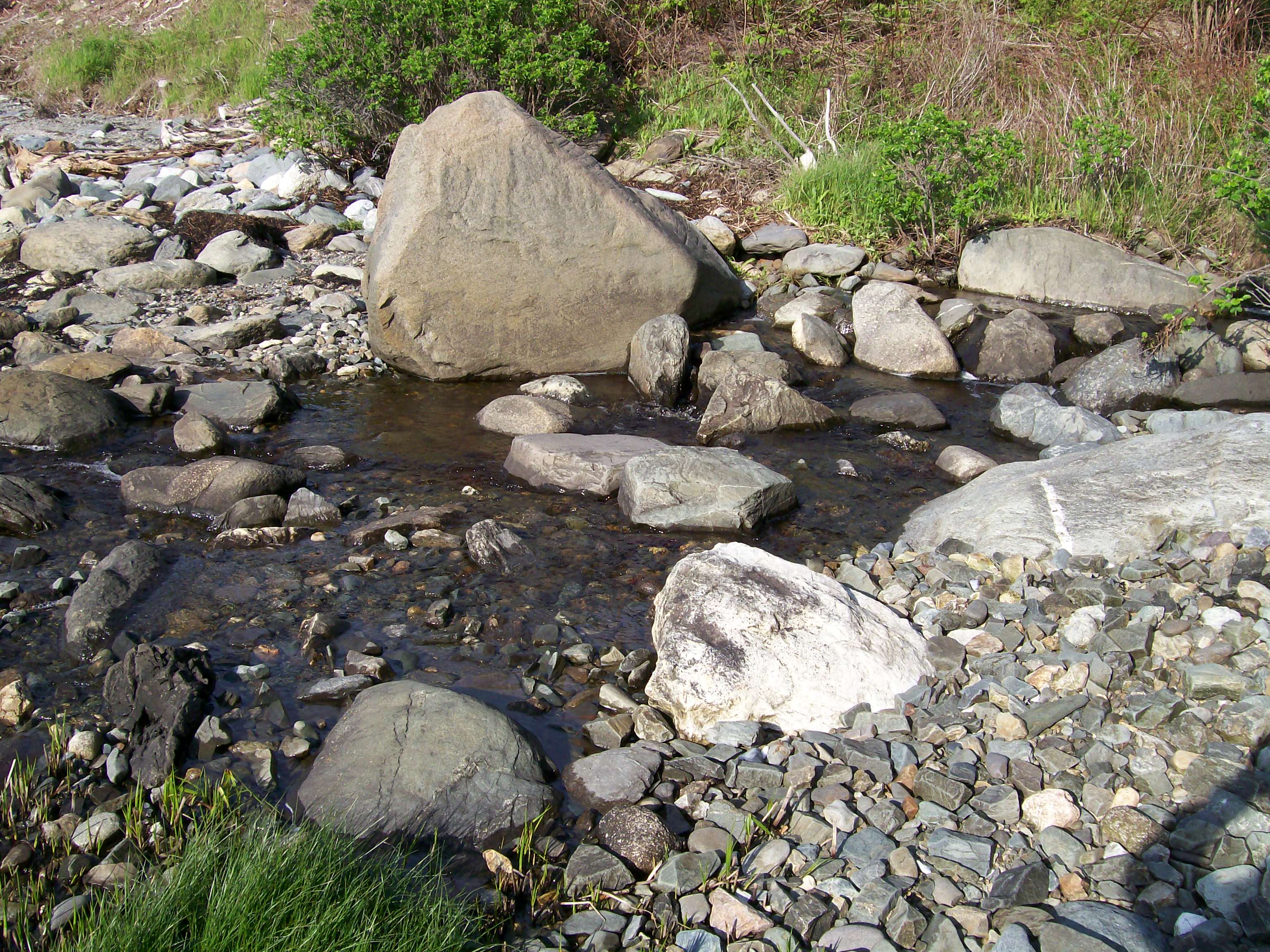
There’s lots of variety to the weather in Maine.  Not usually tornadoes, which we have escaped coming across the country.  It’s also not usually sunny and warm when we arrive about the first of June.  This year it was.  We know it had been raining, because the stream is running strong. (No, you can’t see the motion in a photograph.)

stream

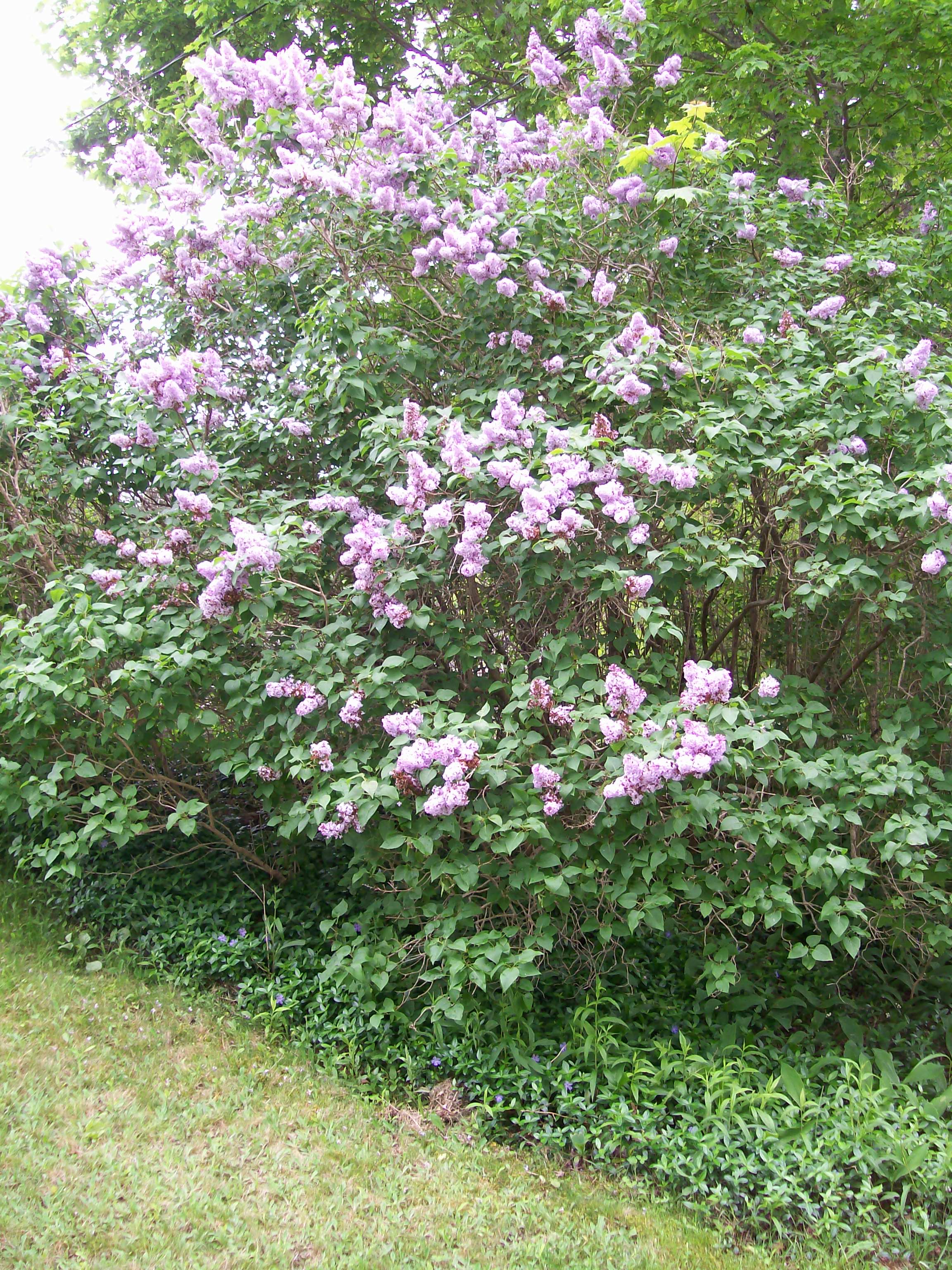
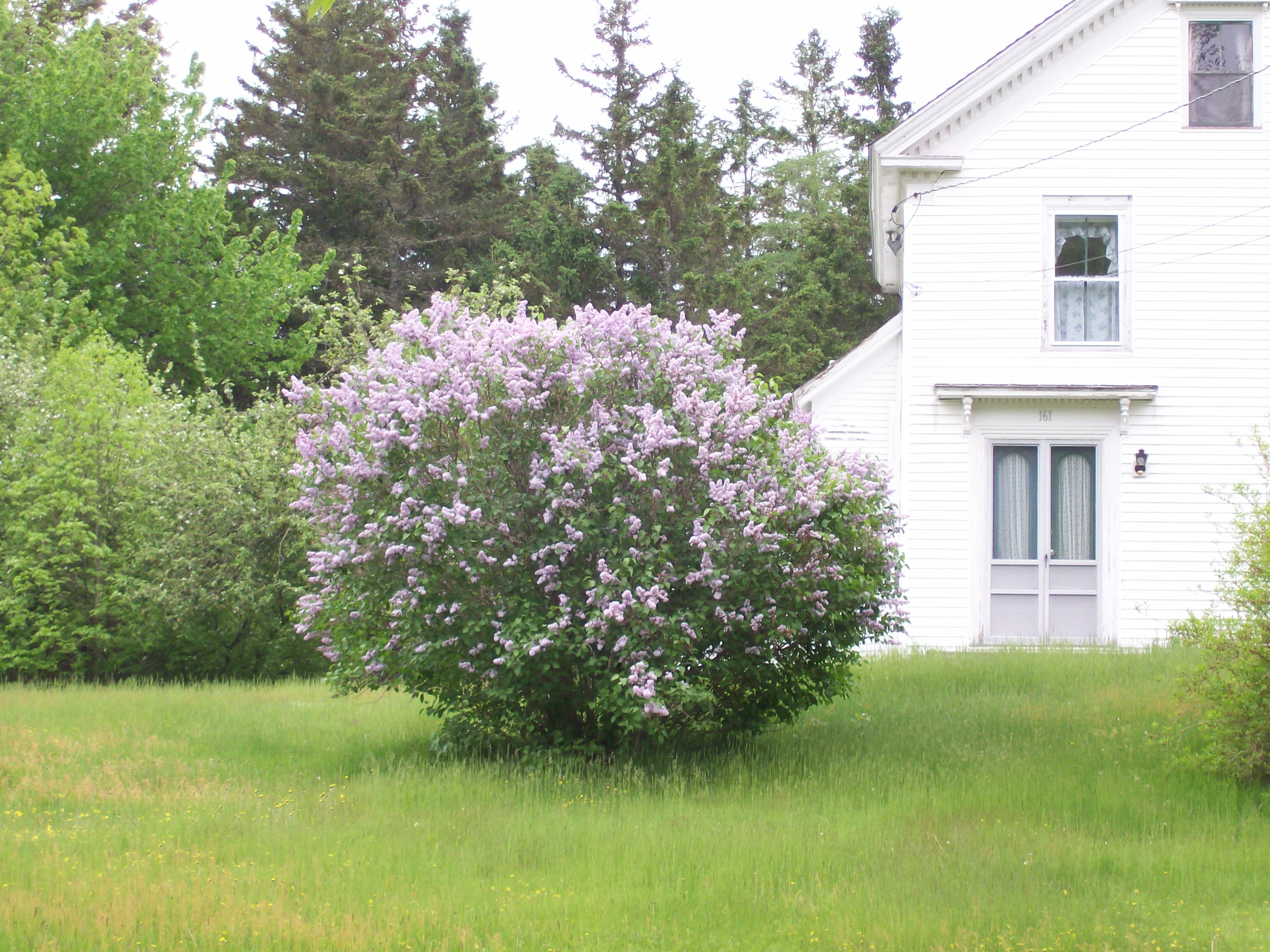
And we know it has been a cold spring, because the lilacs are in their glory.  Most years they are past or fading when we arrive.

lilacs

So many lilacs that the poem by Alfred Noyes starts running through my mind:

Go down to Kew in lilac time, in lilac time, in lilac time
Go down to Kew in lilac time.  It isn’t far from London.
And you shall wander hand in hand . . .

It’s from Noyes’s most quoted poem, “The Barrel Organ.”  I remember more fondly “The Highway Man” who came riding, riding, “When the moon is a ghostly galleon.”  Neither is great poetry, yet they’ve lasted.  They stick in the brain.  I’ve never been to Kew, and as I look at the moon I sometimes wonder which shape Noyes thought looked like a galleon, but how the words stick!

100_0825

A Treat for Both Sides of the Mind

1 Comment

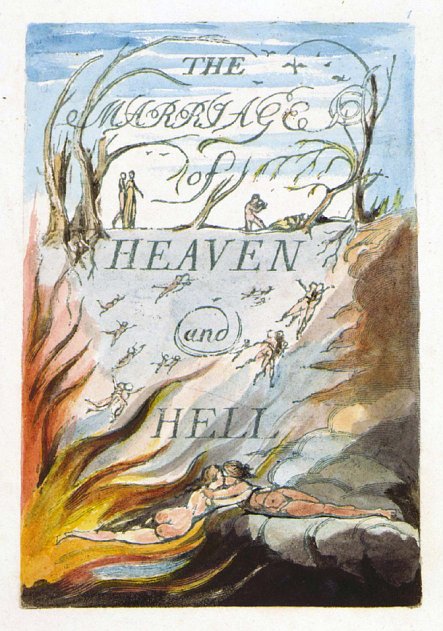
MoH&H_titleWilliam Blake’s The Marriage of Heaven and Hell is a work to delight both the poet and the freethinker.  It is a short book that combines language and art, serious ideas and comedy.

Most of us know Blake, if at all, for his short poems, like “The Tiger”:

Tiger, tiger, burning bright
In the forests of the night

or “The New Jerusalem”

Till we have built Jerusalem
In England’s green and pleasant land.

The latter is an introduction to a long work titled “Milton” though the Milton who appears in this tale is not the actual writer.  “Milton” is forty five pages of tiny script and complex images, telling an equally complex story.

“The Marriage of Heaven and Hell” is shorter, easier to follow, and fascinating for both the ideas and the language.  Blake constructed these books by etching copper plates, printing and then hand coloring each page.  “The Marriage of Heaven and Hell” consists of 27 such pages.  There are nine copies in existence; fortunately reproductions can be found in quite a variety of editions, some very inexpensive.  These editions usually print out the text as well, for those spots where Blake’s script is difficult to interpret.

Blake was a Nonconformist, which means that he was not a member of the Church of England.  He did not fully align with the other nonconformist traditions either.  His little book is partly a tirade against priests, of all times and places, and partly a celebration of creative energies.

What might be called Blake’s thesis statement is found on page 3:

Without Contraries is no progression. Attraction and Repulsion, Reason and Energy, Love and Hate, are necessary to human existence.
From these contraries spring what the religious call Good and Evil. Good is the passive that obeys Reason.  Evil is the active springing from Energy.  Good is Heaven.  Evil is Hell.

It will follow that in this dichotomy, hell is the more interesting place to be.  A few pages later, Blake comments:

The reason Milton wrote in fetters when he wrote of Angels & God, and at liberty when of Devils & Hell is because he was a true Poet and of the Devil’s party without knowing it.

Three pages are given over to “Proverbs of Hell,” a wide range of short statements.  Here are just a few:

In seed time learn, in harvest teach, in winter enjoy.
The road of excess leads to the palace of wisdom.
A fool sees not the same tree that a wise man sees.
No bird soars too high if he soars with his own wings.
You never know what is enough unless you know what is more than enough.

These proverbs, which send the mind going in many different ways are followed by three sections entitled “A Memorable Fancy” in which angels and devils and giants all appear and further commentary against such errors are trying to separate body and soul, or make peace between two classes of humans he calls the Prolific and the Devouring.  By the first he means the creators.  The second are those who only consume because they cannot create.

I have only picked out samples from the book.  To get the sense of the whole, you will need to go read it yourself.  After reading a copy from the library, I bought my own copy from Powell’s for $5.00.

Recommendation: David Chorlton’s “The Porous Desert”

Leave a comment

When I learned that David Chorlton had written a book of poems called “The Porous Desert” I knew that was a book I wanted to read, because I have been fascinated by and writing about the desert since moving to Las Cruces eight years ago.  The book did not disappoint.

The book is not just about the desert but about the desert in drought, our current condition.  His desert is not quite like the one here because they have significant winter rains, which we do not.  A number of his poems are named by dates in February, a month when those in Arizona expect some rain.  Here is one of the more complex poems, titled “February 9th”:

We’re logging on to tomorrow, divining
our way through hours
as they drip from a rusty faucet.
We type in the address: http://www.water.com

but it comes up dry; so we try a search
for rain.  The first result
is a tease: On February 6, 1896, 3.86
inches of rain fell in Philadelphia,
setting a maximum daily record.
Tonight

there will be a meeting to discuss
the heat island in our urban region
which spreads further and digs
deeper by the day, down to the ruins
of a past civilization: clay pots

still bearing the potter’s fingerprints,
and the tracks her sandals
left behind when she looked into the future,
saw us, and walked the other way.

The book contains 49 poems on 54 pages; I don’t know whether to call it a long chapbook or a short book.  One that is less specifically about the drought, though it is clearly about a dry place, is “Condor”:

The condor stares down into time;
the work of years
with a knife edge, of seasons
that sand away and polish
surfaces then grind them into wizened planes
stacked one above another
until the clifs hang on a talon.
The daily passage of shadows

from rim to canyon rim
and the final drop
of light disappearing from the highest rock
are nothing but sighs
to a bird suspended from the sun

while the minutes drip
from its wings, evaporating
before they can reach the river

moving at the pace of history,
water burning deep
into pages of stone.

Particularly felicitous phrasing or strong images turn up almost unexpectedly.  “Highway Religion” for example begins:

The desert keeps its good looks
for a while west of Phoenix
then it turns honest.

Here’s the beginning of “December”:

An empty nest floats through winter
in the fingers of a tree
scratched against a mountain
at rest.

Here’s one of “Three Lies About Moths”

In previous lives
moths were books that stood unread
on library shelves.  When the lights went out
they eased themselves free of confinement
and nobody knew in the morning
what mysterious force
opened exactly the pages
whose text described the moon.

It fits Chorlton’s overall matter-of-fact approach to call these “Lies” rather than “Myths.”

Two poems specifically refer to the work of writers.  One, called “Proofreading” begins:
This is the detail work
of flossing between the letters.

The second, called “Writing in the Desert” I give in its entirety:

Once you have entered the desert
a lock behind you clicks.  A new vocabulary
floods your tongue and leaves you struggling
to pronounce the words.  After the first year
you learn that silence is the official language
here.  The longer you stay
the shorter the book you came to write becomes
until the manuscript fits on the wings
of a moth.  Each dusk, a lifetime’s work
draws closer to the flame.

I feel that way sometimes too.  It’s a good thing this is not literally true; if it were this book, “The Porous Desert” would not have been published.  I recommend it.
Visit to Portland

2 Comments

I had three things in mind for my visit to Portland, Oregon, last weekend.  All came out well.

The first was a visit with my mother’s cousin Del, whom I had not seen in over ten years.  She is living with her grandsons Dan and David, who, like so many in their thirties and even their forties these days, could not afford to buy a house without her help.  We had great conversation and good food together.

The second thing and the main excuse for making the trip was a meeting of the American Society of Church History.  Years ago, as a graduate student, I was giving papers at meetings like this one.  Now I listened to current students as well as older scholars.  The varied topics included the warlike language of new churches during the second world war, and the changes in sacred spaces at various times in religious history.  Just what makes a space sacred is always a good topic for debate.

My third activity was sightseeing, which meant a visit to the one place I know is an important tourist destination in Portland: Powell’s Book Store.  It did not disappoint:  a huge establishment with a nice café, it was quite busy on Friday morning.  They have two long sets of shelves of poetry books, much more than any other bookstore I’ve been in, and were selling them at 15% off in honor of Poetry Month.  I came home with four more books to add to the pile of books I had ordered from them online back in January.  Having the books in one’s hand makes it harder to resist.  And, yes, I bought the tee-shirt.

Powells Logo

Powells Logo

Outside it was spring; the rain was washing down blossoms from the tree.  Coming from the desert I enjoyed the damp air and took several walks.  I’m not sure how long I would appreciate the gray skies, but for a weekend it was wonderful.

Finding Troy

3 Comments

The Greeks turn up in unexpected places.  Recently I found them in Ray Bradbury’s Zen in the Art of Writing.  I suppose most writers are guilty of seeking out and devouring books about writing.  We read every one that comes to our attention, even though, after about five of them, each may only provide one new idea or trick for keeping at the writing craft.  It was a quotation on a LinkedIn group which brought Bradbury to my attention.  It had been several months since I’d read a good craft book so I tracked down a used copy.

The book is a collection of essays about Bradbury’s own work, his methods, his efforts at teaching.  It is well worth reading although you may, as I did, feel a bit jealous when he speaks of being able to type out a full story in one short sitting.

The Greeks show up not among the Martians and other aliens with whom Bradbury has spent most of his time, but in one of the poems that form a sort of coda to the book, in the form of Troy.  Troy is a symbol of archaeological work, the digging and finding of treasure, as it was when Schliemann excavated there in the late nineteenth century.  For Bradbury it becomes a metaphor for his finding his own unique path in life.  Others tried to dissuade him, but “I knew my Troy.” he says. He had to keep it secret. however.   “I dug when all their backs were turned.” he says, in order to avoid the scorn of those who did not believe.  He concludes the poem speaking about what he found:

One Troy? No, ten!
Ten Troys? No, two times ten!  Three dozen!
And each a richer, finer, brighter cousin!
All in my flesh and blood,
And each one true.
So what’s this mean?
Go dig the Troy in you!

How satisfying that he can stay with and expand that one image, that Troy that has been magical since Homer.  It rings and resonates.

For me, one Greek leads to another, one archaeological site leads to another.  Schliemann, who found Troy, also unearthed gold masks and other riches at Mycenae where Agamemnon ruled.  He went looking for Pylos, the home of Nestor, the wise older advisor of the Iliad.  Like Schliemann, I cannot settle on one site.  But Bradbury does promise many Troys.

There are nine layers at Hissarlik, the site of Troy.  Schliemann was wrong about which was the Homeric Troy.  He thought Priam’s Troy was the second layer; it appears now to have been the sixth.  Layers are also metaphor: the layer of history is overlaid by the layer of excavation in the tales of the place; between what we learn and what happened there is always a big gap, but the set of tales about what was found adds its own layer to the story.

Each of us, Bradbury suggests, has our Troy or series of Troys to find, though we would be wise not to talk too much about them.  Mine is the next poem project; it always takes some searching to find what I’m after.  May you be fortunate in finding your Troy.

Recommendation: Joe Somoza

2 Comments

I Thought of Buying

a new shirt to
walk around in
San Francisco.
But then I thought, “Why not
wear my old shirt
with the warped, stretched
collar and fade spots.”?
I don’t want to “visit”
San Francisco:
I want to live there
for however long
our stay, the way
I’ve lived inside
my green shirt with its
emblem on the pocket
grown more
faded with every washing.
I want to be
a San Franciscan there,
stop at Bob’s for lunch,
next to that tobacco shop on
Polk Street where other
San Franciscans walk by in their
everyday faded wear, wearing
usual faces that might
look in on me
having lunch there
at a booth
beside the window.

This is my favorite poem in Joseph Somoza’s new collection Miraculous.  I like it both for the craft and for the idea, because I too would like to “live” in San Francisco for as long as my visit might last, to be a casual part of it.  He has captured that longing well.

The book is a collection of twenty-five love poems.  Many express love for his wife, Jill, others, like the one above, love for places, still others love of words or love of life.

Here’s one that’s mostly word play:

Ground

The ground, like coffee grounds
spilled on the ground and
ground together with ground by the
rain drop by drop that dropped
down to the ground, pitting it
among twigs, stones, ants, and,
here and there, grass stalks that
don’t stalk and don’t talk, I talk for
them in a presumptuous way
trying to be the sumptuous way they
green the ground green wherever
they are, grown from the ground
up
to where the rain rains
and the sun suns.

And here’s the beginning and end of “When She’s Gone”:

She’s out
shopping, and as often
happens when she’s gone,
corners of the house
begin to fill
with her―the stove
where she left today’s
bean soup warming
for me to watch, . . .

It’s only because she’s
gone that I can
tell you this.
It’s because she’s not
around to talk to
that it occurs to me.

For the rest of this poem, and the other twenty-two, buy the book, which is enhanced by drawings by Louis Ocepek.  His sketches of stray items suit the mood of the poems well.  Miraculous is produced by blurb.com: http://www.blurb.com/b/3809469-miraculous.

Somoza’s latest full length book is Shock of White Hair, published by Sin Fronteras Press and available on Amazon.

Poetry for the People

2 Comments

In journals like Poetry there are frequent essays discussing who reads poetry, who should read poetry, why more people don’t, and what the real role of poetry in society and culture is or should be.  It’s a never ending quandary.  People for whom poetry is important bewail its lack of influence in wider spheres.

Now and then, instead of arguing, somebody does something about making poetry more accessible.  Like providing it for free, in small doses.

One such effort is The Rag, put out by Karin Bradberry and Elaine Schwartz and made available free at bookshores and other sites in Albuquerque.  The Rag is a monthly publication on one 8 ½ by 14 inch page, folded in quarters.  One panel has all the background and contact info.  The other seven-eighths of the sheet are crammed full of poetry.  There are thirteen poems in the March issue, one of which is mine:

Bilateral

We have two hands,
dexterous and sinister.

Not ambidextrous, are we
meant to be ambivalent?

Turning this way, that,
picking up and letting go,

the two-fisted body
divides the mind

which waffles, wavers
though the tug

between x and y
is never equivalent.

There is great variety in the poems selected.  I congratulate the editors: March 2013 is their 177th issue.  For any poetry journal, that’s a good long run.  May it continue and thrive.

Subscriptions, for those who live beyond reach of stores where it is offered for free, are $15.00 per year, available from Karin Bradberry, 11322 Campo del Sol NE, Albuquerque, NM 87123.  Use the same address for submissions of 3-5 poems.

Happy “Exelauno” Day

2 Comments

Exelauno is a good Greek word that one learns in first year Greek, reading Xenophon’s Anabasis, which chronicles the march into Asia and back of Greek armies under Cyrus in 401 B.C.E.  The text is richly redundant as the troops march on and on, day after day.  On March fourth, I celebrate my first year Greek class of many years ago:

March Fo(u)rth

Chill morning, mud season in
Massachusetts, not winter, not
spring. Freshman Greek class
starts precisely at 8 a.m. We
trudge with Xenophon’s army,
up from the coast, a day’s march
forty stadia or two pages,
as many as forty new words.

This morning, Peggy trudges
down from the dorm, up into
Sever Hall, salutes her classmates
with “Happy ‘exelauno’ day!”
savors the “Huh? oh!” as they
catch on, pick up her banner,
a signal marking our progress
across Asia, toward spring break.

March fourth as ‘march forth’ day:
Peggy’s pun assures us we will
conquer Xenophon’s long march,
survive our own, gives us
laughter and one Greek word
we’ll always remember.

I noticed as I typed this in that it is in proper Pindaric form: two equal sections as strophe and antistrophe and a shorter conclusion (epode).  Pindar wrote odes in honor of Greek athletes.  This poem is an encomium (poem of praise) for Peggy DeBeers Brown.

Older Entries Newer Entries