Home

Social Justice Then and Now: A Poem

5 Comments

“Social Justice” is a poem in my Paley series, drawing on William Paley’s Natural Theology, published in 1802.  First, a quote from Paley:

Again, there are strong intelligible reasons, why there should exist in human society great disparity of wealth and station.  Not only as these things are acquired in different degrees, but at the first setting out of life.

Now, my response:

Social Justice

Paley never said society
should run like a watch, nor
that it operates as God intended,
efficient as a well-oiled mill, yet
he wanted even revolution to
be rational, restrained: no mobs
dragging out Tory sympathizers,
no armies beating back
impoverished protestors.

I stand at the Federal Building,
restrained by fear, as rational
friends, frustrated by the tick,
tick, tick of same old, same
old injustices, lie across doorways.
Their calculated choice includes
awareness that effects are often
not proportionate to causes,
anything can happen.

This poem is included in Ascent: Five Southwestern Woman Poets.  See Books page.

Thinking About Form, II

Leave a comment

Robert Duncan, The H.D. Book

I don’t recall what review comment spurred me to ask for Robert Duncan’s The H.D. Book for Christmas.  It has been a long read, full of stimulating ideas about poetry and poems.

Duncan has an interesting take on form, shaped by his notion of what the work of poetry is.  The H.D. Book places H. D. in the context of her two colleagues, once close, later moving in different directions, Ezra Pound and William Carlos Williams.  Duncan sees each of these as working in poetry not as a life’s work in the sense of a career, but as life work.  The driving force is this: “that in our concern to redeem, to save or keep alive the wholeness of what we are alive, we discover the work to do.”

Duncan describes the overall work of H.D., Pound and Williams as an organic process: “They move in their work thru phases of growth towards a poetry that spreads in scope as an aged tree spreads its roots and branches, as a man’s experience spreads; . . .”  This organic property appears also in individual poems, the poet committed to the poem until it reaches the shape that belongs to it.

Structure, Duncan writes, “is not additive, but is fulfilled only in the whole work.”

He contrasts the work of Marianne Moore, using “He ‘Digesteth Harde Yron’” as his example:

The number of stanzas is arbitrary.  The poem presents examples of itself, a series that may be “complete” at any point because, otherwise, it is extensible as long as the poet’s rationalizations continue.  The form of the whole in conventional verse does not rest in the fulfillment of or growth of its parts toward the revelation of their “life” but in the illustrations of the taste and arbitration of the poet.

Is Duncan asking too much?  In his desire to lift up H.D. and her work, has he overstated the case?  Or is he simply explaining why it is that the truly great poets are intimidating as well as inimitable?

His approach challenges the reader to take her own creative work with utmost seriousness.

Thinking about Form and Content

Leave a comment

I have long been of two minds – or more―about the relationship of form and content.  Which comes first?  Which, in a poem, becomes primary?  They’re linked, but how?

I’ve found an explanation worth sharing from Paul Horgan and a stunning example of how they can work in satisfying tension from Ellen Bryant Voigt.

Paul Horgan, in Approaches to Writing (rev. 1988) connects form and content organically, saying that the initial impulse (idea) can only become a finished work

if as early as possible it begins to find, in the writer’s imagination, the precisely appropriate from for its fulfillment.
Once that is glimpsed, even incompletely, the subject, the idea, is safe . . .

In other words, the planned form gives the idea (content) staying power in the writer’s mind.

In Kyrie Ellen Bryant Voigt took an unusual subject for poetry, the influenza epidemic of 1918-1919, and combined it with a tight form: a series of sonnets and near sonnets.  The structure is able to carry the confusion, fear, anxiety of the time, as well as a variety of characters and crises, and to keep them in a frame; the contrast increases their power.  I think it must have helped greatly in the composition process as well.  Here is my favorite of the sonnets:

To be brought from the bright schoolyard into the house:
to stand by her bed like an animal stunned in the pen:
against the grid of the quilt, her hand seems
stitched to the cuff of its sleeve―although he wants
most urgently the hand to stroke his head,
although he thinks he could kneel down
that it would need to travel only inches
to brush like a breath his flushed cheek,
he doesn’t stir; all his resolve,
all his resources go to watching her,
her mouth, her hair a pillow of blackened ferns―
he means to match her stillness bone for bone.
Nearby he hears the younger children cry,
and his aunts, like careless thieves, out in the kitchen.

Though there are no end rhymes, this follows the sonnet form of four quatrains of increasing intensity and a final couplet which wraps up the poem in what goes on outside of the boy: all of it painful for the him.  We never learn the boy’s name, but he will appear in other pieces, trying to cope with the changes after his mother’s death.  This is powerful work.

Return, A Poem

5 Comments

This is especially for my writing colleagues who juggle multiple goals, roles, and responsibilities.  In the last scene, picture whatever god, goddess, muse or other comforter helps you get your balance back.

Return

Kitchen utensils return
each to its proper tray
like parents home
from work.  I celebrate
routine, but when
habit takes over,
hares in my head give
quick, thoughtless
answers.  My heart jerks,
a connection breaks.

The burn in the rug,
a dent made in the table
thirty years back
when a two-year-old
discovered a hammer
recall those absent.
I pour a glass of wine for
the kitchen god who sits
at the table with me
late into the night.

“Return” is included in my chapbook, The Map of Longing, (Finishing Line Press, 2009) available on Amazon, or inquire on the Contact page.

Celebrating June

Leave a comment

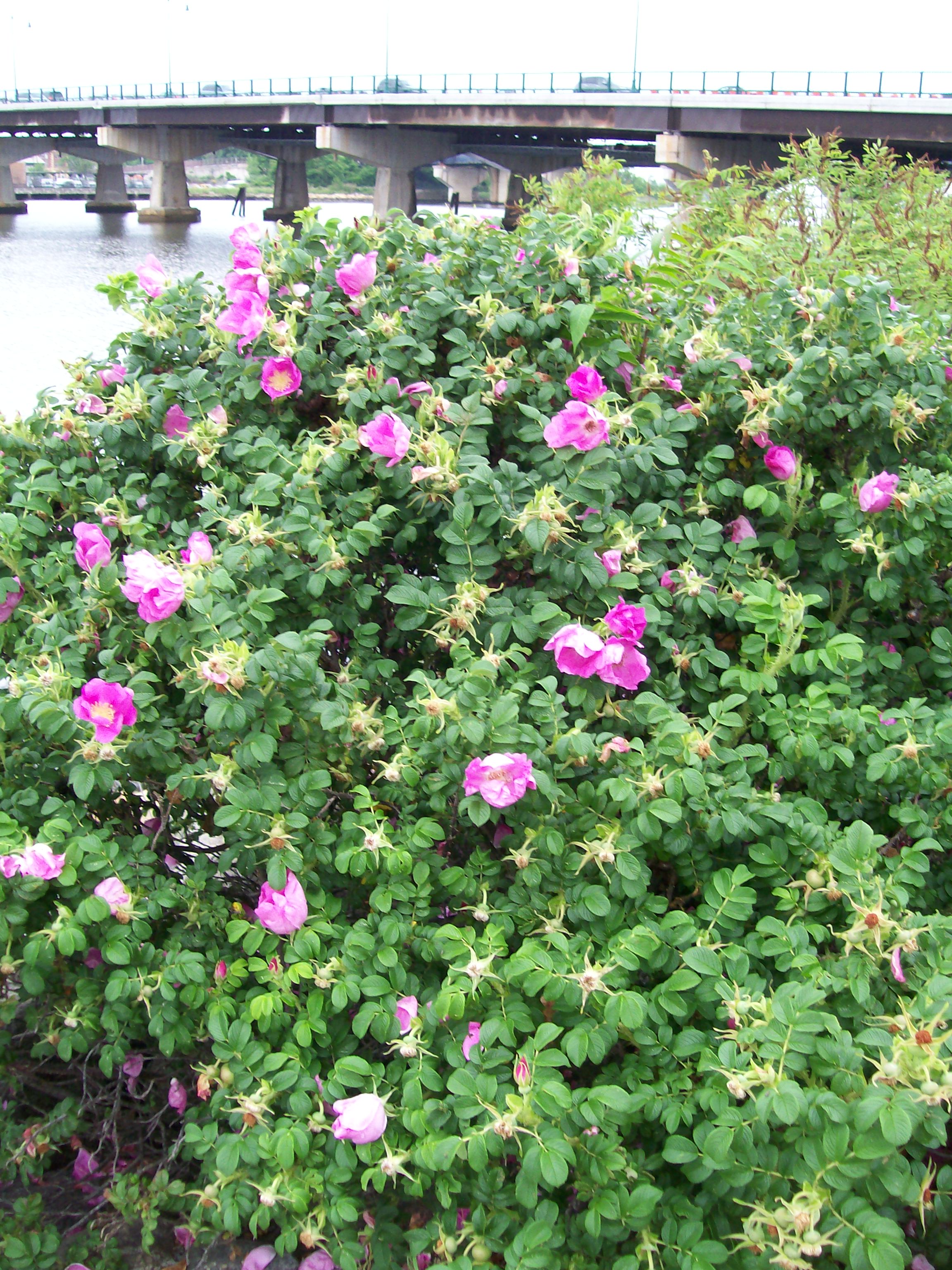
Wild Rose, Neponset River, Quincy, MA

It’s June, and James Russell Lowell’s prelude to The Vision of Sir Launfal comes to mind:

And what is so rare as a day in June?
Then, if ever, come perfect days;
Then heaven tries earth if it be in tune,
And over it softly her warm ear lays:
Whether we look, or whether we listen,
We hear life murmur, or see it glisten;
Every clod feels a stir of might,
An instinct within it that reaches and towers,
And, grasping blindly above it for light,
Climbs to a soul in grass and flowers; . . .

And that is as far as my memorization as a young person went.  I did not know this June as a young person, but I thought I did.  When I came to the clod I pictured the freshly plowed orchard beside my house, ignoring the fact that the plowing happened long before June.  June where I grew up could be hot, uncomfortably so.

This passage celebrates June in New England.  I know that now, because I visit Maine in June.  The fact that the description didn’t fit my experience was no concern to me as a young person.  Without realizing it – until I thought back much later – I put the world of books and words in a separate compartment from the world I lived in.  It did not occur to me that those New England writers which formed so much of my education were trying to convey real experience.  From where I stood, on the west coast, it might as well all be imaginary.

What is your experience in finding the relation between literature and life?

What will the end be?

4 Comments

If you are a booklover as I am, can you imagine a better final end than this?

            Booklover

First editions, clean and primly
jacketed, bore me.  I cherish those
lived in, lived with, a note card or
flower left between pages.

I have pored through such tomes
as if to find in them a future
project, a new idea.  I
can see clearly now my

self on a back shelf in a used
bookstore, loose cover, yellow pages,
among books not classified: is it
history, is it romance, is it

worth the paper it’s printed on?
The seller believes there’s a circle
in hell for those who burn books,
will find a ring in purgatory for

those who cannot discard one.  He
never comes here to dust.  I lean
against another volume, convinced 
there are worse ends than this.

This poem is from my collection in Ascent: Five Southwestern Women Poets (see Books page.)

Questions of Scale

Leave a comment

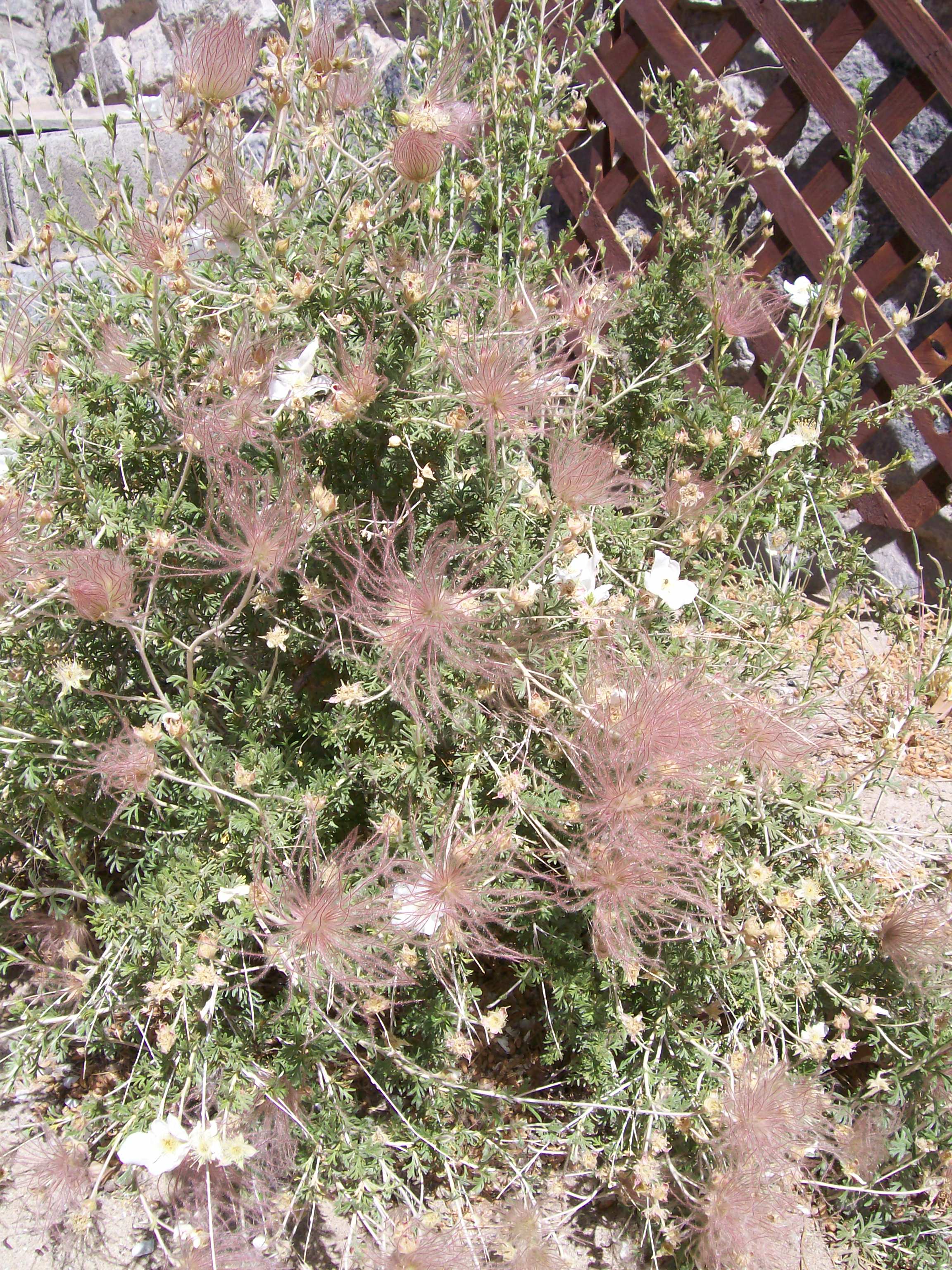
Apache Plume (Fallugia paradoxa, a member of the rose family) has been in bloom in our area recently.  I first learned about Apache Plume in a nature guide at Dripping Springs, a BLM recreation area in the Organ Mountains.  Nothing was in bloom at the time; I could not guess which plant beside the trail the guide referred to.

Reading that the plant was named for the seed plumes, which look like Apache war bonnets, I pictured something grand.  It was at first a disappointment to discover that the five-petalled white flowers are about 1 ½ inches across.  The seed heads are pink plumes of about the same size.  The pink soon turns brown and the seeds are blown away by the wind.  The plant is beautiful in bloom, in the seed stage or, as here, at half and half.  The season is short: for most of the year all one sees are the small clustered leaves on an often straggly plant.

Who first saw a war bonnet in this small, delicate shape?  Was it someone for whom raids by Native tribes were a real and present danger?  Was it someone who recalled such raids as recent and treasured history?

To see the large in the small requires a certain kind of creativity, a talent for comparison across difference.  To see the small in the large may be an even rarer gift―or perhaps it simply is not mine.  The ability to see similarities in things of different scale is the way of metaphor, an important tool for poets and others who seek to see things in fresh ways.

Introducing My Current Obsession

2 Comments

“Obsession,” one of my poems in Ascent (see Books page) begins:

I’m fixed on this book
like a three-year-old on trucks,
a five-year-old on dinosaurs.  You could
make it my motif, were I young
enough for birthday parties.

The book I refer to is William Paley’s <i>Natural Theology</i>, published in 1802.  This book from a long past era presents nature, particularly the human body, as evidence not merely that there is a God but that this God is wise and good.   The eye, the ear, the joints: each is a sufficient example, in design and practicality, of the skill of the Maker.  While I soon recognized that Paley’s world view was one of fixed order, incompatible with my awareness of evolution and change, his delight in all levels of creation was contagious.

The watch with which Paley begins his discussion is a controlling metaphor: as a watch must have had a maker, so the forms of nature must have been designed.  Paley is drawn to and impressed by all manner of mechanics, of which the watch is just one example.  He equally admires mills, telescopes, the new iron bridge he sees over the Wear River, and other human inventions, especially those in which he finds a parallel to some natural form.

Having spent two years in this man’s company (the man is actually hidden behind the book, but I have come to talk as if this is as a personal acquaintance) I am now in the process of sorting and sifting the pieces that came out of this “time together” to create a book―my book in response to his book.

I have decided that obsession is a good thing for a writer.  Perhaps it is even a necessary thing in the development of one’s art.

Word Play: Ramke’s and Mine

Leave a comment

 Bin Ramke’s poems are not easy reading, but I find them fascinating in their particulars.  In “Tendrils” (Theory of Mind: New & Selected Poems, p. 191), he writes:

“Replicate” can be pronounced several different ways―one of these, as an adjective, can refer to an insect wing folded back on itself.  From the Latin plicare, to fold, also replicare, to unfold or to reply.  An answer as an unfolding.  To speak, for instance, to a figure with wings, and then to see the wings begin to unfold, as your answer.  As in, “I love you,” and she unfolds her wings to leave you.

Mid-paragraph I get up to check my own dictionaries, Latin and Oxford English. My dictionary says the Latin verb can also mean unrolling.  What’s the difference between a fold and a roll, I wonder.

Replica comes from the same root: a copy.  So that replicate is also to make a copy of.  Making copies is in Ramke’s poem too.  But I am stuck on folding, unfolding, and why isn’t it also refolding–folding again?

Making a copy neither unfolds nor answers.  Poems do not copy, nor do they give answers.  Poems unfold, but if I said “this poem replicates” you would be thoroughly confused, thus demonstrating that “replicate” no longer carries this third meaning.

This is no way to read a poem; I forget entirely what came before and so am unprepared to pick up the poem after this definitive interruption. (Rupture= break: erupt, disrupt, interrupt).  Is this Ramke’s fault?  I’m the one who went for the dictionary.

The “she” who unfolds her insect wings.  Why does she matter to him?  He doesn’t say.  His language hides her in its many folds.

Language will not stay still.

Sin Fronteras Journal now accepting submissions

Leave a comment

Sin Fronteras/Writers Without Borders Journal is an annual journal published in Southern New Mexico by Sin Fronteras/Writers Without Borders, a non-profit organization whose mission is to encourage a community of writers, develop an audience for those writers, and give voice to those whose voices may not be heard.  Issue #16 has just been published; the cover art is by Helen Stork.


Sin Fronteras is now accepting poems, short stories, essays or short plays for issue # 17.  Submissions must be unpublished but are not limited to writers of the Southwest, and “borders” can be interpreted broadly.  Send 3-5 poems or one short prose piece to:

Sin Fronteras/Writers Without Borders
c/o DAAC
PO Box 1721
Las Cruces, NM  88004

Deadline is June 30, 2012

Copies of Issue No. 16 are available from the address above for $8 plus $2 postage; prior issues are available for $5 each plus $2 postage.

Dick Thomas and Ellen Roberts Young are co-editors of the Journal.  Other readers include Joan Glickler, Duncan Hayse and Michelle Holland.  Michael Mandel is manager of the organization, which also sponsors open readings at Palacio Bar in Mesilla, New Mexico, on the third Tuesday of the month. You can also find Sin Fronteras/Writers Without Borders on Facebook.

Older Entries Newer Entries