Home

Trip, part 4

1 Comment

The high speed train from Lyon to Paris went so fast it was hard to observe the landscape.  Just when something interesting appeared it was hidden as the train went into a cut.  Then the ride from the train station to the hotel was slowed by much traffic.  I avoided the bus tours in favor of walking and using the metro.

The highlight of my trip, and the reason I chose this travel package, came on my last day in Paris.  In pouring rain I found my way to the Cluny Museé du Moyen Age, which has a great collection of medieval art.  While it was worth taking time all the way through, the major piece is the room containing the “Lady and the Unicorn” tapestries.  After studying these for several years for Lost in the Greenwood it was amazing to see them “in person.”  The photographs cannot give the full effect, though small sections come closer. I sat there for quite some time looking from one panel to the next.

The tapestries are famously misnamed because every panel also includes a lion, heraldic partner to the unicorn, and many animals are represented in the background. Rabbits abound.
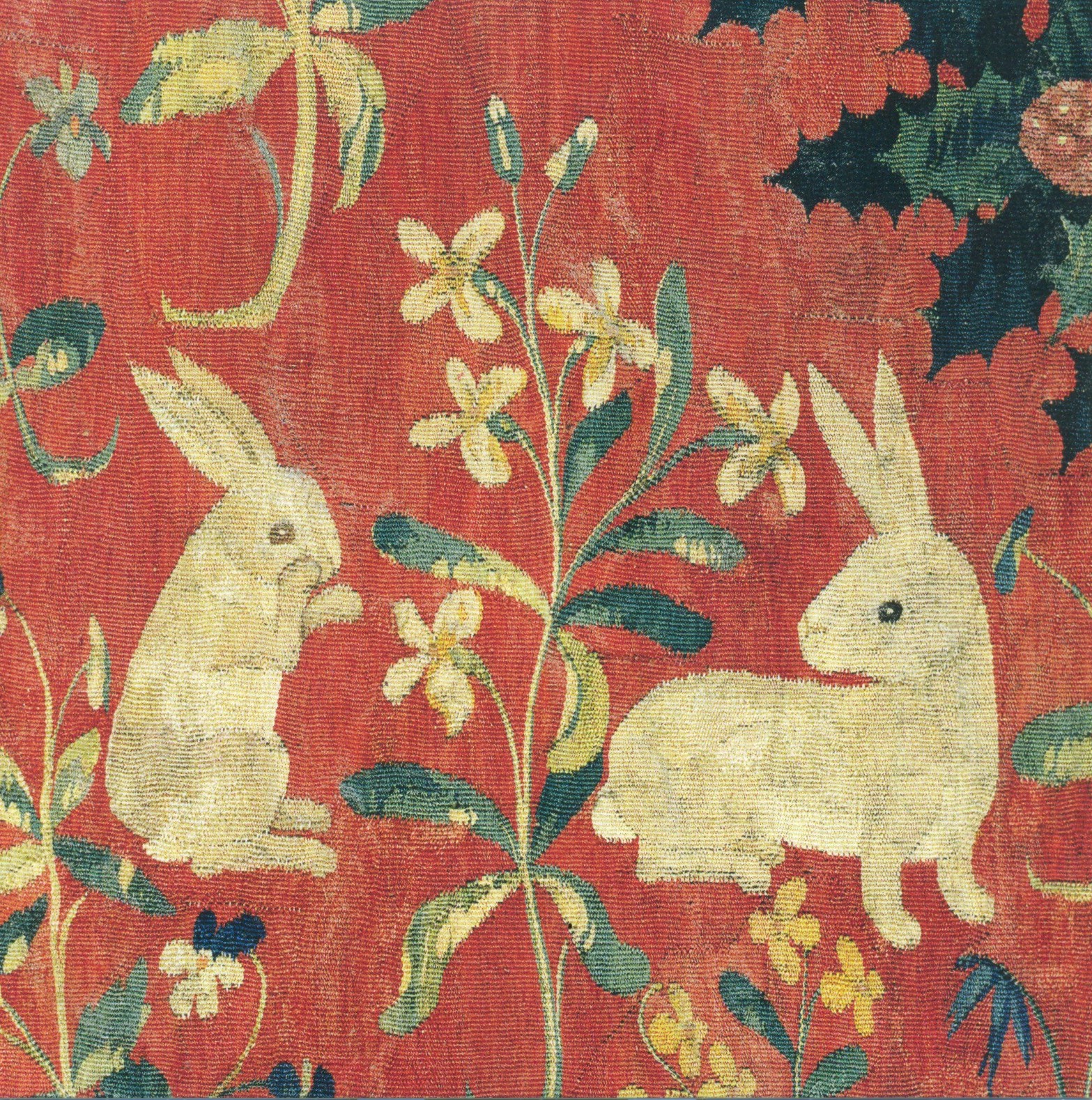
Here is a poem from Lost in the Greenwood which shows the role these background characters can play, in the imagination.

Accomplishments Make the Lady

(“Hearing” panel from the Lady and Unicorn tapestries)

A servant pushes bellows,
her mistress touches keys
of a polished table organ.

How long must she practice
to be called accomplished?

Lion and unicorn
carry sculpted poles,
bodies facing outward.

Their heads, ears, lean in
toward the woman musing.

The bored maid could stop
the sounding if she would;
her mind is far away.

Below a hound stares at
a young wolf.  All are in pause,

except six scattered rabbits,
twelve ears on the alert,
expecting sound in the silence.
Thinking about dreams

Leave a comment

Are elevator dreams limited to people in academic disciplines who go to conferences in big hotels? Do they have a particular meaning? This poem reflects on one such dream.

At the Annual Conference

I dream of elevators
in a large hotel. A wish
to be lifted up?  One is
too crowded, the next
stops at floor nineteen,
my room on seventeen.
As I realize I could
walk down two flights,
the doors close, reopen
on floor twelve, my fear
of yielding control
justified.  The next
elevator goes
through the roof,  
travels sideways,
glass walls providing
a view of the city.
Seeing that big box
from the street, I
know I’ve missed
a flight to freedom.

I hope you appreciate the tall-building shape. I’ve been tinkering with this poem for a couple of years, but still haven’t figured out what I wanted to fly away from. That is probably another poem.

A Poem

2 Comments

Sorting through some folders from old workshops, because the file drawer was getting too stuffed, I came across a few I had left behind.  They needed some tweaking, tightening, but seemed to still have potential.  Here is one of those poems given new life.

Where Story Begins

Mine was born
between two leaves
on a library shelf.
I don’t remember which
first bewitched me.
I ate up every book
in the case, omnivorous
hunger for text, tone,
word to name my
place in the world.

Place shifted, words
multiplied meanings,
Too tall, like Alice,
to enter again through
that bookcase, I reach
for another book
to restart my story,
recover my where.

In Honor of the Queen

1 Comment

Watching the reports of Queen Elizabeth’s funeral today, I recalled my early admiration of her, expressed in this poem from my chapbook, Transported.

Parallel Lines

Tales of moats and castles frame
my picture of a king.  The Queen
is a prim lady in a trim suit, matching hat.

Alice’s nemesis is dwarfed
by the real, living Elizabeth,
her patient smile akin to my mother’s,

her age-mate, name-sharer. A child,
I hold these two in equal honor.
My mongrel American family

choosing its tradition, links “English”
and “proper,” visits the Cotswolds,
Cambridge, and Windsor Castle,

where neither the Queen nor I can play
with the regal, cased-in-plastic doll house
made for her grandmother, Mary.

Thanksgiving Poem

1 Comment

Joining in the widespread nostalgia this year for those big extended family gatherings.

Mashed Potatoes

            “ . . . are to give everybody enough.”
                              Ruth Krauss, A Hole Is to Dig

So there must be gravy
and a decision about who’s to make it.
Thanksgiving celebrates acquisitions,
mergers: his family’s sauerkraut,
her neighbor’s homegrown squash
will be replicated for decades.
Four burners heat six pots
when the niece comes in to make
macaroni for the youngest ones
whose urgent hunger cider and celery
cannot satisfy.  A lump in the potatoes
proves they’re real.  The masher
blames distractions, so many
people in the kitchen. The gravy maker
stays focused while other pans
change places, the drawer
at his elbow opens, closes, opens.

First published in The Broken City, thebrokencitymag.org, 2013

There is much to be thankful for, even in 2020.

Another Minor Poem for this Time

4 Comments

This came from the prompt: what is an inanimate object trying to tell you?

Messages

He says the microwave is talking to him.
What’s she saying, Henry?  She says,
“Noli me tangere.  The last person
may have been exposed.”  She says
it’s time to work from home.

We have no microwave at home;
our toaster oven serves us very well.
“Don’t take me for granted,” toaster
protests, “I can only do what I can.”

Does the second line sound familiar?  It’s a quotation from Finian’s Rainbow.  The boy Henry interprets the message of the mute dancer.  A traveling company performed the musical in my high school auditorium in my youth.  Some things stick for a long time, reappearing when least expected.  That’s one of the deep pleasures of writing.

Prompted

1 Comment

In April I subscribed to the daily prompts put out by Two Sylvias Press.  I’ve done this before, I always get behind, and I do well if half of the prompts lead to something useful.  A few prompts spark new poems, but more often I produce what I think of as “pomelets” (“pome -lets” sounds better to me than “po-emlets”).

Here’s one, my response to the prompt: write a journal entry for a famous fictional character:

Roadrunner’s Journal

It’s a living, harassing Coyote,
somebody has to do it,
but is it a life?  Wish I could
find a mate, breed chicks,
a next generation, a legacy of sorts,
though I hear offspring can be unreliable,
reject their parents’ values,
go off their own way.  Mine
wouldn’t leave the desert would they?
That golf course, damp and green,
might tempt them to deny their heritage.
I only go to visit, briefly.

Roadrunners have a challenge figuring out how to coexist with the increasing number of humans, and their golf courses, in their territory.  I saw two in a neighbor’s front yard on one of my walks recently and wondered where they make their nest.

Image Problem, In Reverse

3 Comments

Has anyone else been struck by how elegant, how almost attractive, some of the images for the coronavirus are on television?

Image Problem

All those flower-like
protrusions as if marketing
designed a logo for it, as if
it were not ugly—and
too small to see.

Are these trumpets signaling
attack, mouths to gobble
the good microbes, suction
cups structured to latch
onto surfaces or cells?

What marks the defense
against this enemy?  Where
are their marketers, their
support-our-troops posters?

February Snow Times 2

3 Comments

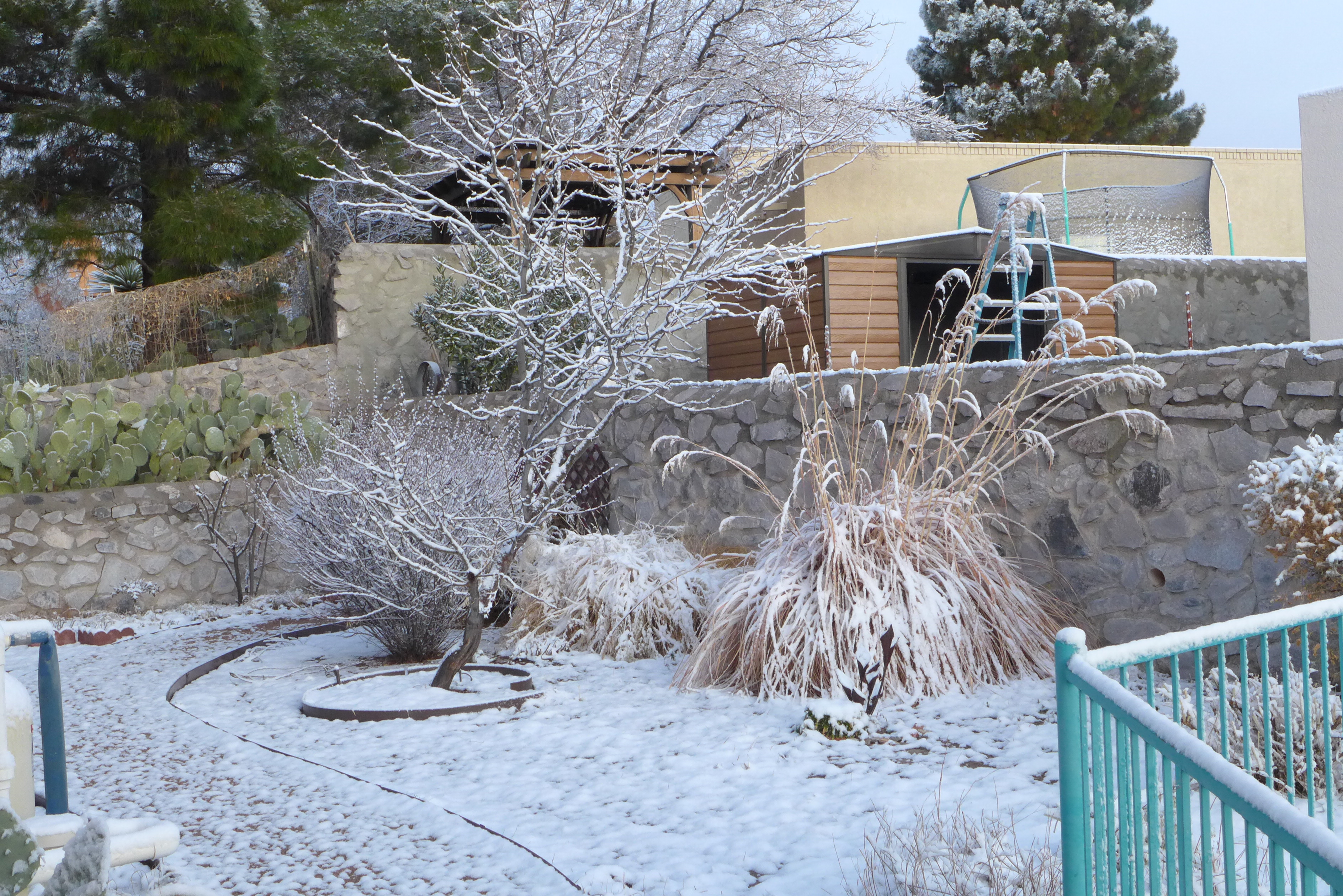
Snow is a rare thing here, although we often see it up on the mountain.  Even more unusual, this year we’ve had two snows in two weeks.

P1010199The first made a lovely covering, for the short time it lasted.  Here is the view through my study window.P1010203

The second week’s snow was a heavy wet one, giving a different effect.  It even covered the bonsai that sits at the edge of my patio.P1010205


P1010208

I wrote this poem for a friend who used snow falling as a symbol of depression.  That seems unlikely in the desert southwest.

February Morning
for John

He tells me snow
is a product of the air’s
despair.  Perhaps

he’s right: seedheads
of the tall grass are weighed
down, shawled in white.

But each twig on the tree
is highlighted, while the earth
sleeps cozy under its blanket

and every thirsty plant
will drink the melt; the birds
can feed again.


I think we’ve had our winter.  Spring winds should be here soon.


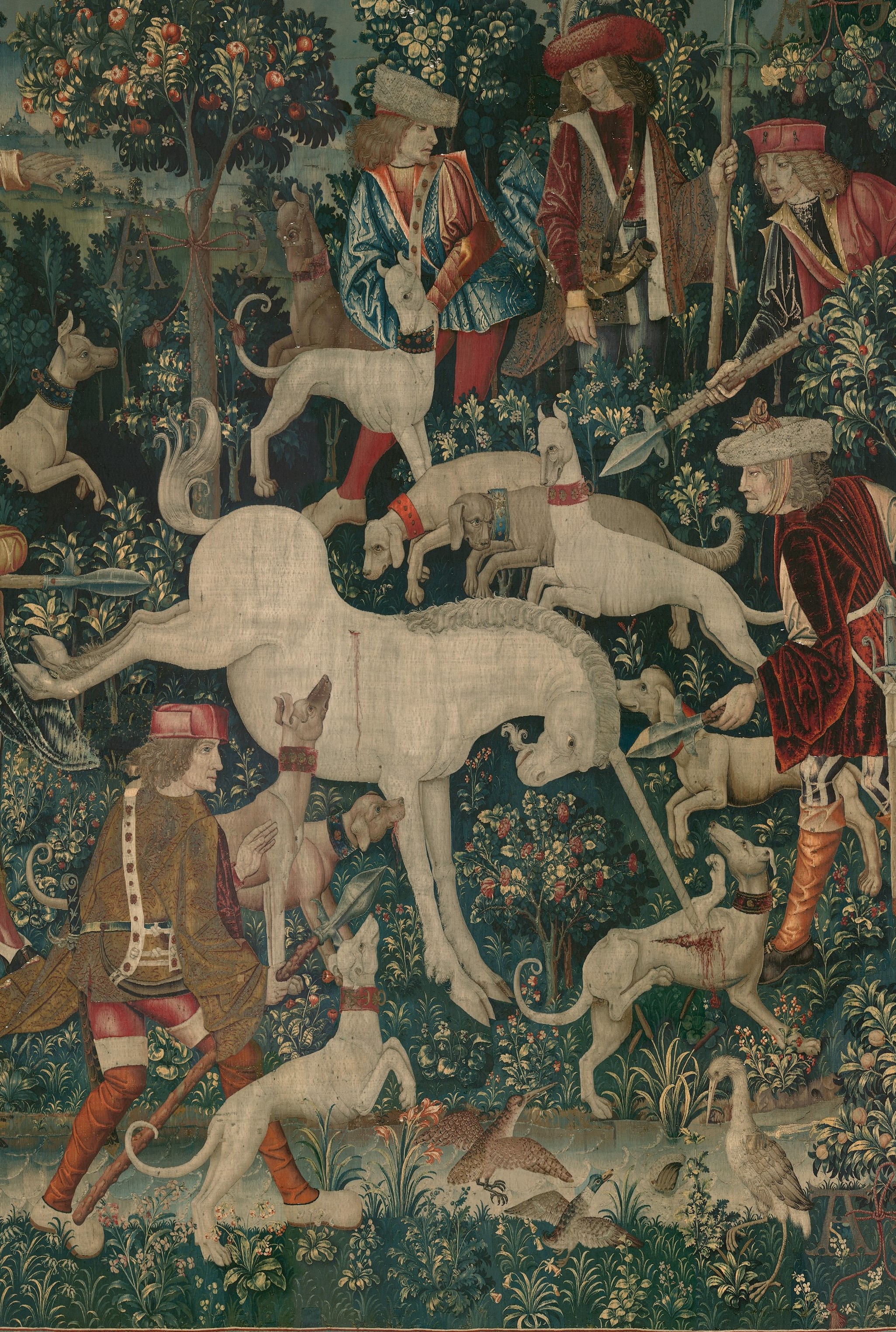
The World of the Unicorn Tapestries

Leave a comment

I am often irritated by radio announcers who talk on about the composers whose works they are about to play, some facts well known, some gathered from the internet and often tangential.

Yet, when I was working with the unicorn tapestries I wanted to know “more, more, more” about the world in which they were made.

DP118987 Defends cropped

The Unicorn Defends Himself (part)

I discovered two history books from the 1920s.  The Autumn of the Middle Ages by Johan Huizinga is translated from the Dutch.  The translation I have is from 1996, indicating that the book is still important.

A second, less well-known, history is Lucien Febvre’s Life in Renaissance France.  Both of these authors convey a sense of loss in describing the vitality of the era they describe.

These two books, and the energy of the tapestries themselves, persuaded me.  Pictured here is just part of one of the tapestries from the Hunt of the Unicorn series in the Metropolitan Museum of Art.  I’ve come to share the two authors’ sense of loss and wish I could know personally these two good writers.


Historians

When the world was half a thousand years
younger all events had much sharper
outlines than now.
     Johan Huizinga, Autumn of the Middle Ages (1923)

The unicorn’s realm is beyond our reach.
We cannot leap half a millennium
to dance with the lords and ladies
of the country in which he thrived.

Admiring the vigor of that age,
Lucien Febvre said we are hothouse
flowers.  The past is a mirror too distant
to give us clear sight of ourselves.

Lucien and I and Johan Huizinga
wander along cold, unswept streets,
wanting to crash the splendid parties
we are too late to attend.

Note:  “more, more, more” is a quotation from A Very Special House by Ruth Krauss.  See my post of August 28, 2013.

Older Entries Newer Entries