Home

If Society Were Child’s Play

Leave a comment

William Paley (see entry on “My Current Obsession”) and William Blake were contemporaries who never met.  They represent opposite views of society, religion and much else.  Picture them as two six inch pieces of wood, a square pillar (Paley, Anglican clergyman) and a round column (Blake, nonconformist and visionary).  I see them lying on a green wall to wall carpet near a wooden box with holes.  The child who plays there has wandered off.

The pillar has been in and out of the box several times.  The column is too wide to fit.

“Square up, man,” the pillar says to the column.  “Then you can join the party.”

The column protests, “I cannot be four-faced, confined to opposites.”

“But see, the holes are square.  This is our proper shape.”

“If all are square, society is too boxed in for me.”

“You’ll end up all alone.”

“I can live with that.  My dreams are different, my desire’s to roll.”

“Don’t be stubborn,” the pillar pleads.  “You’ll find it’s not so bad.”

“The same as not so good,” the column counters.  “I’ve wider visions.”

“It’s just a slice or two . .”

“Or four, I gather.”

“You’re fat!”

“I’m a well-proportioned cylinder, you fence post!  Why blame me if I don’t fit in?  I say the holes are wrong.”

“Your core remains.  You’ll be the same inside.”

“I’d lose my voice, my round cadences.  Better to sing out here than narrow to a sigh.”

“It’s what we’re made for.  You’ll be a part . . .”

“With a splintered heart!  For wholeness, I must keep apart.”


Questions of Scale

Leave a comment

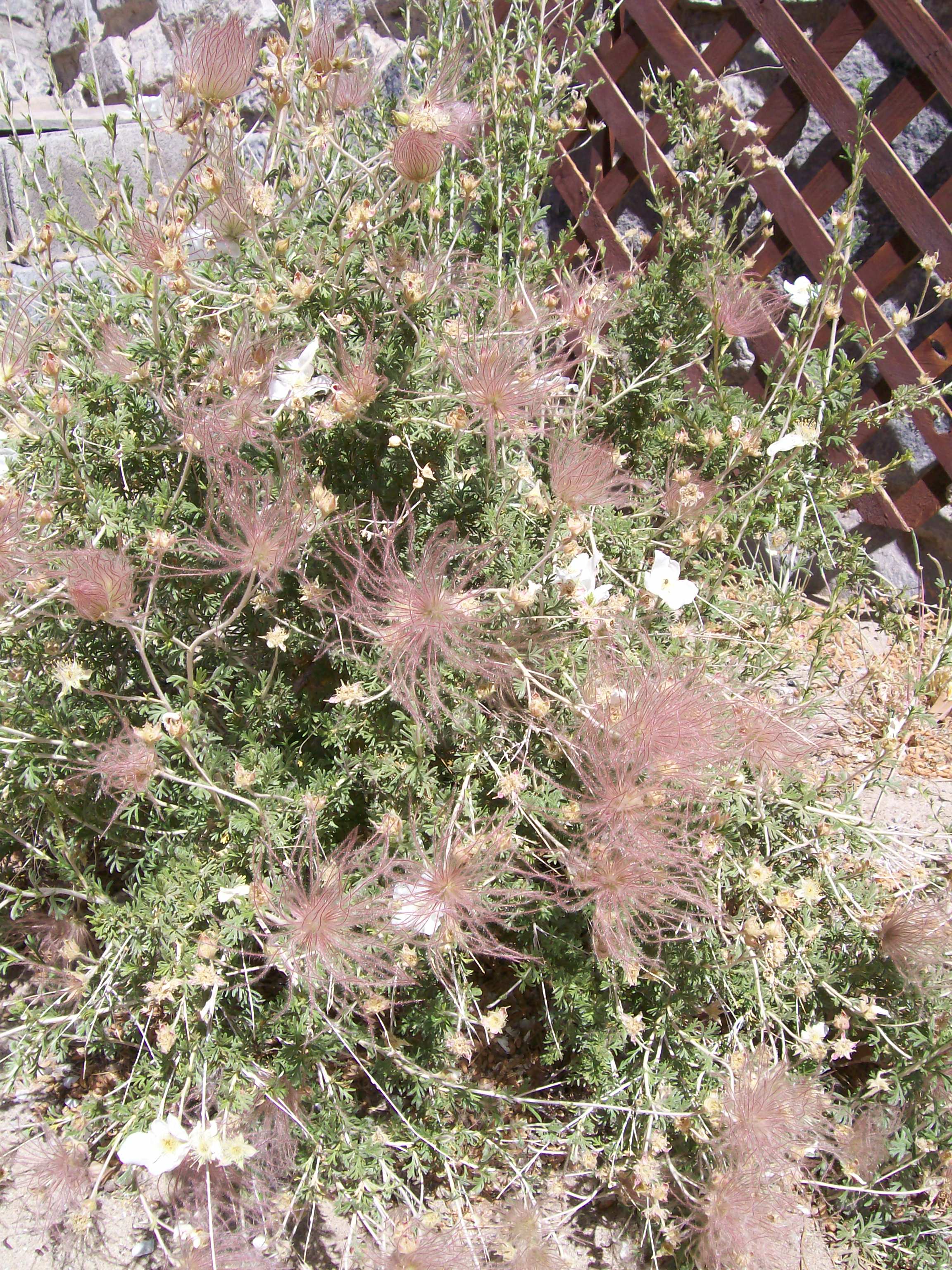
Apache Plume (Fallugia paradoxa, a member of the rose family) has been in bloom in our area recently.  I first learned about Apache Plume in a nature guide at Dripping Springs, a BLM recreation area in the Organ Mountains.  Nothing was in bloom at the time; I could not guess which plant beside the trail the guide referred to.

Reading that the plant was named for the seed plumes, which look like Apache war bonnets, I pictured something grand.  It was at first a disappointment to discover that the five-petalled white flowers are about 1 ½ inches across.  The seed heads are pink plumes of about the same size.  The pink soon turns brown and the seeds are blown away by the wind.  The plant is beautiful in bloom, in the seed stage or, as here, at half and half.  The season is short: for most of the year all one sees are the small clustered leaves on an often straggly plant.

Who first saw a war bonnet in this small, delicate shape?  Was it someone for whom raids by Native tribes were a real and present danger?  Was it someone who recalled such raids as recent and treasured history?

To see the large in the small requires a certain kind of creativity, a talent for comparison across difference.  To see the small in the large may be an even rarer gift―or perhaps it simply is not mine.  The ability to see similarities in things of different scale is the way of metaphor, an important tool for poets and others who seek to see things in fresh ways.

Introducing My Current Obsession

2 Comments

“Obsession,” one of my poems in Ascent (see Books page) begins:

I’m fixed on this book
like a three-year-old on trucks,
a five-year-old on dinosaurs.  You could
make it my motif, were I young
enough for birthday parties.

The book I refer to is William Paley’s <i>Natural Theology</i>, published in 1802.  This book from a long past era presents nature, particularly the human body, as evidence not merely that there is a God but that this God is wise and good.   The eye, the ear, the joints: each is a sufficient example, in design and practicality, of the skill of the Maker.  While I soon recognized that Paley’s world view was one of fixed order, incompatible with my awareness of evolution and change, his delight in all levels of creation was contagious.

The watch with which Paley begins his discussion is a controlling metaphor: as a watch must have had a maker, so the forms of nature must have been designed.  Paley is drawn to and impressed by all manner of mechanics, of which the watch is just one example.  He equally admires mills, telescopes, the new iron bridge he sees over the Wear River, and other human inventions, especially those in which he finds a parallel to some natural form.

Having spent two years in this man’s company (the man is actually hidden behind the book, but I have come to talk as if this is as a personal acquaintance) I am now in the process of sorting and sifting the pieces that came out of this “time together” to create a book―my book in response to his book.

I have decided that obsession is a good thing for a writer.  Perhaps it is even a necessary thing in the development of one’s art.

Word Play: Ramke’s and Mine

Leave a comment

 Bin Ramke’s poems are not easy reading, but I find them fascinating in their particulars.  In “Tendrils” (Theory of Mind: New & Selected Poems, p. 191), he writes:

“Replicate” can be pronounced several different ways―one of these, as an adjective, can refer to an insect wing folded back on itself.  From the Latin plicare, to fold, also replicare, to unfold or to reply.  An answer as an unfolding.  To speak, for instance, to a figure with wings, and then to see the wings begin to unfold, as your answer.  As in, “I love you,” and she unfolds her wings to leave you.

Mid-paragraph I get up to check my own dictionaries, Latin and Oxford English. My dictionary says the Latin verb can also mean unrolling.  What’s the difference between a fold and a roll, I wonder.

Replica comes from the same root: a copy.  So that replicate is also to make a copy of.  Making copies is in Ramke’s poem too.  But I am stuck on folding, unfolding, and why isn’t it also refolding–folding again?

Making a copy neither unfolds nor answers.  Poems do not copy, nor do they give answers.  Poems unfold, but if I said “this poem replicates” you would be thoroughly confused, thus demonstrating that “replicate” no longer carries this third meaning.

This is no way to read a poem; I forget entirely what came before and so am unprepared to pick up the poem after this definitive interruption. (Rupture= break: erupt, disrupt, interrupt).  Is this Ramke’s fault?  I’m the one who went for the dictionary.

The “she” who unfolds her insect wings.  Why does she matter to him?  He doesn’t say.  His language hides her in its many folds.

Language will not stay still.

Juxtaposition and more of Levi Romero

2 Comments

I have a long-enduring fondness for the word “Juxtaposition.”  In an early poem using that title, now justifiably forgotten, I wrote “things touch at their edges.”  Where things touch, they affect each other; that’s juxtaposition, whether in nature or in art.  In this entry I juxtapose a piece of my work with a little more of Levi Romero’s work

Levi Romero’s book, Poetry of Remembrance, focuses, as I discussed previously, on stories and the past, but he includes other more current facets of his life: as teacher and leader of workshops and as an architect – an architect who cannot expect to be welcomed into a home he has designed.  In a poem he titles “Juxtaposition” he describes a visit to one such building as it was being built:

may I help you?
I am asked by the realtor
standing at the door,
thinking that I may be the guy
who mixed the mud and pushed the wheelbarrow . . .

I once was asked by a home magazine journalist
if I felt insulted by such incidents
well, no, I said, my mind mixing for an answer
a good batch of cement is never accidental

Romero has learned to live with  kindness but close attention on the edge of a culture where others assert that he does not belong.

This “outtake” from my own recent writing uses the term to describe juxtaposition in nature:

Chance
juxtaposing gypsum
deposits, playa, crystals, wind,
forms rolling dunes of white
sand in a brown desert.

in the Tularosa Basin of New Mexico, gypsum washed down from bands in the mountain collects in Lucero Lake, then crystallizes as the lake goes dry, is worn away by wind, and blows into the dunes of White Sands National Monument. 

When I think anthropomorphically about God (and sometimes I do, knowing that all language about God is metaphoric) I picture an artist putting different elements of nature together to see what will happen.  The result may be wild or wonderful―and totally impractical.

What a powerful word!  “Juxtaposition” has taken me from society through poetry to nature and theology.  This may explain why I can’t seem to categorize my posts.

One New Mexico Poet

Leave a comment

Levi Romero is the New Mexico Centennial Poet.  This means he is making a lot of presentations.  One of them was at NMSU in Las Cruces recently.  He read from his collection, <i>A Poetry of Remembrance: New and Rejected Works</i>.

A poet who is willing to subtitle a collection “New and Rejected Works” certainly gets my attention.  It turns out this subtitle is also the title for a poem, which is placed as part of a section on lowriding, the passion of the young men Romero grew up with in Northern New Mexico.  Many of the poems describe the world of Romero’s youth, others focus on family and on community that hasn’t disappeared but is at risk.  The second and last poems in the book describe Romero’s visits to his mother in a nursing home; both are about telling stories, listening to stories and passing them on.

Some of the poems are in Spanish, and some mingle Spanish and English.  My bit of Spanish could get many of the pieces, but not the whole poems.  In his presentation Romero explained that he uses the mixed dialect of his northern New Mexico region.

August and fall seem to predominate in these poems, suggesting all that is passing or has passed as Romero moves into his own elder years.  He is well aware of the unreliability of stories also, as indicated in this section from “Most Skin Hits Road”:

our own histories
who we are
where we come from

could be reinvented
in the next sentence uttered
the next clever line spoken
the next interjection of humor and
sincere display of pleasantries
masking over the face of a new persona

and further answers to all possible questions
made more believable
than the reality of our own true selves
our leaking faucets, ragged lawns
oil stained driveways, two nights of dinner dishes . . .

Romero makes the reader welcome in his story-filled, ambiguous and basically cheerful world.  I recommend this book as an introduction both to an unusual subculture and to a writer who accepts and honors the layers of complexity in contemporary life.

Poems describing more of the many cultures and landscapes of New Mexico can be found at http://200newmexicopoems.wordpress.com/

And the Greeks . . .

Leave a comment

I was introduced to Thomas Lynch through an interview in <i>Writers Chronicle</i>.  He writes essays and fiction but says, “I wouldn’t write sentences or paragraphs that were worthy if I weren’t also writing poetry.”  That led me to find his book, <i>Walking Papers</i>, and I was hooked by the opening lines of the opening poem:

What sort of morning was Euclid having
when he first considered parallel lines?
(“Euclid”)

I have always been partial to Greeks because of my studies in Greek and Archaeology, but I have been fond of Euclid since I was in the equivalent of seventh grade in an English School.  There geometry was taught as a series of theorems and their proofs.  One of the first was “When two straight lines cross, the opposite angles are equal.”

It was rote learning, but I loved it.  I believed this was the way Euclid himself had presented his ideas.  I remember the small paperback book clearly, while I’ve forgotten entirely the geometry text I used when I came to the subject again as a sophomore in high school.

Lynch says little more about Greeks, but in this first poem, Euclid takes a place along with Lynch’s contemporaries, each working out their understanding of the world, and they go together well.


Ascent Goes Public

Leave a comment

Let this bold blooming yucca in my neighbor’s yard stand for the achievement of the five southwestern women poets as we presented our work in our book Ascent to the public today at our local library.

Some of us have been writing for decades, others only recently, but for all of us this is work of our maturity.  Three years of critiquing each others’ work had not blurred the difference in the way we see our world.

I shared this observation on the environment where I now live:

A jackrabbit feeds on
freeze-dried prickly pear,
bolts a my approach,
happy in his speed, doing
what he’s made for.

Susan Gomez describes a dust storm in “Fury”:

Our small car listed
as we navigated the wind
with its airborne sediment. . . .

Air and silt, violent, howled into the night.

Teral Katahara closely observes another part of our landscape:

I stop to see Sandia and pungent Jalapeno
chile plants
sitting in the neighbor’s field. . . . .

Sun shines through
translucent red skins
splotched with warm gold.

The other poets chose to share pieces about their past.  Lucille Tully recalls Chicago in “State Street 1957”:

Now in the quiet of the late night
I walk alone except for the one

staggering drunk who does his dance
while I smile, do mine, to stay clear of his

Still, as strange, silent companions
we share this concrete way.

Polly Evans, eldest and in many ways wisest of the group, encompasses a lifetime in “Hide and Seek,” beginning with basement and closet. Then

The apple tree was easy . . .
I hid in the foliage.
The big dog knew I was there;
I watched the cats,
and the kids coming home.

After a stanza about hiding in early marriage, the poem concludes:

The night you died
there was no place to hide.

Ascent is a truly self-published book, available only from the authors.  See the Books page and use the Contact page for more information.

Mystery and Courage

Leave a comment

H.D.’s Trilogy, a book of three long poems written in the 1940s, begins with a vivid portrayal of the stress of the bombing of London and the longing for respite.  Woven in with this world are Greek and Egyptian deities and an awareness of those who distrust poets (herself and her companions) because of their lack of “usefulness.”

In the second section what the rest of us think of as “real” takes second place to angels and a Lady who is both Astarte and Mary and who also appears with a book, as if she were patroness of poets.  She is goddess portrayed in many ways through the ages:

We see her hand in her lap,
smoothing the apple-green

or the apple-russet silk;
we see her hand at her throat,

fingering a talisman
brought by a crusader from Jerusalem;

In part III the focus shifts again, for here two Biblical stories dominate, the woman with the alabaster jar, and Kaspar, the Wise Man who brought myrrh to the Christ Child.  H.D. intertwines them so that the two figures are contemporary.  In this, H.D. shows the courage to follow where the poem leads her, though it could well be offensive to those detractors she mentions earlier.  She describes the encounter of the woman and Kaspar.

As he stooped for the scarf, he saw this,
and as he straightened, in that half-second,

he saw the fleck of light
like a flaw in the third jewel

to his right, in the second circlet,
a grain, a flaw, or a speck of light

and in that point or shadow,
was the whole secret of the mystery;

The final sections bring conclusion to the whole series, yet leave mystery intact: the mystery of deities and creativity, of courage and hope, of Good Friday and Easter.

What’s In Your Suitcase?

Leave a comment

On a recent trip to Albuquerque I visited the Art Museum, which has a current exhibit of New Mexico artists, for which many artists have provided quotations.  This one comes from Melissa Zink (1932-2009):

It’s like you’re walking around with this enormous suitcase full of magic and you are never allowed to open it, because the rules say that the tings in that suitcase are not worthy of artistic consideration.  Worlds, childhood memories, pretend, fantasy, archaeology – all that.

What a great metaphor: a picture I can carry with me like that suitcase.  Zink has clearly found her way to break those “rules”: her piece in the exhibit is three dimensional wall art: clever, whimsical, thought provoking.

I was captured by this statement partly because one of the things in Zink’s suitcase is archaeology.  That is something that peeks out every time I open my suitcase.  Digging into the past, pottery sherds, separating the gem from the dirt: these are images I have used often.  There are also real memories from my time in Egypt and Italy. 

I never worked as an archaeologist, but I am one if you count digging in books, archives and other relics of the past.

Each of us has more past to explore than we can fit in one suitcase.

Older Entries Newer Entries