Home

Poetry and History: A Recommendation

1 Comment

Eve Rifkah’s book Outcasts is a book of poetry which doubles as a history lesson.  The subtitle describes what the book is about: The Penikese Island Leper Hospital 1905-1921.  This hospital, really a kind of imprisonment on a deserted island, was an effort of the State of Massachusetts to deal with the problem of leprosy.  It involved a total of 36 patients in its sixteen years of existence, fourteen of whom died and were buried there.  Rifkah recreates twenty of the patients, who were of many different cultures and ethnicities.

Rifkah uses historical documents, including the journal of Dr. Parker, who ran the institution, as well as newspaper clippings and other records collected by Mrs. Parker.  To these she adds a large dose of sympathetic imagination.  The desolate island, the smallest of the Elizabeth Islands south of Cape Cod, is vividly portrayed, echoing the desolation of the residents.

Each of the characters has a history and a role on the island.  Willie does the laundry, Archie runs the wireless telegraph, and so on.  Some are characterized further by their religion: Isabelle and Flavia pray to Mary, Solomon laments in verses from the Psalms, Iwa speaks to the Buddha, whose statue is his one possession.

The title page, below the subtitle, describes this collection as “A docu-drama in verse” and the sections are called Acts.  This is misleading, there is very little drama.  The poems are mostly soliloquies or descriptions of an individual.  The sort of tensions that would surely exist in such a situation are scarcely referred to.  Those few interactions which are portrayed  are largely between a patient and Dr. or Mrs. Parker, who are presented as loving, highly competent and inventive people.  I would describe this book as elegy, not drama.  One moment of group activity is portrayed in the following poem:

Here We Are Safe

huddled around Lucy reading the news
between songs on the Victrola
Till We Meet Again
our eyes look away
at the floor      the windows   nowhere
goodbye means the birth of a tear drop
and the singer talks about love
in A-flat

I remember hearing how the Shakers
called all outside their home the World
wind-up songs and newsprint all we have from that
place

the farther shores

out there          war      the reporters now call
the Great War             the war to end
war
we look at each other              imagine
exploding buildings                men ripped apart
in the World                the place we left
as though waking or entering dreams

Rifkah does not tell us who the “I” in this poem is.  The lack of punctuation and irregular line lengths are typical of most of the poems in the collection.

The language of most of the poems is tight, often fragmented, and does not rely on images outside the barren landscape and experience of the people.  This helps to build the feeling of lament which runs through the collection.  An example of such lament is “Frank Counts the Waves”.  Frank had been a fisherman.  Rifkah uses this history to inform the poem.

Frank Counts the Waves

high tides follow a blind moon
storm from the west blows
spray to walls              salt
seasoned crust on my lips
shattered shuttered shake

white roughed waves
roll and heave              break and break
one two three four
daylong nightlong

I sit back to cabin wall
hear Iwa praying to his Buddha
his language hard as the wind
I look to the cross my wife sent with me
hanging over my narrow bed
Why hast thou forsaken me
who am I to turn to.

all the world comes in goes out

no return passage
I said when leaving Cabo Verde,
the flowering islands,
in New Bedford fished cold water
fed my laughing children
named my first born Isaac, to laugh
I have passed into uncharted seas
breath in out as waves counting

years roll the sun summer high winter low
still counting
one two three four
ready or not.

As here, the other patients are usually peripheral to each person’s personal laments. It is a sad world, yet only rarely an ugly one.  Rifkah’s compassion permeates the book.

A listing of the actual patients whom she has lovingly brought to life is included in the back of the book; the summaries look oddly like contributors’ biographies in the back of a journal.  Rifkah has also written an Author’s Note giving the historical background.  Those who still lived when the institution was closed in 1921 were transferred to a federal leprosarium in Carville, Louisiana.  There, she writes “they experienced conditions even more horrific than those on the barren island.”

Overall, a harsh history has been softened by carefully chosen, crisp language.  It is an excellent way to tell the story.  It is a story worth knowing.

Outcasts was published by Little Pear Press in 2010.  It is available on Amazon.com.
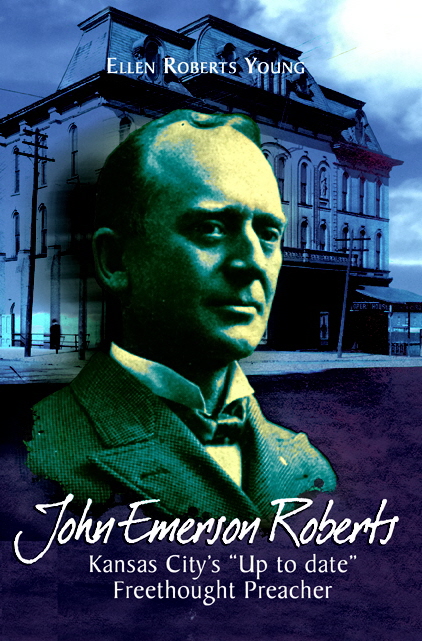
A Freethinker’s View of Women: From the Biography

1 Comment

John Emerson Roberts was “Kansas City’s up-to-date freethought preacher” partly because he was an avid reader.  He readily absorbed new ideas and included them in his lectures.  One example of this is a lecture he gave in 1900 was called “Woman and Modern Religion.”

            The lecture claims that the Bible and Christianity have been the cause of the debasement of women.  Like many of Roberts’s lectures, this is arranged as a historical progression.  He begins with recent theories about the power of women in ancient societies, citing stories about Egypt, Rome, China and Zuni tribes as fact.  In each he finds a queen or a priestess with significant power.  He summarizes his view of the ancient past:

“The pagan philosophy that recognized the natural superiority of woman must have proceeded in the most rational way.  It looked upon her as the mother, the creator, and the preserver of man and of his world.  Man knew then as we know now that civilization began with the mother. All progress in this world is led forward by the divine guide, love.  Woman was the lover first; man was the fighter.”

Acknowledging that no one can explain how the matriarchal era was replaced by patriarchy, Roberts goes on to describe the patriarchal attitudes found in the Bible.  He declares it “the charter of masculine tyranny” and “the instrument that has forged chains for the enslavement of woman.”  Because of the Eve story, theology has made woman the cause of all sin.  He mentions the Levitical rules of cleansing after childbirth: 40 days for a son, 80 for a daughter.  He asserts, “The New Testament makes no advance toward the elevation of woman.  Jesus seems to have no regard for woman.”

Roberts continues his history with a tirade against the middle ages, one of his recurring themes:  He calls them “a period of a thousand years that has never been paralleled in the history of mankind for its debauchery, its superstition, its intellectual vagaries, its frightful and nameless criminal practices.”

            The concluding section of this lecture is a paean in praise of motherhood.  Roberts speaks of “the mother” but he is surely drawing from his own recollection, either of his own mother, who died in 1885, or perhaps from the example of other mothers, such as Josephine Parks, his second wife’s mother, who had lived with them:

.” . . .when I remember how all we are we owe to her, how in the glad and happy time she sang as she rocked our cradle, knitting or mending or sewing while under the inspiration of a chaste and holy love; when I remember how in the wayward and unthinking years of childhood and youth it was the mother whose love was never overtaxed, it was the mother whose arms were ever open with forgiveness in her heart; when I remember how she toiled and toiled that we might have a little better chance in this world than had come to her; when I remember how she grew old and white haired and wrinkled and wan and feeble with the patient and uncomplaining toil of many years and how we folded at last her cold hands in peace across the loving breast; how the smile, even after death’s cold touch illuminated her face like a halo from the home of God; when I remember the mother, I can worship the best by paying the homage of my honor, my respect, and my love to the motherhood of this world.”

Motherhood, as described here, was a nineteenth century concept.  It developed alongside the new idea that childhood is a special stage of life..  This idealization had little to do with equality or real power.  Roberts apparently did not see the difference between this admiration of motherhood and the matriarchies which he believed characterized the ancient world.

When Roberts spoke the idea that ancient societies were matriarchal was widely accepted.  Later scholarship has concluded that this idea was a figment of nineteenth century imagination.  The idea appealed to Roberts because it made an excellent contrast to Christian, and especially medieval, patriarchy.  The seriousness of the offense, in his view, would not be called into question by the error in his starting point.


Excerpts are from John Emerson Roberts: Kansas City’s “Up-to-date’ Freethought Preacher, which is available from Amazon, through ERYBooks.  Or use the contact page to order directly.

Up-to-date In Kansas City: From the Biography

Leave a comment

At the end of the nineteenth century, Kansas City was an exciting place to be.  Businessmen were optimistic, having survived a local real estate bust in the 1880s and the national economic crisis of 1893.  John Emerson Roberts’s “Church of This World” fit right in with the sense of progress.

People back in Michigan, where Roberts had grown up and where he returned each summer, took notice of his success.  In a long interview reported in the Grand Rapids Herald, Roberts was asked about his church.  He responded:

“We don’t deal with anything of which we have no knowledge. We have quit fooling with phantoms and ghosts and the future. We are satisfied to live in this world and to study life here rather than what we are to enjoy hereafter. We don’t lie about what we don’t know. As for prayer and that sort of thing, I can’t see any occasion for it. Christ never prayed in public.”

When the reporter suggested that the Gospel of John indicates otherwise, Roberts argued that that book was written long after the events, and that the writer had no personal experience of the case.  At the end of his article the interviewer referred to Roberts as “the Kansas City up-to-date minister.”

            In 1900, Kansas City was “up to date,” a phrase widely used at the time, in a number of ways. The “skyscraper” celebrated as “seven stories high” in Oscar Hammerstein’s lyrics for Oklahoma was actually ten stories tall. It was the New YorkLifeBuilding at 20 W.    Ninth Street. A few other buildings had reached eight stories by 1900. The city’s boosters were eager to make a national impression. They persuaded the Democratic Convention to meet there in July, in the Convention Hall they had built with private money the year before. They got more attention than they expected. Convention Hall burned down in April. A campaign began immediately to rebuild. City leaders assured the Democratic Party that the work would be done in time and it was—just barely. The convention itself brought in plenty of business but it was not an exciting event: The nomination of William Jennings Bryan was a foregone conclusion.


The excerpts above are from John Emerson Roberts: Kansas City’s “Up-to-date” Freethought Preacher (Xlibris, 2011).  For more information, see the Books page or contact me.

A New “Church”: From the Biography

Leave a comment

John Emerson Roberts’s contacts with Robert Ingersoll, described in my blog of October 6, bore fruit in the fall of 1897.  From my biography of Roberts, here is a description of Roberts’s independent “Church” and how it operated:

The Church of This World held its first service in the Coates Opera House on September 12, 1897. In addition to Roberts’s lecture, which he still called a sermon, music was provided by Carl Busch. The service apparently consisted only of this music and the sermon with no offering, no hymnody, and certainly no prayer. It is interesting that the organization was called a church, given the comments Roberts made in the spring about the negative connotations of that term. The phrase “this world” was evidently taken from Ingersoll’s letter praising Roberts’s sermon about the boy who died in jail: “You are preaching a religion for this world.”

Carl Busch was a major figure in the music world of Kansas City.  Born in Denmark in 1862, he studied in various institutions in Europe.  In 1887, Busch was working in Paris, playing in orchestras conducted by Camille Saint Saens and Charles Gounod. The Danish vice-consul in Kansas City invited Busch to organize a string quartet and bring it to America. Busch did so, and spent the rest of his life based in Kansas City. Times were not easy for the arts. Busch organized a series of orchestras and programs, but between the economic troubles of the late 1880s and the 1890s, and the lack of developed musical taste among the well-to-do business class who were the city’s elite, support was not always sufficient. The position as music director for the Church of This World was at least steady work, though very part time; Busch was still employed there when his biography was written for Whitney’s Kansas City, Missouri, in 1908.

The Church of This World was set up with a board of trustees just as the Unitarian Society had been. The names of the earliest set of trustees are not known. The trustees are listed in the newspapers only in later years when there were stories of development or decline to report. The funding for the church was provided by supporters who paid for their seats; the cost ranged from $5 to $25 per year. This practice is comparable to the idea of pew rentals, which many churches used to provide a base of income; the theater seats were no doubt more comfortable than typical pews. Seats for those who just came in were free.

The sermons Roberts gave in that first year are lost.  In the fall of his second year, however, Roberts published a series of sermons as a hardbound book.  A few copies have survived.

These sermons show how his preaching and views had evolved. The first sermon was titled “The Imperial Demands of Progress.” The word progress had become a highly resonant term for Roberts. He begins with the idea that one has an obligation to participate in progress:
“Deeper upon enlightened minds grows the conviction that progress is the world’s supreme law. To contribute to that progress, to obey that law, is the cosmic business of everyone and of everything that is.”
While he sees this as a human undertaking, however, he has not become a true Ingersollian; he has not given up talking of God, of spirit and of the divine. He concludes this first sermon by saying,
“Let us trust the old, the common, the misunderstood earth. Let us hail the dawn of the day coming fast and sure, when all men everywhere shall see that the earth is divine, man is divine and God is all in all.”
Though “thought” and “reason” are among his favorite themes, Roberts also holds on to the idea that religion, as opposed to specific religions, is an element of life that will endure.

There’s that dawn metaphor again in the second quotation, an image Roberts used often.  Read more about his most unusual institution in John Emerson Roberts: Kansas City’s “Up-to-date” Freethought Preacher, available through Amazon from ERYBooks (or use the contact page).

A Pure Beginning: Reflections and Poem

2 Comments

In the nineteenth century, when John Emerson Roberts was a liberal preacher, there were many people who believed in an original “pure” Christianity, before things got messed up with doctrines and debates and rules.  One such person was Alexander Campbell, whose follower were first called “Campbellites.” They eventually became the denomination Christian Church/Disciples of Christ.  Another case was that of Joseph Smith; he  avoided creating one more denomination among many by developing a whole new Church, the Church of Jesus Christ of Latter Day Saints.

In the twentieth century there was another kind of belief in an original Christianity as feminist scholars like Elizabeth Schussler Fiorenza gathered together clues of the roles of women in early Church communities, before the bishops made them second class members.

Current scholars recognize plenty of evidence that there was no original “pure” Christianity.  The letters of Paul reflect lots of discord: “You shouldn’t eat that!”  “You shouldn’t do that!”  “My way or the highway!”  In fact, the writer of the Acts of the Apostleswhom we call Luke may have been the first to imagine a state that never existed, one of harmony and agreement among all.

What I imagine in the early church is a stronger fellowship.  But it may be that strong fellowship requires a common danger.  Those who see “true Christianity” as beleaguered in today’s “secular” culture, probably are able to build such fellowship more easily than others.  Here’s my image of then and now:

Twilight

The half-light of half-learned lessons
cuts us off from elders
of the sharp-edged pagan years.
Outlined by evening sky
they walk toward prayer,
leaning over their lamps.
By flickering light they stand
in corners cut in damp earth
holding each other tall.

Old story told once more,
we rise from cushioned pews,
let fall each other, uninstructed
in the catch of shifting weight.
Shadows of wistful wishes wax
in failing light.   The dark
is out there.  Who can teach
the bending into it?

I don’t recall what darkness concerned me when I wrote this poem.  Perhaps I was just discovering that darkness is a part of life, not to be avoided.  I learned through dance that catching one who falls can be taught; we were also taught how to allow ourselves to be caught.  It’s the same with emotional support – we can learn to give and to receive, but it is something we do need to learn.

Thanks to Allen Matlins for returning this poem to the light by posting it on his blog last November.  It was published in Christian Century in 1983.  Rediscovering it has led me to look at other poems I wrote about that time, to ponder how things and people change over time, and to find several which are still “good enough to share.”

Popular Preacher, Part II: Rhetoric and Religion

Leave a comment

When John Emerson Roberts did his five part series on The Inevitable Surrender of Orthodoxy, he set up a series of parallels, a good rhetorical device.  The second sermon was on “Two Gods” the God of vengeance and the God of mercy.  The third sermon, on “Two Bibles,” contrasted the Bible, valuable as a record of human development, with the natural universe, “the only book God ever wrote.”  The fourth sermon, “Two Plans” he used mostly as an excuse to discuss and dismiss old ideas of the atonement.  “The necessity of an atonement disappears with the old idea of a capricious and changeable God,” he concluded, ignoring his own earlier comments on a God of judgment vs. a God of mercy.  A rhetorical flourish.

Only in the final sermon of this five-sermon set did Roberts turn to more positive thoughts.  It’s another parallel, this time between Jesus and Voltaire.  This idea was not new with Roberts; he borrowed it from Victor Hugo, who had spoken on the occasion of the hundredth anniversary of Voltaire’s death in 1878.  In fact, a good third of the sermon is straight from Hugo, though Roberts does not admit it.  This is normal for preachers; they are not required to identify their sources.

Voltaire was a popular freethought hero in the United States in the second half of the 19th century.  Born Francois Marie Aroeut in 1694, he was a poet, playwright and philosopher who challenged authority at every turn.  He wrote satires about church and society.  Of his works, one that survives today is Candide – in large part because Leonard Bernstein made an opera out of it.

One hundred years ago Voltaire was much better known:
●  In 1866, Voltairine de Cleyre was named after him.  After enduring education in a convent (her parents thought it was the best education available to a young woman) she became an atheist and an anarchist.
●  In 1879, the Music Hall was built in Chicago partly to provide a platform for David Swing, a liberal preacher who had left the Presbyterian denomination.  Voltaire’s bust was included along with those of Moses, Mozart and other heroes of faith and music.
●  Clarence Darrow, who had admired Voltaire since his youth, found him a profitable lecture topic in the early 20th century.

Roberts begins his discussion of Voltaire with a strong metaphor:  “The plain is habitable because the mountain is beyond,” he says, and continues:

Voltaire was the mountain.  Rugged, defiant, implacable, lightning-scarred, storm-enveloped, immovable, august, sublime, he towered above Europe and the eighteenth century with unspeakable scorn for superstition, secular or sacred, and with unquenchable devotion to reason and light.  Kings exiled him.  Police officers arrested him.  Bastilles and prisons confined him.  Ignorance hated him.  Superstition execrated him.  The priesthood denounced him. . . .

What has this to do with Jesus?

There are of necessity two kinds of prophets.  One shows the way to heaven, that is to moral health, to sanity, to a consisten and reasonable faith and to kindness toward men and reverence toward God
Such was Jesus, and such are all great souls who, from the spirt and genius of the world of matter and of man, imbibe the thought of God.

Voltaire is another kind of prophet, one of those “whose visions disclose the abyss towards which the unreasoning haste.”  Roberts’s argument requires the assumption that religion in Voltaire’s time had reached a very low point.  Voltaire, Roberts says, “rescued it from ecclesiastical asphyxiation and gave it light and air.”

After going at length into the contrast of Jesus and Voltaire as two types of prophet, Roberts brings them back together:

The church in all ages has put dogma first, charity and tolerance last.  Christianity today is dogma plus all the virtues that support the social order.  Jesus reversed that method.  Voltair reversed that method.  Jesus was called in his own day a heretic, and would be called a heretic now.  Voltaire was called a heretic, and would be called a heretic now.  But God sends such heretics among men to sweeten life, to establish justice, to illuminate the true, the beautiful and the good, to plead for humanity and for God and prevent religion from perishing from the earth.

Roberts was carried away by his own rhetoric, and so was his congregation.  He filled a 500 seat sanctuary with his sermons.  It is quite a stretch to call Jesus a heretic, since the Judaism of his time was both varied and non-dogmatic; the charge of heresy requires a single controlling authority.  Roberts is reading back from his own experience and his own era.  There is, however, some truth in his claims.  Christianity has always been at risk of becoming a prop for the status quo: “dogma plus all the virtues that support the social order.”  Roberts seems to be putting his hope in a new Voltaire, rather than a prophet like Jesus.

This post is an expansion of material in John Emerson Roberts: Kansas City’s ‘Up-to-date” Freethought Preacher.

John Emerson Roberts, Popular Preacher: Excerpts from the Biography

2 Comments

John Emerson Roberts left the Baptist church in 1884 because he no longer believed in hell.  He still believed in God, and he was quickly accepted into the Unitarian fellowship.  Just three years after his rejection by his Baptist congregation, Roberts was back in Kansas City as a Unitarian preacher.  He was even more popular as a Unitarian than as a Baptist, which is interesting because the Unitarians, although much more conservative than in our time, were at the liberal fringe of Christianity.

Roberts still believed in God and could speak eloquently of that belief:

         We cannot get rid of God.  When the last analysis has been made, when we have dissected to the uttermost, when we have said the last wise word about matter, force and motion, then in matter, making it what it is; in force, its final energy, in motion, its unexplained residuum, is that subtle, awful omniscience―there is God.  To eyes that see, no fact should be plainer than this―that nature is everywhere a manifestation of the Infinite; that all things that are, all things everywhere; show forth behind all appearances real, in all mutations, immutable, in all and over all, that the supreme fact of the universe is God.

What sort of God is this?  It is not a personal God, who would be active in the affairs of individuals.  The “final energy” of force is certainly an abstract concept.  Roberts’s congregation loved this kind of language.  So did the news reporters; The Journal reporter wrote:  “This sermon was one of the most eloquent Dr. Roberts has delivered during his pastorate, and at the close he was warmly congratulated by many of the large congregation which listened with closest attention throughout.”

In 1895, Roberts gave a series of five sermons under the title, “The Inevitable Surrender of Orthodoxy”:

The title had been used by Roberts’s colleague, Minot Savage, in 1889 for an article in the North American Review.  For both Roberts and Savage “orthodoxy” meant Calvinism, the stern form of Protestantism which emphasized the fall of man and the freedom of God to choose who would be saved, the rest condemned to a hell made vivid in Jonathan Edwards’ sermon “Sinners in the Hand of an Angry God” back in 1743.  Though most churches had loosened up a good deal (many Baptists, for instance, focused on the individual’s choice to accept salvation) these doctrines continued to be expressed and defended.  It was the incongruity of a God of love and an eternity of hellfire which brought many to liberal religion and drove others away from religion altogether.

While Roberts had tried gently to persuade his Baptist congregation of the seriousness of this incongruity in 1884, in 1895 he was speaking to people whose ideas had developed as his own had.  He could really tear into the issue.  Using inequalities of wealth as a parallel, he describes the doctrine of hell as one which “creates a monopoly of happiness, and joy and favor of God for endless ages in the interest of a few and dooms the uncounted millions to a place compared with which a poor-house were a paradise and a penitentiary a palace of delight.”   Is this a reasonable doctrine? He almost explodes in response:

            No!  No! By all the sanctions of reason, no! By all the unsyllabled persuasion of the moral consciousness, no! By all the sanctity of man who bears, though marred, the image of God.  By the pathos of human struggle and the pleading of human hope.  By the eternal justice of the Infinite God, no! no!

This exclamation is in a sermon called “Two Plans.”  Clearly, Roberts doesn’t think the threat of hell has any part in a good God’s plan.  He doesn’t line out a contrary plan, but he is sure of this:  “This world and all the worlds belong to God.”

Another sermon in this five part series gives us information on how Roberts is thinking about Jesus.  I’ll discuss that next.

For more on John Emerson Roberts: Kansas City’s “Up-to-date” Freethought Preacher and how to obtain a copy, see the Books page.

Rationalist And Revivalist: More on Robert Ingersoll

Leave a comment

Excerpts from an essay I’ve posted on the American Society of Church History blog.

Robert G. Ingersoll and Dwight L. Moody were two of the best known speakers of their generation, from roughly 1875 to 1899, the year both died.  They represented two poles on the religious spectrum, the rationalist debunker of orthodoxy, and the orthodox evangelist.

In my blog post of August 11, I described Ingersoll’s career and beliefs.  Dwight L. Moody’s development took the opposite trajectory.  Born into a Unitarian family, he converted to orthodox Christianity at age 18, after he had left home.  He worked as a salesman until he felt the compulsion to teach and to preach the Gospel.  He first was a teacher, moving into evangelism after 1871.  A tour of Britain in 1875 began the period of his peak success, in his famous collaboration with the musician Ira Sankey.   Moody’s focus was on immigrants in the cities.  He was supported by coalitions of churches and by business leaders.  He introduced many businesslike aspects in his revivals, including advance men and rooms where volunteers could meet with those who answered the altar call.  Moody himself came to recognize that the revivals were not having the effects desired and turned his focus back to education, though he continued to preach extensively.

Moody’s message addressed behavior as well as conversion.  This is evident in a sermon variously called “Sowing and Reaping” or “Reaping Whatsoever We Sow.”  It is based on the text from Galatians 6:7-8:  “Be not deceived.  God is not mocked.  For whatsoever a man soweth, that shall he also reap.  For he that soweth to his flesh shall of the flesh reap corruption; but he that soweth to the Spirit shall of the Spirit reap life everlasting.” Moody begins by stressing that God cannot be deceived and giving examples, from individuals to nations, of consequences arising from sin.  In the version I have seen of this sermon Moody intertwines consequences in this world, confession and making amends in this world, and confession to God, repentance and the promise of eternal life.  The free grace of God is almost lost: “He will forgive you the sin, though He will make you reap what you sow.”  God forgives, but society does not.

Robert Ingersoll responded to this sermon with a lecture in which he pointed out that Moody was contradicting himself.  Most of the lecture laments the fact that Moody has not read some useful books, such as Darwin and Spencer.  Ingersoll’s climax points out the inconsistency: that a man can convert just before death and be forgiven, but when a man appears before God moments after death, God sends his soul to hell.  (Moody, of course, avoided the death-bed conversion scenario entirely, calling for conversion at the time he spoke.)  Ingersoll concludes with the idea that Moody is behind the times. “Yes, the people are becoming civilized, and so they are putting out the fires of hell.  They are ceasing to believe in a God who seeks eternal revenge.”

Was Moody behind the times?  Would reason win out over revivals?  For the complete essay, go to:

http://www.churchhistory.org/blogs/blog/revivals-and-reason-rationalist-protests-1875-to-1920/

The Story Begins: Excerpts

2 Comments

        In 1869, John Emerson Roberts ran away from home. He was sixteen. His father had just died in the Michigan Asylum for the Insane inKalamazoo. His two elder brothers had left home, leaving him to be the man of the family for his mother and four younger siblings. Perhaps this was more responsibility than he was ready to bear. Many years later, Dr. Roberts told a newspaper interviewer that his plan was to go toNew Orleansand become a sailor.

This action is the first indication of John Roberts’s individuality and courage.  He was born in 1853 in Ohio, where his father was a Baptist minister.  His mother had strong religious roots going back to her grandfather who was a Congregational minister in Connecticut.  John’s family moved every few years, following his father’s calls to different churches, until they settled  in Michigan in 1857.  John grew up as a farm boy outside Battle Creek.

Mental illness was not well understood in the 1860s.  John’s father was diagnosed with melancholia (severe depression) in 1864, but was only admitted to the hospital in 1869, when the facility expanded.  Two primary theories about melancholia were that it was hereditary, in which case it could not be entirely prevented, and that it was caused by too much “brain work,” for which the remedy was physical labor.  John was a thinking person, as his later career would demonstrate, so he may have feared that he was susceptible to his father’s illness.

            The life of a sailor would both free John from the constraints of religion and reduce the risk of developing a disease that was believed to be caused by too much thinking and not enough physical activity. To his sixteen-year-old mind in 1869, it appeared to be a good solution to the frustrations of his situation as he headed south toward the Mississippi River. The action also shows his curiosity and readiness to try something new.

Excerpts from the first chapter of John Emerson Roberts: Kansas City’s “Up-to-date” Freethought Preacher.  See more on the Books page.  Or go to www.goodreads.com for a giveaway which ends on August 8.

Thanks to All My Readers

2 Comments

This is the first anniversary of the publication of my biography, John Emerson Roberts: Kansas City’s “Up-to-date” Freethought Preacher.  I’m celebrating, first by saying thank you to all who have read it, are reading it, or are reading about it (along with other things) on this blog.

I’m also celebrating by offering two free copies on Goodreads, one of the places I first made connections beyond my existing circles.  If you’re interested, go to www.goodreads.com and check out their giveaways.

The book’s “launch” was a soft one.  Xlibris is good at fast turnaround.  They kept me moving to the next stage of production when I thought I’d have more time to prepare for marketing.  Suddenly the book was done, while I was on vacation, and they wouldn’t wait until the date I wanted to start publicity.  They sent out press releases – to whom I could not figure out from the data base they sent me – three weeks before I was ready.

I know about book signings, presentations, emails and post cards and went at those steps eagerly.  But this book is a niche item.  It appeals to people interested in freethought, history, and/or Kansas City.  We are a relatively small group.  Yet I know I have not gotten the word out to all of those who would enjoy reading the book.

I didn’t know what to do next.  I looked up freethought groups, religious historians, regional libraries and sent a variety of letters, announcements and sample copies.  “You need to market on line,” people said.

Xlibris wants to do marketing for its authors.  They set up a website for the book as part of my production package, but I have no access to it.  They will happily provide additional services, many at more than the cost of production.

“How will you target the niche this book is intended for?”  I asked.

“Librarians,” they answered.  “We will put an ad in their journal and send out emails to librarians across the country.  For you, a $500 discount on the price.”

“No, thank you,” I said.

“New York Times Book Review,” they suggested.  It must be nice to see your book as one of eight on a full page Xlibris ad in the New York Times, but there’s no room for any of the words I’ve carefully crafted to explain why it’s a good story. [See my Books page, if you haven’t already.]

I felt I was very considerate not to laugh out loud at the Xlibris salesman who suggested television ads.  Was he going to survey freethought historians before deciding where to place those ads?  I thought not.

I’ve learned a lot this year, connecting on social media, getting advice from many sources, sending out more letters, creating this blog.  As a “platform” this is still a bit wobbly, but I progress.  If you can’t find your niche, you make one, right?

Such was the beginning of my non-fiction book in the world.  Next time, I’ll turn to the beginnings of the story IN the book – for those of you who haven’t read it yet.

Older Entries Newer Entries