Home

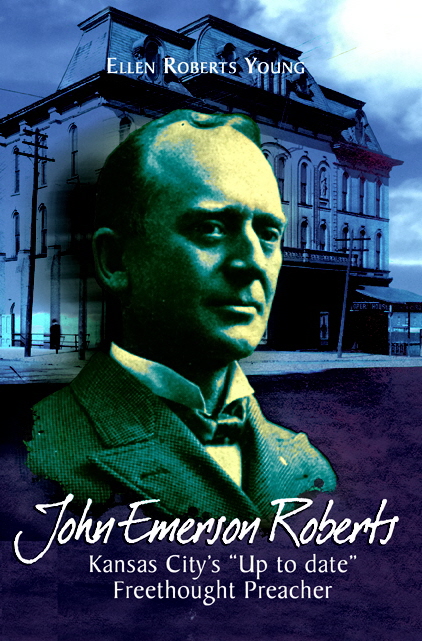
Up-to-date In Kansas City: From the Biography

Leave a comment

At the end of the nineteenth century, Kansas City was an exciting place to be.  Businessmen were optimistic, having survived a local real estate bust in the 1880s and the national economic crisis of 1893.  John Emerson Roberts’s “Church of This World” fit right in with the sense of progress.

People back in Michigan, where Roberts had grown up and where he returned each summer, took notice of his success.  In a long interview reported in the Grand Rapids Herald, Roberts was asked about his church.  He responded:

“We don’t deal with anything of which we have no knowledge. We have quit fooling with phantoms and ghosts and the future. We are satisfied to live in this world and to study life here rather than what we are to enjoy hereafter. We don’t lie about what we don’t know. As for prayer and that sort of thing, I can’t see any occasion for it. Christ never prayed in public.”

When the reporter suggested that the Gospel of John indicates otherwise, Roberts argued that that book was written long after the events, and that the writer had no personal experience of the case.  At the end of his article the interviewer referred to Roberts as “the Kansas City up-to-date minister.”

            In 1900, Kansas City was “up to date,” a phrase widely used at the time, in a number of ways. The “skyscraper” celebrated as “seven stories high” in Oscar Hammerstein’s lyrics for Oklahoma was actually ten stories tall. It was the New YorkLifeBuilding at 20 W.    Ninth Street. A few other buildings had reached eight stories by 1900. The city’s boosters were eager to make a national impression. They persuaded the Democratic Convention to meet there in July, in the Convention Hall they had built with private money the year before. They got more attention than they expected. Convention Hall burned down in April. A campaign began immediately to rebuild. City leaders assured the Democratic Party that the work would be done in time and it was—just barely. The convention itself brought in plenty of business but it was not an exciting event: The nomination of William Jennings Bryan was a foregone conclusion.


The excerpts above are from John Emerson Roberts: Kansas City’s “Up-to-date” Freethought Preacher (Xlibris, 2011).  For more information, see the Books page or contact me.

One Nation or Eleven?

Leave a comment

Are we one country?  I haven’t finished reading Colin Woodard’s American Nations, but it already helps me make sense of the chaos, the confusion, the peculiarity of the fall hysteria called a national election.  Woodard’s basic thesis is that eleven groups of people―ethnic groups, class groups, religious groups―came to this continent, beginning with the ones he calls “First Nation” who came from the west.  These eleven groups spread across the continent.  The group that got to any region in sufficient numbers first made its imprint on the culture in that place.  Others who came later, though they came from other “nations,” were absorbed into the existing culture rather than changing it.  The map of the continent showing these nations is a set of very wiggly lines. These lines rarely bear any relation to present state or even national borders.  The territories vary from wide to very narrow bands.  The map, which is on the front of the paper cover of the book, looks like an etch-a-sketch drawing gone wild.

Some of the “nations” make immediate sense.  In particular, the “First Nation” dominates part of Canada, and “El Norte” is the name given for the Spanish movement up from Mexico.  France had a significant influence in the areas now represented by Quebec and New Orleans.  The other nations take some study and persuasion.  Most of them were founded by the English.  The different classes and religious formations, however, produced very different views of what political life should look like.

I won’t go into all of Woodard’s claims and explanations here.  He might be horrified at my simplifications of his detailed arguments. The book is well written and an easy read in spite of the complications of his argument.  I recommend it.

To begin with the founding of the country, I learned long ago that the establishment of the government involved major compromise between the New England and the Southern ideas.  Woodard makes clear that even the language was different.  From the beginning New Englanders, because of their covenantal religious structure, were committed to participatory democracy in town meetings where everyone could speak, but expected considerable social conformity.  They were big on schools, since reading the Bible was important. The leaders of Tidewater Virginia, in contrast, were country gentlemen who expected “liberties” according to their class, and considered government a privilege and responsibility of the elite.

“Midlanders” the “nation” which first settled New Jersey, Pennsylvania and Delaware, were a mixed lot, Quaker, Dutch and German, who valued tolerance, with minimal interference in one anothers’ cultures.  A second group came in through Pennsylvania, settled in the interior and then moved down into Appalachia.  Woodard calls these “Borderlanders” because they came from the desperate border areas of Britain.  For the Scots, Irish and Scotch-Irish, the sense of community was in family and clan and they valued fighting skill, honor and independence.  “Freedom” to them meant being left alone, a contrast to the freedom of the Yankees to participate in government.

These groups spread west, so that the Midwestern states are divided in bands of different cultures, with Yankees in the northern sections and Borderlanders in the south, with a narrow strip of Midlanders in between.  My one sentence summaries of their different attitudes should make it clear that these three groups will be seeking totally different conditions in their governments.Yankees want to put everyone in school; Borderlanders want to be left alone.  Midlanders want to get along, both socially and economically.  Thus the Midlanders come to be the swing votes in the swing states.

Woodard claims that it was the Midlander vote going for Obama which gave him the win in 2008.  It will be interesting to see how he characterizes the 2012 election.  He makes me wish we had a lot more “Midlanders” in Congress.  My sense of the election results is that we, the country, are going to need all the tolerance we can get from our leadership.

A New “Church”: From the Biography

Leave a comment

John Emerson Roberts’s contacts with Robert Ingersoll, described in my blog of October 6, bore fruit in the fall of 1897.  From my biography of Roberts, here is a description of Roberts’s independent “Church” and how it operated:

The Church of This World held its first service in the Coates Opera House on September 12, 1897. In addition to Roberts’s lecture, which he still called a sermon, music was provided by Carl Busch. The service apparently consisted only of this music and the sermon with no offering, no hymnody, and certainly no prayer. It is interesting that the organization was called a church, given the comments Roberts made in the spring about the negative connotations of that term. The phrase “this world” was evidently taken from Ingersoll’s letter praising Roberts’s sermon about the boy who died in jail: “You are preaching a religion for this world.”

Carl Busch was a major figure in the music world of Kansas City.  Born in Denmark in 1862, he studied in various institutions in Europe.  In 1887, Busch was working in Paris, playing in orchestras conducted by Camille Saint Saens and Charles Gounod. The Danish vice-consul in Kansas City invited Busch to organize a string quartet and bring it to America. Busch did so, and spent the rest of his life based in Kansas City. Times were not easy for the arts. Busch organized a series of orchestras and programs, but between the economic troubles of the late 1880s and the 1890s, and the lack of developed musical taste among the well-to-do business class who were the city’s elite, support was not always sufficient. The position as music director for the Church of This World was at least steady work, though very part time; Busch was still employed there when his biography was written for Whitney’s Kansas City, Missouri, in 1908.

The Church of This World was set up with a board of trustees just as the Unitarian Society had been. The names of the earliest set of trustees are not known. The trustees are listed in the newspapers only in later years when there were stories of development or decline to report. The funding for the church was provided by supporters who paid for their seats; the cost ranged from $5 to $25 per year. This practice is comparable to the idea of pew rentals, which many churches used to provide a base of income; the theater seats were no doubt more comfortable than typical pews. Seats for those who just came in were free.

The sermons Roberts gave in that first year are lost.  In the fall of his second year, however, Roberts published a series of sermons as a hardbound book.  A few copies have survived.

These sermons show how his preaching and views had evolved. The first sermon was titled “The Imperial Demands of Progress.” The word progress had become a highly resonant term for Roberts. He begins with the idea that one has an obligation to participate in progress:
“Deeper upon enlightened minds grows the conviction that progress is the world’s supreme law. To contribute to that progress, to obey that law, is the cosmic business of everyone and of everything that is.”
While he sees this as a human undertaking, however, he has not become a true Ingersollian; he has not given up talking of God, of spirit and of the divine. He concludes this first sermon by saying,
“Let us trust the old, the common, the misunderstood earth. Let us hail the dawn of the day coming fast and sure, when all men everywhere shall see that the earth is divine, man is divine and God is all in all.”
Though “thought” and “reason” are among his favorite themes, Roberts also holds on to the idea that religion, as opposed to specific religions, is an element of life that will endure.

There’s that dawn metaphor again in the second quotation, an image Roberts used often.  Read more about his most unusual institution in John Emerson Roberts: Kansas City’s “Up-to-date” Freethought Preacher, available through Amazon from ERYBooks (or use the contact page).

Mutual Admiration: From the Biography

Leave a comment

John Emerson Roberts did not always preach on “orthodoxy” and theology.  One sermon he gave in November, 1895, was very topical: it concerned the death of an African American boy in the county jail.

Titling his sermon “Dead in Cell No. 5, Fourth Tier East” Roberts first relays the story in considerable detail.  Three boys had been caught stealing from a house they’d broken into.  Known to the police as troublemakers, they were sentenced to ten months to a year in the county jail.  Three months into the sentence, Willie MacManamy, age 11, died of pneumonia.  The arguments among those in charge following this event, which had taken place the Monday before Roberts spoke on the issue, were over who had to pay how much to whom to care for the body and release it for burial.

Roberts asserts, in spite of the volume of newspaper coverage, that “Society did not feel even a momentary acceleration in its modulated pulse-beats.”  Calling a child of the streets the “abridged edition of the people,” Roberts suggests that the child has great potential if only good seed can be sown on “the waiting soil of his virgin heart.”  But the time for such intervention is very short, and society fails to sow the seed because society itself is immature.  The philanthropic activity that exists is mostly selfish, an effort to keep the needs of others at a distance.  Roberts concludes by using the motif “if Christ came to Kansas City.”  He contrasts the number of well-appointed churches with the problems of street children and overcrowded jails.  The churches are no better than society as a whole.

The progressives who were beginning to seek to reform cities across the nation would agree with the way Roberts laid out the social problem.  Roberts, however, was not a reformer.  He was content to watch and wait, confident that society would in time grow up.

Roberts’s sermon was published in a local magazine called “Humanity.”  Robert Ingersoll was in Kansas City in May, 1896; while there he picked up a copy of the magazine.  After he got home he wrote to Roberts:

Rev. J. E. Roberts,

My dear Friend:

On my way home I read in “Humanity” – a sermon of yours in which you tell of the death of the child in jail.

The climate of that sermon is like a perfect day in June, and I write simply to thank you for delivering it.  No one can read it without having his heart touched and softened. —

You are preaching a religion for this world – for the living while they are alive and by all odds you are the best, the most enlightened, the most liberal, the most intelligent, the most eloquent minister, so far as I know, in the whole world.

With the greatest admiration, I remain

Yours always, R. G. Ingersoll.

“The climate of that sermon is like a perfect day in June.”  Roberts remembered this praise, long afterward referring to it as “that sermon has the breath of a day in June.”  It was a metaphor that stuck with him. “You are preaching a religion for this world” pleased Roberts too.  He knew now that Ingersoll understood that he, John Emerson Roberts, was on the same wave length – I shouldn’t put it that way, because “wave length” is an anachronistic term neither man would have understood, but it suggests a resonance between the two men.  They understood each other and admired each other to the end of Ingersoll’s life, which unfortunately was only a few years later.

Quotations are from John Emerson Roberts: Kansas City’s “Up-to-date” Freethought Preacher.  For more information see the Books page.  Ingersoll’s letter is one of four to Roberts included by Eva Ingersoll Wakefield in The Letters of Robert G. Ingersoll (Philosophical Library, 1951).

One for Fun

3 Comments

I’m sharing a poem today of which I am particularly fond because it was one of those rare ones that just came.  There’s nothing factual in it―perhaps it has the truth of a good story, flash fiction in poetic form.  Enjoy!

Decaf, Please

An old car knocks,
and an old man, thin hair
slicked like the teenager
he once was, asks me
to go with him,
leave the museum,
grab some grub, or a latte
(we’ve given up smoking).
Seize the day, he begs me,
a seizure might interrupt.

The era of ambience
is over – dimmed lights,
candles, appearances
that mattered in the eighties.
We pass up Starbucks
for a booth at the diner:
when the nineties’ bubble
burst we were thrown
back to essentials:
a man, a woman, a drink.

“Decaf, Please” was first published in Into the Teeth of the Wind and is included in my collection Accidents (Finishing Line Press, 2004).

Rereading Sacred Text, With a Poem

2 Comments

In my last post I mentioned in passing the feminist interpretation of the Biblical record.  There have been many kinds and layers of this.  I was involved in a number of them.  I attended meetings of the Evangelical Women’s Caucus.  I read Daughters of Sarah and Free Indeed, two periodicals produced by women seeking to reinterpret what they had been taught.  Both survived only for a time, which is typical of small magazines of all kinds. Free Indeed took its name from the passage from John, “If the Son makes you free, you are free indeed.”  Daughters of Sarah published a few of my poems.

I learned to think for myself through looking at the many different women’s approaches to scripture.  I had gotten through college as a very good student who believed what I read, whether it agreed with my own experience or not.  Amid all the women’s perspectives, it was necessary to make choices, and one of the keys to those choices was “does it fit with my experience” instead of “does it fit with what I’ve been taught.”  This approach was the gift, for me, of feminist interpretation.

There are many stories about women in the Bible.  Some are extensive, some seem to be only fragments.  At one time I concluded, “The named woman is the one who got into trouble.”  Here is a poem I wrote during this period.

Sirens

As I circle stony islands
where ten foot tides turn ledges
into granite waves,
threats to an outboard propeller,
I hear Delilah sing
with Jael and Judith.

On a bluff of ragged rock
these three women, servants
to god and country, sing by turns
of Sisera, Holophernes, Samson,
of tent peg, sword, and scissors.
The song repeats like blues,
like scissors, rock, paper,
break, cover, or cut
to the next story,
the next severed head
served up on a fine platter.

The trays have corroded
on which the tribes they served
once served them empty honors.
Their hungry song blends
with calls of cormorants and gulls.
From such contagious sorrow
I flee to deeper water.

Among other things, this poem is meant to suggest that the situation for women is similar on both sides of the conflict; Delilah was, in the history, an enemy of Jael and Judith, yet I imagine their stories were similar.  I’ve placed them not in the Mediterranean but on the Maine shore, which I know, can describe more vividly, and have used to reflect their mood and situation.

Many of the women whose work I was reading in those days gave up on the patriarchy of Christianity, and Judaism as well, altogether; some became Wiccan.  I stayed in my tradition, but continued to rethink the reading of Scripture.  Now I look at my sacred texts from many points of view.  Some days I take the words quite literally, but I am convinced that, however much inspired, they were written down by people who could only communicate in the language of their time.  Other times I am struck by how much of our God language is, and has to be, metaphor.  Always I find it a rich source of story, language and reflection on the human condition.

“Sirens” was published in Daughters of Sarah in 1990.

A Pure Beginning: Reflections and Poem

2 Comments

In the nineteenth century, when John Emerson Roberts was a liberal preacher, there were many people who believed in an original “pure” Christianity, before things got messed up with doctrines and debates and rules.  One such person was Alexander Campbell, whose follower were first called “Campbellites.” They eventually became the denomination Christian Church/Disciples of Christ.  Another case was that of Joseph Smith; he  avoided creating one more denomination among many by developing a whole new Church, the Church of Jesus Christ of Latter Day Saints.

In the twentieth century there was another kind of belief in an original Christianity as feminist scholars like Elizabeth Schussler Fiorenza gathered together clues of the roles of women in early Church communities, before the bishops made them second class members.

Current scholars recognize plenty of evidence that there was no original “pure” Christianity.  The letters of Paul reflect lots of discord: “You shouldn’t eat that!”  “You shouldn’t do that!”  “My way or the highway!”  In fact, the writer of the Acts of the Apostleswhom we call Luke may have been the first to imagine a state that never existed, one of harmony and agreement among all.

What I imagine in the early church is a stronger fellowship.  But it may be that strong fellowship requires a common danger.  Those who see “true Christianity” as beleaguered in today’s “secular” culture, probably are able to build such fellowship more easily than others.  Here’s my image of then and now:

Twilight

The half-light of half-learned lessons
cuts us off from elders
of the sharp-edged pagan years.
Outlined by evening sky
they walk toward prayer,
leaning over their lamps.
By flickering light they stand
in corners cut in damp earth
holding each other tall.

Old story told once more,
we rise from cushioned pews,
let fall each other, uninstructed
in the catch of shifting weight.
Shadows of wistful wishes wax
in failing light.   The dark
is out there.  Who can teach
the bending into it?

I don’t recall what darkness concerned me when I wrote this poem.  Perhaps I was just discovering that darkness is a part of life, not to be avoided.  I learned through dance that catching one who falls can be taught; we were also taught how to allow ourselves to be caught.  It’s the same with emotional support – we can learn to give and to receive, but it is something we do need to learn.

Thanks to Allen Matlins for returning this poem to the light by posting it on his blog last November.  It was published in Christian Century in 1983.  Rediscovering it has led me to look at other poems I wrote about that time, to ponder how things and people change over time, and to find several which are still “good enough to share.”

Popular Preacher, Part II: Rhetoric and Religion

Leave a comment

When John Emerson Roberts did his five part series on The Inevitable Surrender of Orthodoxy, he set up a series of parallels, a good rhetorical device.  The second sermon was on “Two Gods” the God of vengeance and the God of mercy.  The third sermon, on “Two Bibles,” contrasted the Bible, valuable as a record of human development, with the natural universe, “the only book God ever wrote.”  The fourth sermon, “Two Plans” he used mostly as an excuse to discuss and dismiss old ideas of the atonement.  “The necessity of an atonement disappears with the old idea of a capricious and changeable God,” he concluded, ignoring his own earlier comments on a God of judgment vs. a God of mercy.  A rhetorical flourish.

Only in the final sermon of this five-sermon set did Roberts turn to more positive thoughts.  It’s another parallel, this time between Jesus and Voltaire.  This idea was not new with Roberts; he borrowed it from Victor Hugo, who had spoken on the occasion of the hundredth anniversary of Voltaire’s death in 1878.  In fact, a good third of the sermon is straight from Hugo, though Roberts does not admit it.  This is normal for preachers; they are not required to identify their sources.

Voltaire was a popular freethought hero in the United States in the second half of the 19th century.  Born Francois Marie Aroeut in 1694, he was a poet, playwright and philosopher who challenged authority at every turn.  He wrote satires about church and society.  Of his works, one that survives today is Candide – in large part because Leonard Bernstein made an opera out of it.

One hundred years ago Voltaire was much better known:
●  In 1866, Voltairine de Cleyre was named after him.  After enduring education in a convent (her parents thought it was the best education available to a young woman) she became an atheist and an anarchist.
●  In 1879, the Music Hall was built in Chicago partly to provide a platform for David Swing, a liberal preacher who had left the Presbyterian denomination.  Voltaire’s bust was included along with those of Moses, Mozart and other heroes of faith and music.
●  Clarence Darrow, who had admired Voltaire since his youth, found him a profitable lecture topic in the early 20th century.

Roberts begins his discussion of Voltaire with a strong metaphor:  “The plain is habitable because the mountain is beyond,” he says, and continues:

Voltaire was the mountain.  Rugged, defiant, implacable, lightning-scarred, storm-enveloped, immovable, august, sublime, he towered above Europe and the eighteenth century with unspeakable scorn for superstition, secular or sacred, and with unquenchable devotion to reason and light.  Kings exiled him.  Police officers arrested him.  Bastilles and prisons confined him.  Ignorance hated him.  Superstition execrated him.  The priesthood denounced him. . . .

What has this to do with Jesus?

There are of necessity two kinds of prophets.  One shows the way to heaven, that is to moral health, to sanity, to a consisten and reasonable faith and to kindness toward men and reverence toward God
Such was Jesus, and such are all great souls who, from the spirt and genius of the world of matter and of man, imbibe the thought of God.

Voltaire is another kind of prophet, one of those “whose visions disclose the abyss towards which the unreasoning haste.”  Roberts’s argument requires the assumption that religion in Voltaire’s time had reached a very low point.  Voltaire, Roberts says, “rescued it from ecclesiastical asphyxiation and gave it light and air.”

After going at length into the contrast of Jesus and Voltaire as two types of prophet, Roberts brings them back together:

The church in all ages has put dogma first, charity and tolerance last.  Christianity today is dogma plus all the virtues that support the social order.  Jesus reversed that method.  Voltair reversed that method.  Jesus was called in his own day a heretic, and would be called a heretic now.  Voltaire was called a heretic, and would be called a heretic now.  But God sends such heretics among men to sweeten life, to establish justice, to illuminate the true, the beautiful and the good, to plead for humanity and for God and prevent religion from perishing from the earth.

Roberts was carried away by his own rhetoric, and so was his congregation.  He filled a 500 seat sanctuary with his sermons.  It is quite a stretch to call Jesus a heretic, since the Judaism of his time was both varied and non-dogmatic; the charge of heresy requires a single controlling authority.  Roberts is reading back from his own experience and his own era.  There is, however, some truth in his claims.  Christianity has always been at risk of becoming a prop for the status quo: “dogma plus all the virtues that support the social order.”  Roberts seems to be putting his hope in a new Voltaire, rather than a prophet like Jesus.

This post is an expansion of material in John Emerson Roberts: Kansas City’s ‘Up-to-date” Freethought Preacher.
John Emerson Roberts, Popular Preacher: Excerpts from the Biography

2 Comments

John Emerson Roberts left the Baptist church in 1884 because he no longer believed in hell.  He still believed in God, and he was quickly accepted into the Unitarian fellowship.  Just three years after his rejection by his Baptist congregation, Roberts was back in Kansas City as a Unitarian preacher.  He was even more popular as a Unitarian than as a Baptist, which is interesting because the Unitarians, although much more conservative than in our time, were at the liberal fringe of Christianity.

Roberts still believed in God and could speak eloquently of that belief:

         We cannot get rid of God.  When the last analysis has been made, when we have dissected to the uttermost, when we have said the last wise word about matter, force and motion, then in matter, making it what it is; in force, its final energy, in motion, its unexplained residuum, is that subtle, awful omniscience―there is God.  To eyes that see, no fact should be plainer than this―that nature is everywhere a manifestation of the Infinite; that all things that are, all things everywhere; show forth behind all appearances real, in all mutations, immutable, in all and over all, that the supreme fact of the universe is God.

What sort of God is this?  It is not a personal God, who would be active in the affairs of individuals.  The “final energy” of force is certainly an abstract concept.  Roberts’s congregation loved this kind of language.  So did the news reporters; The Journal reporter wrote:  “This sermon was one of the most eloquent Dr. Roberts has delivered during his pastorate, and at the close he was warmly congratulated by many of the large congregation which listened with closest attention throughout.”

In 1895, Roberts gave a series of five sermons under the title, “The Inevitable Surrender of Orthodoxy”:

The title had been used by Roberts’s colleague, Minot Savage, in 1889 for an article in the North American Review.  For both Roberts and Savage “orthodoxy” meant Calvinism, the stern form of Protestantism which emphasized the fall of man and the freedom of God to choose who would be saved, the rest condemned to a hell made vivid in Jonathan Edwards’ sermon “Sinners in the Hand of an Angry God” back in 1743.  Though most churches had loosened up a good deal (many Baptists, for instance, focused on the individual’s choice to accept salvation) these doctrines continued to be expressed and defended.  It was the incongruity of a God of love and an eternity of hellfire which brought many to liberal religion and drove others away from religion altogether.

While Roberts had tried gently to persuade his Baptist congregation of the seriousness of this incongruity in 1884, in 1895 he was speaking to people whose ideas had developed as his own had.  He could really tear into the issue.  Using inequalities of wealth as a parallel, he describes the doctrine of hell as one which “creates a monopoly of happiness, and joy and favor of God for endless ages in the interest of a few and dooms the uncounted millions to a place compared with which a poor-house were a paradise and a penitentiary a palace of delight.”   Is this a reasonable doctrine? He almost explodes in response:

            No!  No! By all the sanctions of reason, no! By all the unsyllabled persuasion of the moral consciousness, no! By all the sanctity of man who bears, though marred, the image of God.  By the pathos of human struggle and the pleading of human hope.  By the eternal justice of the Infinite God, no! no!

This exclamation is in a sermon called “Two Plans.”  Clearly, Roberts doesn’t think the threat of hell has any part in a good God’s plan.  He doesn’t line out a contrary plan, but he is sure of this:  “This world and all the worlds belong to God.”

Another sermon in this five part series gives us information on how Roberts is thinking about Jesus.  I’ll discuss that next.

For more on John Emerson Roberts: Kansas City’s “Up-to-date” Freethought Preacher and how to obtain a copy, see the Books page.

Reflections and Poem: Habit

2 Comments

Habits: We need them to survive.  There’s no way we could get anything done if we had to make a decision about every step and action of getting up, getting dressed, preparing breakfast, or preparing for sleep.  It was a dental hygienist, instructing me in flossing my teeth, who told me, ‘It takes four months to make something a habit.”  That’s not very long in the grand scheme of things, but it requires constant attention until the habit takes hold.

There are habits of action and habits of thought.  Prophets, I would say, disrupt our habits of thought.  Prophets are not soothsayers, tellers of the future.  They tell us things we might have seen or understood if we had been looking from their perspective.  They asked us to “think outside the box” back when that was not yet a cliché.

There are habits also of attention: stopping to look or listen as we carry on our habitual activities.  I wrote about my interest in William Paley in a blog back in May (May 9).  In his Natural Theology, published in 1802, Paley, an Anglican clergyman and theologian, asked his readers to pay attention to detail, from the smallest features of the eye and ear to the way plants and insects interact on a summer day.  For Paley this was all evidence of God’s good creation.  But such attention to nature is not bound to any particular theology; many religions suggest this approach to the world, as a way of really seeing, of paying attention to what is.  I tried to capture Paley’s approach, which suits my world as well as it does his very different world view, in this poem:

Habit

Alert to the ordinary, caught
by wonder at small creatures,
hidden muscles, as thumb or
toe is wondrous to an
infant, he has no
mantra, no method
to teach this habit of
attention, wonders at
the lack of wonder
in those who cannot stop
to look, who only admire
the new, the bold, sharply
chiseled lines, contrasting
colors that shout most
loudly in the constant press
of seen and sensed that
batters them until
like overbeaten dough
they lose their power
to rise to admiration, to
wonder at the marvels of
the bodies they inhabit.

“Habit” is included in Ascent: Five Southwestern Women Poets (2011).  See more on Books page.

Older Entries Newer Entries