Home

Recommendation: Sandra Kohler’s “Improbable Music”

3 Comments

In the beginning of the poem, “White,” Sandra Kohler writes

I go around half the time thinking I have
a fatal illness, and I do: life.

In Improbable Music, Kohler observes this condition minutely.  It is the illness of dealing with the dying of others.  It is the effort of trying to grasp and hold on to the ever shifting self.

The world presented in this book is the world many of her readers live in: the complicated world where family relationships occupy most of our time and energy. As keenly as she observes the moods of these relationships, Kohler observes the shifting backdrop of nature: sky, trees, birds.

The first section of the book focuses on extended family relationships; the fourth and final section pairs with this, focusing on the intimacy of a long marriage.  The third section acknowledges the impact of the larger world on the domestic, picturing families caught in major crises of our time: Bosnia, Palestine, Sierra Leone.
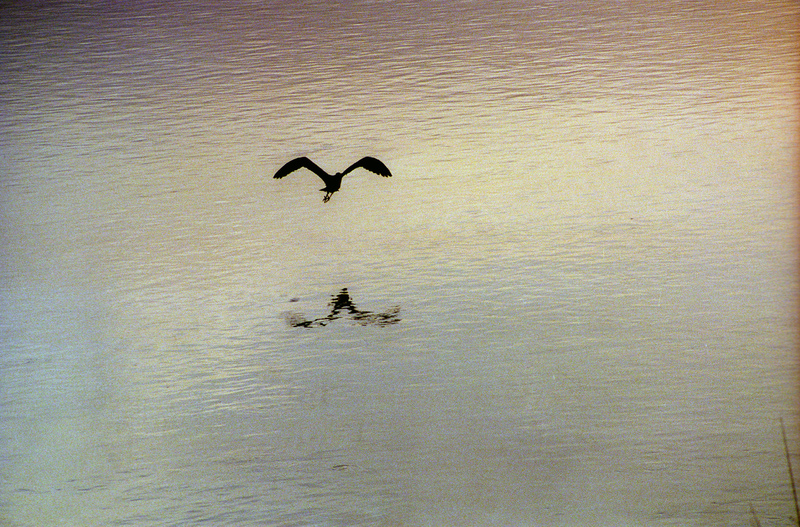
Heron in Flight

The second section is in some ways my favorite; it focuses on the natural world, but with a delightful twist in the character of Heraclitus the heron.  Kohler admits that she may be giving this name to more than one heron.  She writes in “Herons Present and Absent”:

The river without
herons: a diminished
thing, lifeless,
dispirited.
They are my wild
swans, my muse
of absence.

And later in the same poem she returns to uncertainties about the self:

Is it the herons
that have returned
or my ability
to see them?

Some poems are written in short lines like those quoted above.  Others have longer lines with complex syntax.  Most of the poems are long, many in sections, which allows plenty of time for exploring the shifting self.  One of the shorter poems, “The Cup,” captures uncertainty, ambivalence and shift:

This morning, the last of the year, I use my old cup.
The cup that is always there.  Ten days from the solstice:
ten, twelve minutes more light?  Not even that?  I don’t
know.  Cold, I am wrapped in my Guatemalan blanket.
The cold is solid, settled.  My son calls me a sore loser.
That’s it exactly: I ache with losing him.  The cup of losses.
A glitch in my side, an ache, the slow stitchery of a wound
healing or opening.  I’m suspended, detached, unused.
The cup of waiting and the cup of sighs.  How this moment
will be remembered or forgotten depends upon the fact
of morning, on the ice on the creek, on the thin layer of
cloud that screens the horizon’s uniform desolation.
The cup of loneliness and the cup of longing for solitude.
We dream what belongs to the night but the day wakes
echoes of old wars, scarred shadows of scathing blows.
The cup of insecure anxious needing to matter, impress
the self on the world.  In the face of failure, isolation, loss,
we utter variations on a singular theme: I, I, I.  We don’t
want to believe this of our life, though it is ratified by
the minutes of increased light burning on the partially
frozen stream.  The cup of ego, the cup of emptiness.

Every claim to an “I” is a variation; every cup contains a piece of the self.  The weather seems to echo the self, but does not.  Even the night’s dreams and the day’s shadows cannot be sorted out.  Kohler digs deeply into the flux that underlies every claim of identity and offers no answers.  The reading satisfies as the songs of a fellow traveler.  This is not a quick read, but a book to take one’s time with.

A Poem for July 4

4 Comments

Parade Float, 2012

For many years we have celebrated July 4 at our extended family’s summer cottage in Maine. After the small town parade in the morning, we go home to prepare our potluck dish and gather with acquaintances in the afternoon for a party.  Seeing people we haven’t seen for a year can be complicated, producing the sensations in this poem:


Hail, Festival Day!

First the parade: old
cars, fire engines,
floats carry costumed
neighbors.  Then
the party: annual
acquaintance makes
conversation hard.
Even the names slip
from these not quite
strangers: is this
the grandmother who
reported two weddings,
or the mother whose
child had cancer?
An interior parade
imprints names,
connections: she’s
Mary’s daughter, he’s
Frank’s houseguest.
Is Joan the artist
or the realtor?
Brain tires with
body: oil of politeness
cannot loosen stiff
ligaments, strained
from standing
so long at attention.

What Use Is Metaphor?

9 Comments

I believe we think in metaphor.  I’m sure I do.  All the dead metaphors lying around suggest this: melting pot, wall of separation, war on drugs, information superhighway, to mention just a few.  Many people, unfortunately, discount metaphor and this limits their thinking.

If we think in metaphor, this would be the way we think about deity, about religion.  It was reading the work of the medieval Jewish philosopher Maimonides which first made me aware of this.  He asserts that we can only talk about God by analogy.  If we say God is good, we are only saying that this attribute of God is in some way analogous to the qualities we admire in a person we call good.  It makes sense that, if we are creatures, our Creator is beyond our understanding.  Our ideas can at best be vague approximations.

The problem is that modern popular language dismisses metaphor because it is not “true” by which is meant that it is not factual.  The reduction of “truth” to “fact” is unfortunate, because it easily constricts reason to “thinking about facts.”

Beginning in the mid-19th century, those who wanted to gain public attention for new religious ideas presented them in scientific language: the mediums of spiritualism tried to present their work as science; Mary Baker Eddy not only called her belief system “Christian Science,” her basic text is The Science of Health With Key to the Scriptures.  Similarly Madame Blavatsky presented her ideas, to which she gave the name Theosophy, as science.

In our time the dominant popular world view limits the reading of sacred texts because if the only truth is fact, then scripture must be either factual or false.

Fortunately one can escape this trap and think more broadly.  One can read one’s sacred text as human interpretation.  One can recognize that all language about God has to be metaphoric (including such terms as “Father” for God),.  But those who do read their scriptures in this broad way find themselves on one side of a very large gap between two kinds of believers.  And those who take their sacred text literally have the strength of popular scientific thinking on their side.

Some people who are raised in a literal belief system abandon it to find other levels of awareness through other traditions.  Those other levels inform all religions, including the one the former believer has left, knowing only the version diminished by reductive language.

I choose to stay in my tradition and explore its alternative meanings.  This is hard to explain to both literal believers and non-believers.  It is probably wiser to hint at it in poetry than to write explanations.

The Giant Lizard of Lounsberry Beach: A Fable

Leave a comment

Tree Lizard on Beach

A winter storm in Penobscot Bay had carried the tree lizard far up the beach and left him there.  When the weather calmed, he found himself near stairs and beside a very large rock, the largest in sight.  “Good,” he thought, “he will know.”

“Excuse me,” Lizard said, “ Do those stairs lead somewhere?  To a castle perhaps?”

The rock frowned.  “Castle? No castles around here.”  The rock said no more.  He didn’t care for company, though he was feeling fortunate.  If the lizard had been pushed a few yards closer, his head would be resting on the rock’s shoulder.

“I wonder, then,” Lizard said after a few moments, “What my purpose is.  Who am I here to guard?”

There was a murmur around his feet that grew into snickering, as the small stones chattered to each other.

“Hush!  All of you!” boomed the rock.  “What’s this fuss about?”

There was more murmuring.  “He doesn’t know what he’s here for!” one finally said aloud.

“And you do?” asked the rock, his voice still loud with irritation.

“Yes, we do,” the bold bit of granite said.  “We’re here because God put us here.”

“Hmmph!” was all the rock had to say to that.

“Evidently,” the lizard began, looking down at the stones, “You don’t know the difference between cause and purpose.  I know how I got here; the sea carried me.  My question is, what am I to do now that I am here?”  The stones made no response; the discussion was over their heads.

“I had wished for a castle to guard,” the lizard said.  “I guess that’s not to be.”

The rock knew it was his turn to speak, but he saw no point in developing acquaintance with one who would only be carried away again: if not next winter, in another winter to come.  This intrusion on his beach would be easier to endure, he felt, if conversation was discouraged.  He turned his attention to the water.

At night the lizard bends his branch-forelegs down and rests.  When the high tide comes in, he laps the water.  He was carried by it so long it tastes comforting, like home.  All day he stands, observing sea, sky and the rock-strewn beach, alert for whatever he was put there to do.

The possibility that he is there to inspire a story does not occur to him.

The moral: If you long to be useful, don’t limit your options.

Photos by Ellen Young

Social Justice Then and Now: A Poem

5 Comments

“Social Justice” is a poem in my Paley series, drawing on William Paley’s Natural Theology, published in 1802.  First, a quote from Paley:

Again, there are strong intelligible reasons, why there should exist in human society great disparity of wealth and station.  Not only as these things are acquired in different degrees, but at the first setting out of life.

Now, my response:

Social Justice

Paley never said society
should run like a watch, nor
that it operates as God intended,
efficient as a well-oiled mill, yet
he wanted even revolution to
be rational, restrained: no mobs
dragging out Tory sympathizers,
no armies beating back
impoverished protestors.

I stand at the Federal Building,
restrained by fear, as rational
friends, frustrated by the tick,
tick, tick of same old, same
old injustices, lie across doorways.
Their calculated choice includes
awareness that effects are often
not proportionate to causes,
anything can happen.

This poem is included in Ascent: Five Southwestern Woman Poets.  See Books page.

Celebrate World Humanist Day

4 Comments

World Humanist Day is indeed an international holiday.  Various groups celebrated a Humanist Day at different times until the International Humanist and Ethical Union (to which many established groups such as the American Humanist Association belong) settled it on June 21.  Most years, this is the summer solstice; in 2012 the solstice arrives late on June 20,thanks to the leap year correction.

The IHEU notes the solstice connection, but doesn’t say why the date was chosen.  Their website suggests a picnic on that day, which suggests that the organization has a northern hemisphere bias: people in Australia or South Africa might find that suggestion inappropriate due to weather and the early dark.

The idea “humanism” has been around at least since Auguste Comte (1798-1857) wrote about a “religion of humanity”, but in America, at least, the term was not in wide use until the 20th Century.  Before that most people could not imagine ethics apart from a creed or commandments to support it.  Arguments over doctrine were intense; hence the term “freethinker” was in wide use.  Freethinkers, however, had a range of ethical stances.

The IHEU defines humanism in this way:

Humanism is a democratic and ethical life stance, which affirms that human beings have the right and responsibility to give meaning and shape to their own lives. It stands for the building of a more humane society through an ethic based on human and other natural values in the spirit of reason and free inquiry through human capabilities. It is not theistic, and it does not accept supernatural views of reality.

Until well into the 20th Century popular ideas of ethics were drawn largely from the Bible and were focused on the individual.  Some things were agreed upon (e.g. killing is wrong, you should help your neighbor) while others (slavery and women’s rights) were matters of great debate.

Robert Ingersoll was one of many we would now call humanists.  He gave a lecture entitled “Liberty of Man, Woman and Child,” which expresses his view on personhood.  And his “creed,” as he said in slightly different language on several occasions, was:

Happiness is the only good.  The place to be happy is here, the time to be happy is now, and the way to be happy is to make others so.

With a view of the bay from my window, I think I’ll skip the picnic.  I will enjoy the long day, relish the early morning return of the light, and get on with the business of seeking to make the world a happier place through writing.

[Robert Ingersoll plays an important role in the life of John Emerson Roberts.  See Books page.]

Thinking About Form, II

Leave a comment

Robert Duncan, The H.D. Book

I don’t recall what review comment spurred me to ask for Robert Duncan’s The H.D. Book for Christmas.  It has been a long read, full of stimulating ideas about poetry and poems.

Duncan has an interesting take on form, shaped by his notion of what the work of poetry is.  The H.D. Book places H. D. in the context of her two colleagues, once close, later moving in different directions, Ezra Pound and William Carlos Williams.  Duncan sees each of these as working in poetry not as a life’s work in the sense of a career, but as life work.  The driving force is this: “that in our concern to redeem, to save or keep alive the wholeness of what we are alive, we discover the work to do.”

Duncan describes the overall work of H.D., Pound and Williams as an organic process: “They move in their work thru phases of growth towards a poetry that spreads in scope as an aged tree spreads its roots and branches, as a man’s experience spreads; . . .”  This organic property appears also in individual poems, the poet committed to the poem until it reaches the shape that belongs to it.

Structure, Duncan writes, “is not additive, but is fulfilled only in the whole work.”

He contrasts the work of Marianne Moore, using “He ‘Digesteth Harde Yron’” as his example:

The number of stanzas is arbitrary.  The poem presents examples of itself, a series that may be “complete” at any point because, otherwise, it is extensible as long as the poet’s rationalizations continue.  The form of the whole in conventional verse does not rest in the fulfillment of or growth of its parts toward the revelation of their “life” but in the illustrations of the taste and arbitration of the poet.

Is Duncan asking too much?  In his desire to lift up H.D. and her work, has he overstated the case?  Or is he simply explaining why it is that the truly great poets are intimidating as well as inimitable?

His approach challenges the reader to take her own creative work with utmost seriousness.

Thinking about Form and Content

Leave a comment

I have long been of two minds – or more―about the relationship of form and content.  Which comes first?  Which, in a poem, becomes primary?  They’re linked, but how?

I’ve found an explanation worth sharing from Paul Horgan and a stunning example of how they can work in satisfying tension from Ellen Bryant Voigt.

Paul Horgan, in Approaches to Writing (rev. 1988) connects form and content organically, saying that the initial impulse (idea) can only become a finished work

if as early as possible it begins to find, in the writer’s imagination, the precisely appropriate from for its fulfillment.
Once that is glimpsed, even incompletely, the subject, the idea, is safe . . .

In other words, the planned form gives the idea (content) staying power in the writer’s mind.

In Kyrie Ellen Bryant Voigt took an unusual subject for poetry, the influenza epidemic of 1918-1919, and combined it with a tight form: a series of sonnets and near sonnets.  The structure is able to carry the confusion, fear, anxiety of the time, as well as a variety of characters and crises, and to keep them in a frame; the contrast increases their power.  I think it must have helped greatly in the composition process as well.  Here is my favorite of the sonnets:

To be brought from the bright schoolyard into the house:
to stand by her bed like an animal stunned in the pen:
against the grid of the quilt, her hand seems
stitched to the cuff of its sleeve―although he wants
most urgently the hand to stroke his head,
although he thinks he could kneel down
that it would need to travel only inches
to brush like a breath his flushed cheek,
he doesn’t stir; all his resolve,
all his resources go to watching her,
her mouth, her hair a pillow of blackened ferns―
he means to match her stillness bone for bone.
Nearby he hears the younger children cry,
and his aunts, like careless thieves, out in the kitchen.

Though there are no end rhymes, this follows the sonnet form of four quatrains of increasing intensity and a final couplet which wraps up the poem in what goes on outside of the boy: all of it painful for the him.  We never learn the boy’s name, but he will appear in other pieces, trying to cope with the changes after his mother’s death.  This is powerful work.

115 Years ago today . . .

Leave a comment

On this date, June 9, 1897, John Emerson Roberts left the Unitarians to go out to lecture on his own.  He had met Robert Ingersoll, that famous agnostic, and they found themselves kindred spirits.  Ingersoll wrote to Roberts, “You are preaching a religion for this world.”  Roberts told a news reporter about Ingersoll, “He is the greatest apostle of liberty and reason and fraternity.”

Both men called themselves agnostics.  What did it mean in their time?  A religious man wrote “We must stand for faith in God as against atheism, and for faith in immortality as against agnosticism.”

Atheism is clear enough as not believing in God.  Isn’t agnosticism simply a refusal to make a claim where one has no knowledge?

In fact, neither Ingersoll nor Roberts ever challenged belief in immortality.  The desire to believe in a future life, even among educated people, was so strong at that time it might have hurt their careers to argue the matter.  Speeches at funerals, even freethinkers’ funerals, left the option open.

Roberts himself had no wish to challenge the belief.  He said in one lecture, give in 1909:

If this life ends all, then nature is the infinite deceiver, the colossal liar,. . . . and though I do not know it to be a fact and cannot prove it, yet I will trust that when the world is old and the sun is cold and the infinite future is unrolled, man shall yet continue conscious, intelligent, aspiring, deathless, having life and having it more abundantly.

Roberts envisions no traditional heaven, but he wants to believe that life goes on, and until science can persuade him it is impossible, as it could not 100 years ago, he chooses to believe that it will.

The science which underlies arguments about belief has changed significantly since Roberts’s time.

My biography, John Emerson Roberts: Kansas City’s “Up-to-date” Freethought Preacher, is available from Amazon, or from the author.  See more on the Books page.

Return, A Poem

5 Comments

This is especially for my writing colleagues who juggle multiple goals, roles, and responsibilities.  In the last scene, picture whatever god, goddess, muse or other comforter helps you get your balance back.

Return

Kitchen utensils return
each to its proper tray
like parents home
from work.  I celebrate
routine, but when
habit takes over,
hares in my head give
quick, thoughtless
answers.  My heart jerks,
a connection breaks.

The burn in the rug,
a dent made in the table
thirty years back
when a two-year-old
discovered a hammer
recall those absent.
I pour a glass of wine for
the kitchen god who sits
at the table with me
late into the night.

“Return” is included in my chapbook, The Map of Longing, (Finishing Line Press, 2009) available on Amazon, or inquire on the Contact page.

Older Entries Newer Entries