Home

Some Words and their Innuendos

2 Comments

Warning: This post gets political.  As we approach July 4, a couple of words have struck me with unusual force.

July 4 Parade, 2013

July 4 Parade, 2013

“Democracy and capitalism have both been hacked.”  Al Gore writes this in The Future, his current book.  I realize it is the first time I’ve seen “hacked” in serious writing without reference to computers.  So the elites who, whether from greed or ignorance, want to preserve the status quo are “hackers”?

Dictionary.com gives the original meaning of “to hack” as “to cut, notch, slice, chop, or sever (something) with or as with heavy, irregular blows.”  From this, it is clear that computer hackers were seen as cutting or chopping into (or breaking and entering) computer files.

The statement about democracy and capitalism, then, seems to mean that certain parties are bent on destroying the very structures that have made it possible for them to get where they are.  Like Jack, cutting off the beanstalk from above.  Being in the clouds may distort the perspective.

The second word example is a pair of words.  The word “iniquity” appeared in one of today’s scripture readings; it was a passage from that difficult book , the Letter to the Romans.  The reader did not pronounce the word quite clearly enough: it came to my ear as “inequity.”  What a difference a single vowel makes!  It turns out, however, that while “iniquity” is taken usually to mean wrong-doing, and “inequity” has to do with a lack of equality, both go back to the same root―Latin for not equal―and the base meaning for both is a lack of fairness.

Many of us, especially those in the middle or at the bottom economically, know that structural inequity is iniquitous. How could one make that vivid to those who have not been paying attention?

And how do you stop hackers who are supported by the Supreme Court?

Goodreads Giveaway for Made and Remade

1 Comment

Paley front coverI am offering two copies of my book Made and Remade in a pre-launch giveaway on Goodreads.  Go to https://www.goodreads.com/book/show/22163304-made-and-remade if you’d like to sign up.

The proper launch for the book will be in September, with readings in Las Cruces.  If you’d like to invite me to come to your area and share a reading with someone, I can do that too!  I’ll be lining things up soon.

If you don’t win the giveaway, which ends July 20, use the contact page if you’d like to get a book.


This is the opening poem in the collection:

Obsession

for Polly

I’m fixed on this book
like a three-year-old on trucks,
a five-year-old on dinosaurs.  You could
make it my motif, were I young
enough for birthday parties.

Language to sift and savor
artfully, skillfully portrays
a world of fixed order, art
and skilled contrivance.
This balance
wavers as I wonder
at that world’s collapse in
swings, cycles, evolving
life, shifting earth.

Mechanistic views dissolve in
reality’s wash and rub.  I
turn and read again for fragments,
museum quality gems of evidence
for a long dead argument, a fresh fix
of fine writing, proceeding
from a fine mind.


Summer Solstice and a Celebration

3 Comments

Today is a Lowellesque June day.  It’s nice of the clouds and other natural forces to let the sun come through boldly on this longest day (in the Northern Hemisphere).  Here the day is 15 ½ hours long, sunrise to sunset.

 Trees in Sunlight


Trees in Sunlight

The solstice has gradually become more the “other New Year” for me than September.  This is partly because I now live in a place where school starts in August and other things rev up at different times.  It is also partly because I have no one returning to school―except myself, to help some elementary school students with their reading.

June Wildflowers

June Wildflowers

When I return from vacation in mid-July I am at once involved in planning, in sorting submissions for Sin Fronteras Journal, and in a thickening schedule of other activities.  So I spend June days walking on the rocky beach and wondering whether there are things I should do differently this time around.  The place where ocean touches land is said to be an edge where things can arise from the depths, perhaps displacing the set of thoughts, plans, ideas, that lead one into the same old patterns.starting off

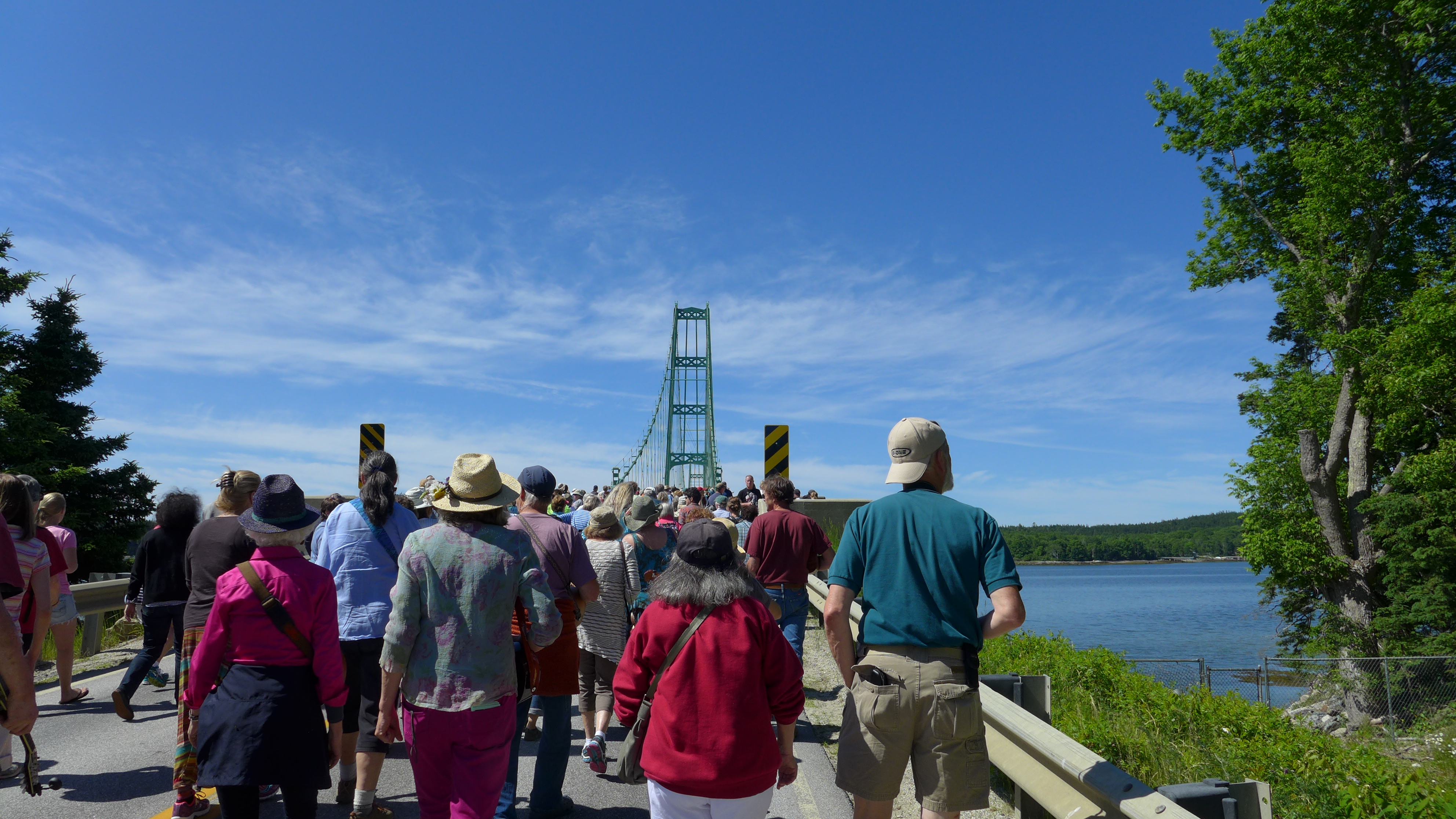
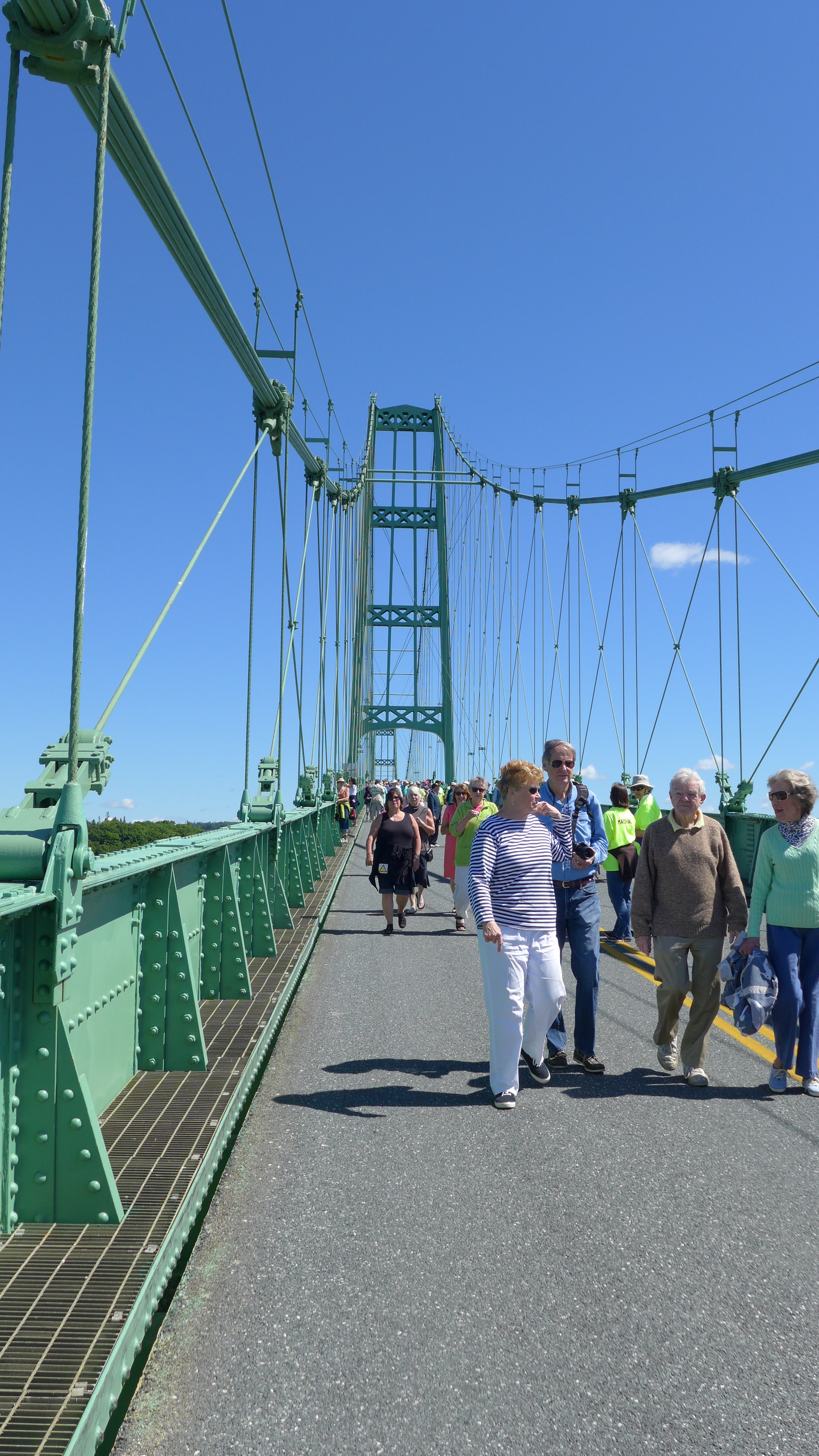
This June day is also a great day for a party.  Deer Isle and Sedgwick celebrated the 75th anniversary of our “great green bridge” this morning by closing it for an hour, so people could walk across it.  Led by a bagpipe and drums and including a mandolin orchestra, a great crowd walked across, while a sailboat circled below and a small plane flew overhead.  A perfect June day.walkers

“Great green bridge” was our family’s name for this bridge, copied from a children’s book called “The Little Red Lighthouse and the Great Grey Bridge” which is about the George Washington Bridge connecting New York City and New Jersey.  Does anyone else remember that book?  It had, appropriately enough, a grey cover.sailboat

Journal Deadline Approaching

Leave a comment

Submissions for Sin Fronteras/Writers Without Borders Journal annual issue #19 are due by June 30 (postmark date).  Send to:

Sin Fronteras Journal
c/o DAAC
PO Box 1721
Las Cruces, NM 88004

Full guidelines are at:  http://sinfronterasjournal.com/submissions/

We use mostly poetry but we always include some prose.  And you do not need to limit your subject matter to New Mexico.  Other borders count too.

Thinking About Line Breaks

1 Comment

Poets talk a lot about line breaks.  There is even a site called linebreak.org, as if that were a synonym for poem.  We need synonyms for “poem” because there is so much debate about what counts as a poem.

James Longenbach takes a different view.  Lines don’t break, he insists.  They just end.  It is the sentence structure that may or may not be broken by the end of the line.

Some lines are end-stopped, when a sentence ends where the line ends.  Where the line ends with the end of a phrase, Longenbach calls it “parsing.”  Where the meaning goes right past the end of the line and into the next in order to make sense, Longenbach calls it “annotating” – a term from a Milton scholar.  Milton did a lot of this.  Often in these lines the sense appears to end but doesn’t – the meaning is changed by what comes in the next line.

This play with terminology is a good reminder not to get stuck in habitual patterns, whether in writing poems or talking about them.  Labels are a hindrance to thinking new thoughts and seeing things in new ways.

“The music of the poem,” Longenbach reminds us, “”depends on what the syntax is doing when the line ends.”  There is no better or worse in the ways the syntax can be broken – or not.  Variety is what makes the poem effective.

Going to the other extreme, in Made and Remade I included two poems which have no line breaks: where the line as you see it ends is merely a function of where the margin is.  Here is one of them:

Perspectives

Walking in this desert I can picture you at work in your study because I have also walked on cobbled streets by Independence Hall, seen portrayed the men who met there, your contemporaries.  Your manse in a northern town at a river’s mouth calls to mind rocky shores I’ve walked on, their ten foot tides; I can see you there.  Yet, walking on sand I too easily picture your heath as always yellow, forget your concrete details do not become sidewalks, driveways alongside asphalt roads.  You have no need to bind with cement, build on your discrete images; all point in the same direction, while my direction shifts with desert winds.

Check out http://www.linebreak.org.  They publish a poem every week, written by one poet and read by another.

James Longenbach’s book is The Art of the Poetic Line (Graywolf Press, 2008).  It is a very small book rich with examples of good poems.

See the Books page for Made and Remade and use the Contact page if you’d like to get a copy directly from me.

My Book is Out!

6 Comments

Paley front coverAnd it is in my hands.  Due to a miscommunication with the publisher, the books had to chase me across the country, but I now have a batch to offer.  You can buy the book on the WordTech website, http://www.wordtechweb.com/order.htm

or you can contact me for a signed copy at a slight discount ($15 instead of $18, and mailing is included, as a special hot-off-the-press offer).

The poems in Made and Remade respond to William Paley’s book, Natural Theology, published in 1802.  Famous for his analogy, “suppose I had found a watch upon the ground . . . the inference we think is inevitable, that the watch must have had a maker . . . .,” the book presents Paley’s case for creation by design.  As cracks developed in a once coherent world view, we have been left with patches and pieces – the material of poetry – with which to make meaning.  The poems move in many directions, reflecting on how much has changed in 200 years.

A Few May Flowers

1 Comment

Each week there are different plants in bloom.  Some last a while, others change so quickly I can’t catch them on film.  I’d do better if I took my camera out with me on every walk.  I can’t seem to make it a habit.  Some of these pictures are plants I’ve run out to the backyard to photograph.  Others belong to my neighbors.

One of the plants in my yard which I classify as a wildflower, but I suspect many call a weed, is wire lettuce.  It is named for the fact that its leaves look like stems.  It has a very small white flower tinged with pink.  Unfortunately, I haven’t yet been able to capture that pink edge on film.

Wie Lettuce

Wire Lettuce

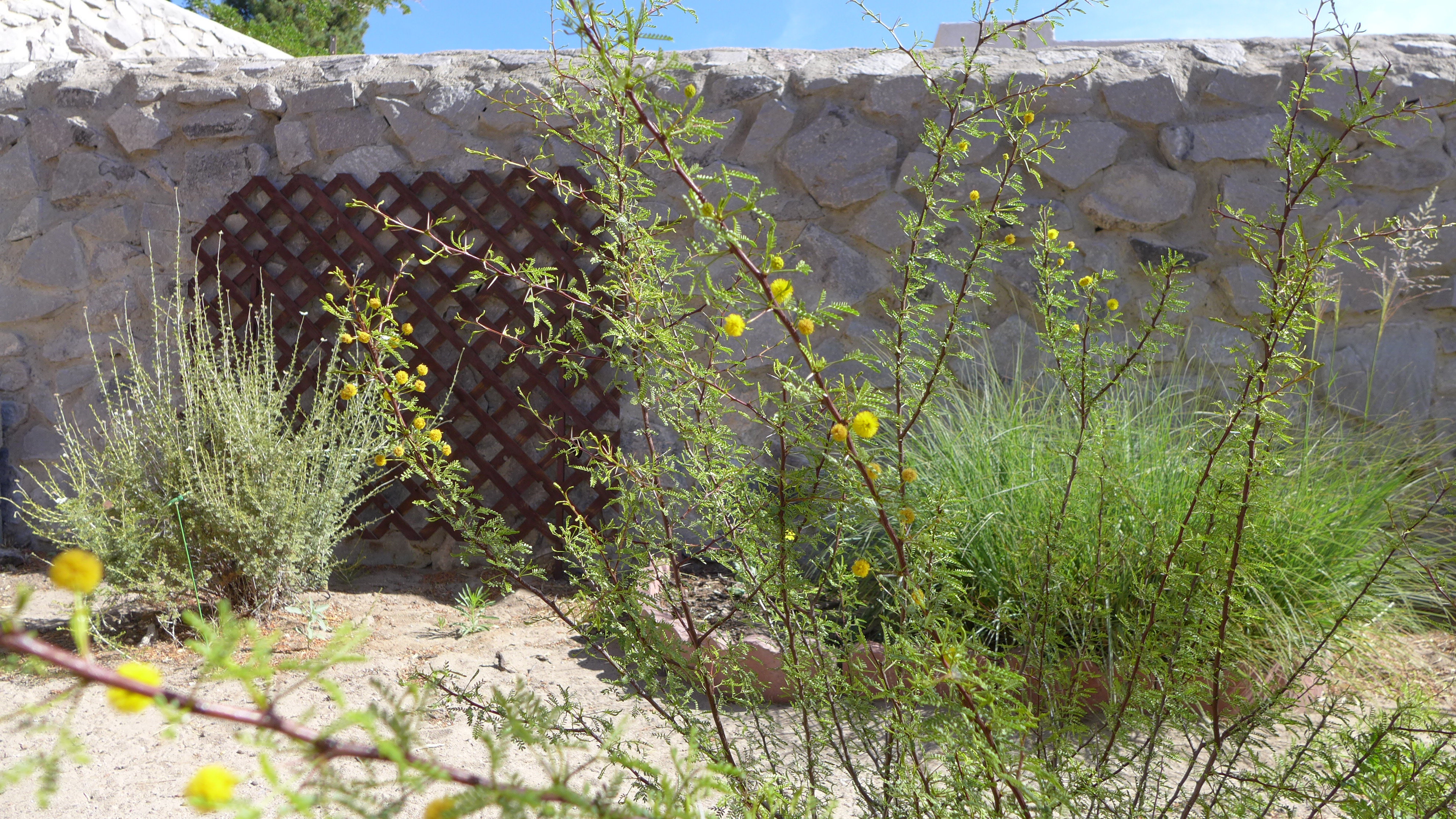
Another plant in my garden is blooming for the first time this year.  It was a volunteer; its seed must have come some distance since I haven’t seen this in any of my neighbors’ yards.  It is an acacia, and, yes, those round yellow balls are the flower, not the fruit.

Volunteer Acacia

Volunteer Acacia

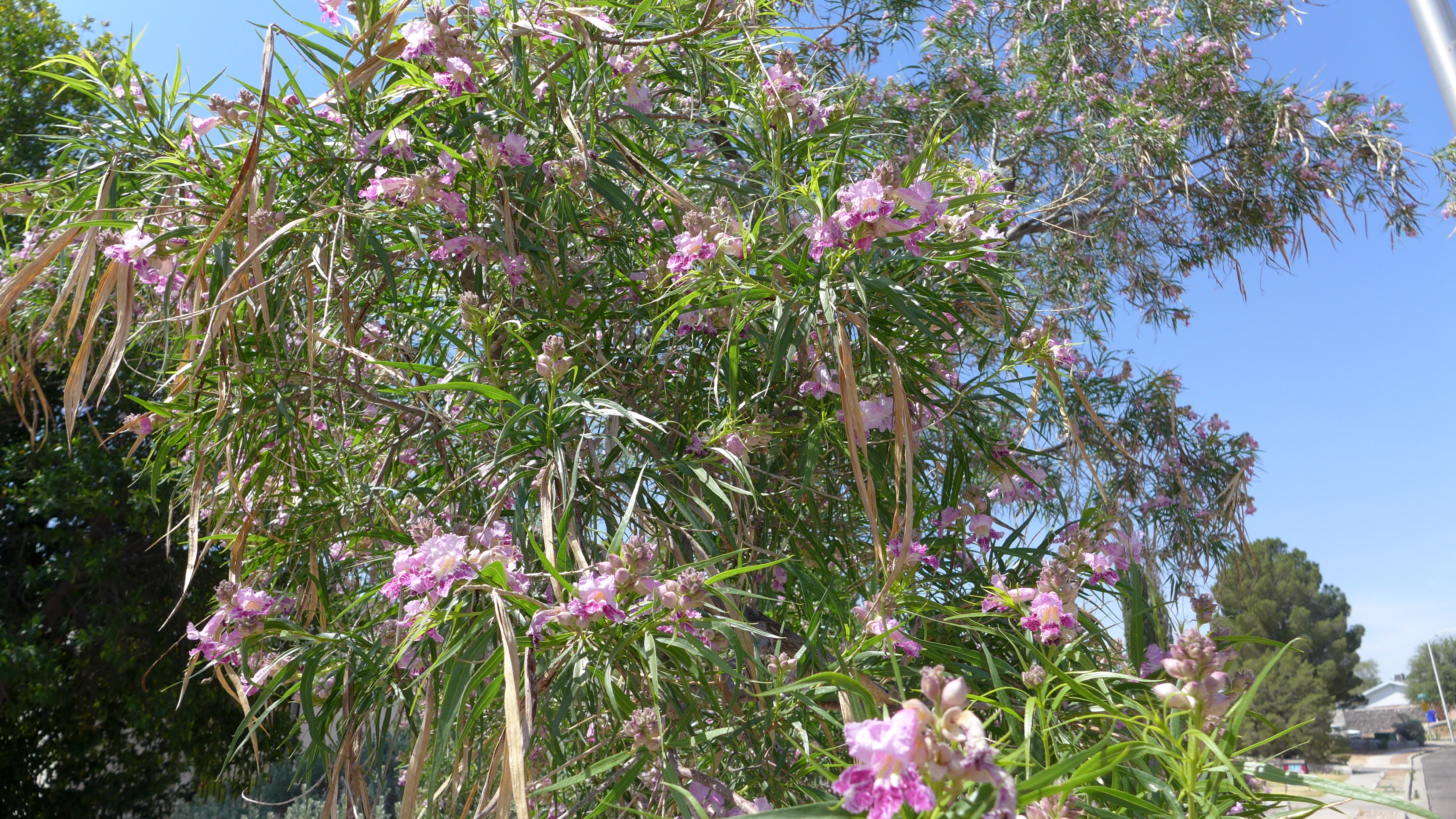
I have two small desert willow plants in my yard.    They’ve only put out one or two flowers so far this year – one last year.  So I admire the mature trees in my neighbors’ yards.  On this one, you can see many blossoms, along with last year’s seed pods.   I think I have quite a few years to wait for this kind of display.

Desert Willow

Desert Willow

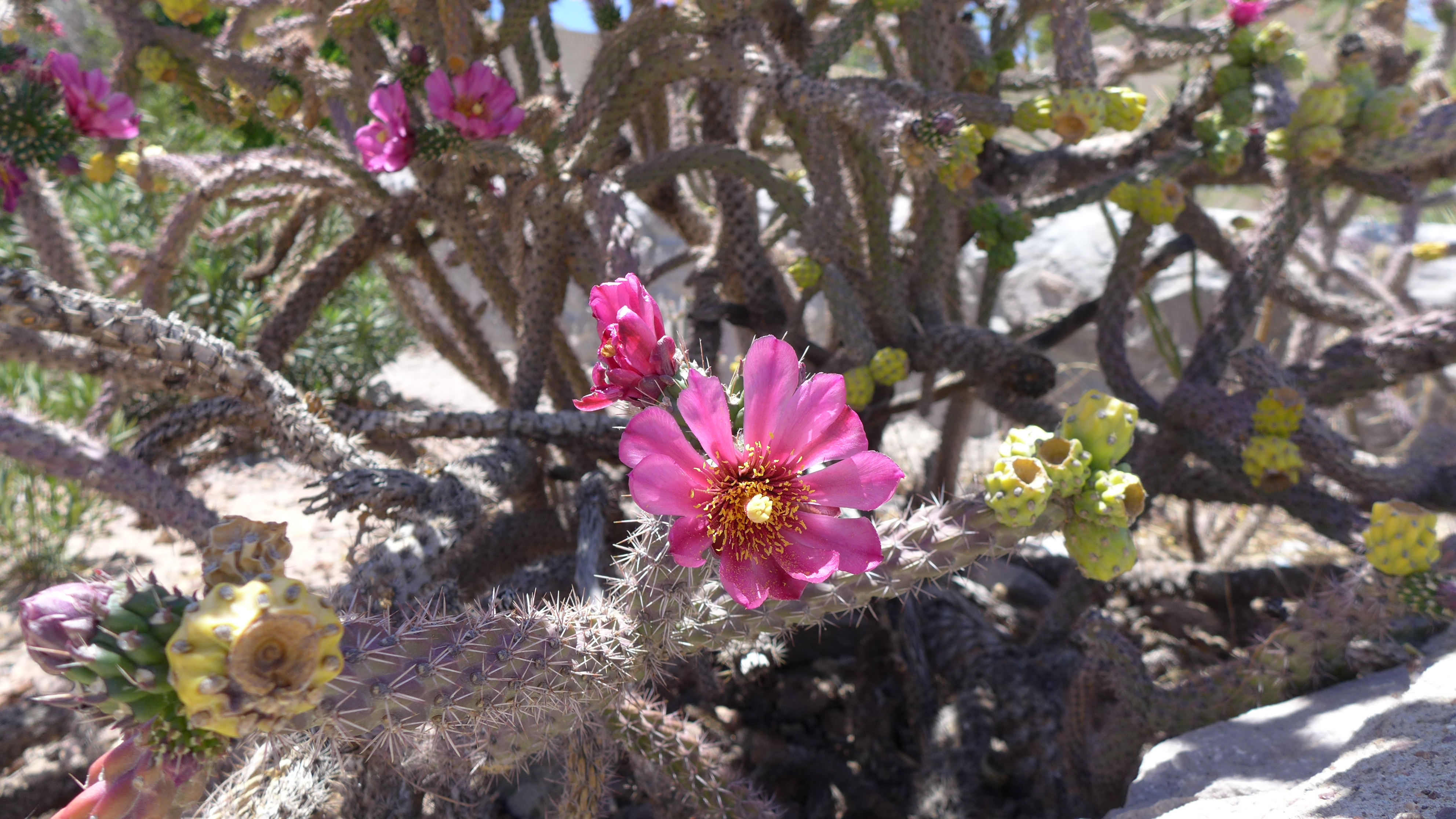
One plant I’ve been wanting for my yard and haven’t found a place for is cholla.  It is much better behaved and less weedy than prickly pear, so I may yet find a spot.  I love the way the flowers appear among the pods from last year.  At some point in my youth I was part of a class in colors, for clothes, in which we were told not to mix purple and yellow.  Nature missed this suggestion.  I see yellow and purple flowers together every all, and here, the purple flowers among yellow seed pods.

Cholla

Cholla


Another Turn in the Wheel of the Year

Leave a comment

I spent a large part of May Day cleaning a nasty piece of malware called “Get Savin’” out of my computer. It could be considered a very modern form of spring cleaning, I suppose. Thank goodness there are helpful websites out there and people who can tell us which ones are good. After all that work I decided to “lie low” for a couple of days. I didn’t want to chance discovering that the “cure” hadn’t been successful.

In the materials I’ve been reading about this cross-quarter day, the mid-point between the spring equinox and the summer solstice, I have been even more struck than usual by the climate specific nature of the Celtic beliefs on which current ideas about Beltane (May Day) and Samhain (Halloween) are based. If you live in northern Europe – or New England – you are likely to be excited about the spring flowers, and you can find dew on the grass on May Day morning. (Apparently there is an ancient tradition that washing your face in that May Day dew will bring you beauty and good fortune.)

Here in the desert, however, the weather is getting hot – this really is the turn into summer, which will last until the fall equinox. the way I measure the temperatures. No waiting for Memorial Day to open the swimming pools around here.

People like Lisa Michaels, whose posts on the seasons and the astrological signs I read regularly, are well aware that they are using language that only fits the northern hemisphere. Christianity too is a northern hemisphere religion, with its light in the darkness themes of Christmas and Epiphany. Christianity has done best when it absorbs aspects of a local religious viewpoint into its ritual and imagery. Where we live, and the images and ideas we draw from our surroundings, make a difference in our world view. Place – the specific place in which we live – matters.

(You can find Lisa’s recommendations on celebrating the seasons at http://www.lisa-michaels.com)

How One Poem Came to Be

1 Comment

Reading Bruce Holsapple’s new book, Wayward Shadow, I was struck by the line “It’s the way you fix yourself in place.” It made me stop to think about how each of us does that. I thought, I’d like to explore that idea in a poem of my own.

It seemed an idea that would benefit from repetition, which led me to consider using the villanelle form, which led me to looking through Holsapple’s book for a possible second line. Instead I found two fragments.

I still thought I would be writing a poem about myself, but I began to see in the lines that came to mind echoes of the ideas that permeate Wayward Shadow. It may be that the way I “fix myself in place” happens to be similar to Bruce’s. In the end, I felt I had captured something of the persona in his book. So this is now a villanelle for Bruce Holsapple.

In Place

Using lines from Wayward Shadow

Climb a mountain, formulate a phrase:
you settled on these deeds because you knew
it’s the way you fix yourself in place.

Life has taught you this. There will be days
when energy is slow to waken to
climb a mountain, formulate a phrase.

Outside and in you need to claim your space.
Shop, fill the fridge, set simmering a stew,
it’s the way you fix yourself in place.

Record the colors on the high rock’s face.
It’s a sure antidote for feeling blue
to climb a mountain, formulate a phrase.

A sentence to rewrite, steps to retrace?
What circles is the animal in you:
it’s the way you fix yourself in place.

As these familiar actions work to raise
your spirits, you may wonder why so few
climb a mountain, formulate a phrase.
It’s the way you fix yourself in place.

If you’d like to get to know the real Bruce Holsapple, Wayward Shadow is available on Amazon.


How Native Plants Behave

3 Comments

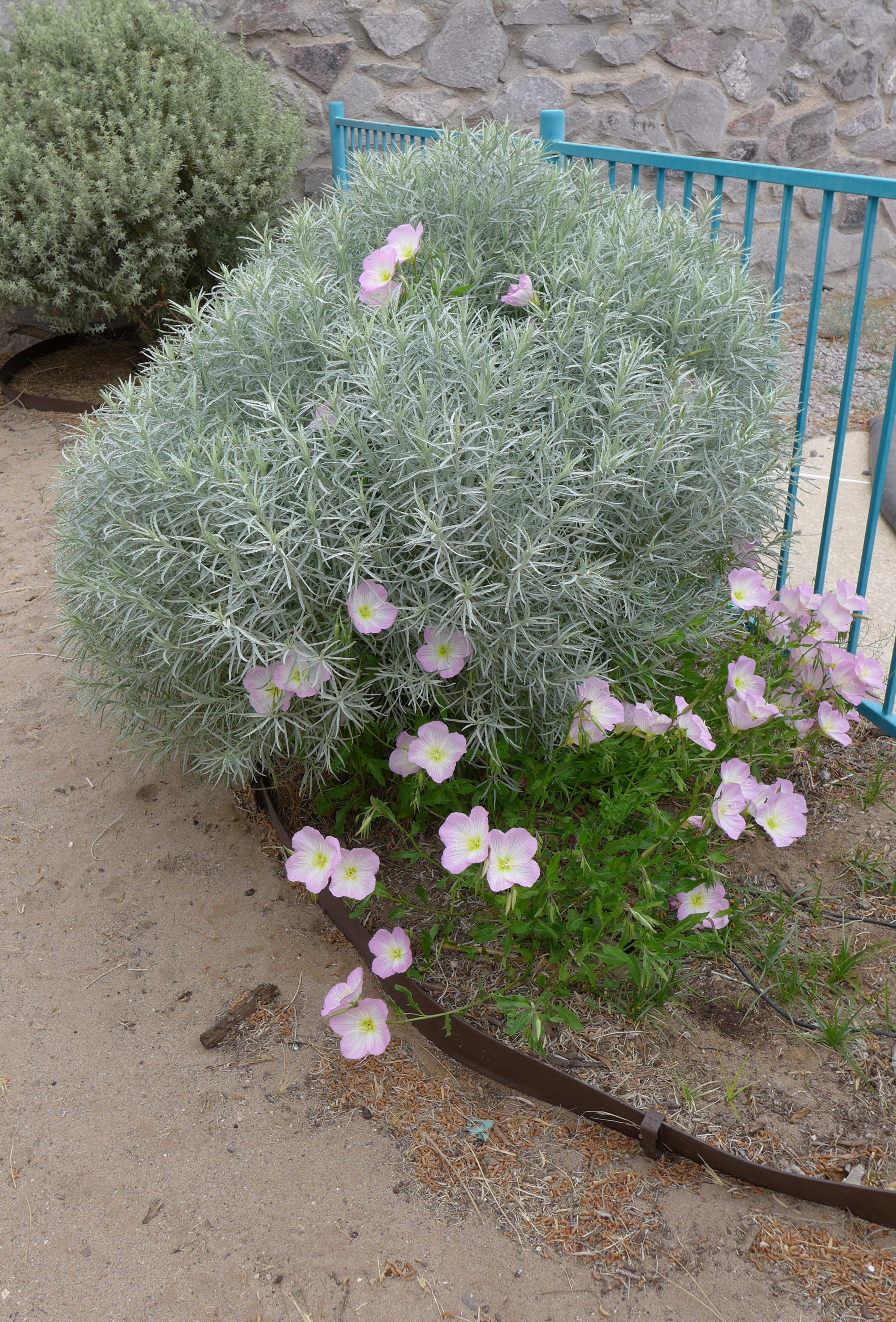
primrose 2Several years ago I planted Mexican primrose.  I thought I had killed it after a year.  There was no sign of it the third year, nor the fourth.  If I had known it could still come back, I would not have planted the chamisa bush quite where I did.  But it turned out that this was just what the Mexican primrose wanted.  Native plants do not need to be spaced.  In fact, they are happier in each other’s shade.  And the Mexican primrose sends its stems in all directions to take its flowers to the sun.

Other native plants have been active.  Poppies come up where ever they choose.  This one is sharing space with a plant I know as “wire lettuce.”  It has a small pink flower, when it decides to bloom.P1000078

Yucca plants which spent years squeezed by a prickly pear cactus have taken advantage of the space in the course of the two years since the cactus collapsed in an unusually deep freeze.yucca close

The yucca is the state flower of New Mexico  There are many varieties and the legislature neglected (or perhaps refused?) to specify which one is the official one.


Older Entries Newer Entries