Home

One for Fun

3 Comments

I’m sharing a poem today of which I am particularly fond because it was one of those rare ones that just came.  There’s nothing factual in it―perhaps it has the truth of a good story, flash fiction in poetic form.  Enjoy!

Decaf, Please

An old car knocks,
and an old man, thin hair
slicked like the teenager
he once was, asks me
to go with him,
leave the museum,
grab some grub, or a latte
(we’ve given up smoking).
Seize the day, he begs me,
a seizure might interrupt.

The era of ambience
is over – dimmed lights,
candles, appearances
that mattered in the eighties.
We pass up Starbucks
for a booth at the diner:
when the nineties’ bubble
burst we were thrown
back to essentials:
a man, a woman, a drink.

“Decaf, Please” was first published in Into the Teeth of the Wind and is included in my collection Accidents (Finishing Line Press, 2004).

Rereading Sacred Text, With a Poem

2 Comments

In my last post I mentioned in passing the feminist interpretation of the Biblical record.  There have been many kinds and layers of this.  I was involved in a number of them.  I attended meetings of the Evangelical Women’s Caucus.  I read Daughters of Sarah and Free Indeed, two periodicals produced by women seeking to reinterpret what they had been taught.  Both survived only for a time, which is typical of small magazines of all kinds. Free Indeed took its name from the passage from John, “If the Son makes you free, you are free indeed.”  Daughters of Sarah published a few of my poems.

I learned to think for myself through looking at the many different women’s approaches to scripture.  I had gotten through college as a very good student who believed what I read, whether it agreed with my own experience or not.  Amid all the women’s perspectives, it was necessary to make choices, and one of the keys to those choices was “does it fit with my experience” instead of “does it fit with what I’ve been taught.”  This approach was the gift, for me, of feminist interpretation.

There are many stories about women in the Bible.  Some are extensive, some seem to be only fragments.  At one time I concluded, “The named woman is the one who got into trouble.”  Here is a poem I wrote during this period.

Sirens

As I circle stony islands
where ten foot tides turn ledges
into granite waves,
threats to an outboard propeller,
I hear Delilah sing
with Jael and Judith.

On a bluff of ragged rock
these three women, servants
to god and country, sing by turns
of Sisera, Holophernes, Samson,
of tent peg, sword, and scissors.
The song repeats like blues,
like scissors, rock, paper,
break, cover, or cut
to the next story,
the next severed head
served up on a fine platter.

The trays have corroded
on which the tribes they served
once served them empty honors.
Their hungry song blends
with calls of cormorants and gulls.
From such contagious sorrow
I flee to deeper water.

Among other things, this poem is meant to suggest that the situation for women is similar on both sides of the conflict; Delilah was, in the history, an enemy of Jael and Judith, yet I imagine their stories were similar.  I’ve placed them not in the Mediterranean but on the Maine shore, which I know, can describe more vividly, and have used to reflect their mood and situation.

Many of the women whose work I was reading in those days gave up on the patriarchy of Christianity, and Judaism as well, altogether; some became Wiccan.  I stayed in my tradition, but continued to rethink the reading of Scripture.  Now I look at my sacred texts from many points of view.  Some days I take the words quite literally, but I am convinced that, however much inspired, they were written down by people who could only communicate in the language of their time.  Other times I am struck by how much of our God language is, and has to be, metaphor.  Always I find it a rich source of story, language and reflection on the human condition.

“Sirens” was published in Daughters of Sarah in 1990.

A Pure Beginning: Reflections and Poem

2 Comments

In the nineteenth century, when John Emerson Roberts was a liberal preacher, there were many people who believed in an original “pure” Christianity, before things got messed up with doctrines and debates and rules.  One such person was Alexander Campbell, whose follower were first called “Campbellites.” They eventually became the denomination Christian Church/Disciples of Christ.  Another case was that of Joseph Smith; he  avoided creating one more denomination among many by developing a whole new Church, the Church of Jesus Christ of Latter Day Saints.

In the twentieth century there was another kind of belief in an original Christianity as feminist scholars like Elizabeth Schussler Fiorenza gathered together clues of the roles of women in early Church communities, before the bishops made them second class members.

Current scholars recognize plenty of evidence that there was no original “pure” Christianity.  The letters of Paul reflect lots of discord: “You shouldn’t eat that!”  “You shouldn’t do that!”  “My way or the highway!”  In fact, the writer of the Acts of the Apostleswhom we call Luke may have been the first to imagine a state that never existed, one of harmony and agreement among all.

What I imagine in the early church is a stronger fellowship.  But it may be that strong fellowship requires a common danger.  Those who see “true Christianity” as beleaguered in today’s “secular” culture, probably are able to build such fellowship more easily than others.  Here’s my image of then and now:

Twilight

The half-light of half-learned lessons
cuts us off from elders
of the sharp-edged pagan years.
Outlined by evening sky
they walk toward prayer,
leaning over their lamps.
By flickering light they stand
in corners cut in damp earth
holding each other tall.

Old story told once more,
we rise from cushioned pews,
let fall each other, uninstructed
in the catch of shifting weight.
Shadows of wistful wishes wax
in failing light.   The dark
is out there.  Who can teach
the bending into it?

I don’t recall what darkness concerned me when I wrote this poem.  Perhaps I was just discovering that darkness is a part of life, not to be avoided.  I learned through dance that catching one who falls can be taught; we were also taught how to allow ourselves to be caught.  It’s the same with emotional support – we can learn to give and to receive, but it is something we do need to learn.

Thanks to Allen Matlins for returning this poem to the light by posting it on his blog last November.  It was published in Christian Century in 1983.  Rediscovering it has led me to look at other poems I wrote about that time, to ponder how things and people change over time, and to find several which are still “good enough to share.”

Political Conventions Then and Now

1 Comment

The purpose of a political convention, traditionally, is to select a party’s candidates.  This year that’s all been done, due to a long process and lots of media attention.  Instead of a meeting to make a decision, the conventions are carefully scripted presentations, meant to persuade those outside the hall, who, thanks to the television coverage, can usually see what’s happening on the stage more clearly than those inside.

Things were different in 1876, when Robert Ingersoll gave his famous speech nominating James G. Blaine for the Republican candidate for the presidency.  In those days the people outside the hall had to wait to read the speeches in the newspaper.  Ingersoll’s rhetoric was for the attendees alone.

In matters other than technology, however, there were similarities between 1876 and our present state of affairs.  The national debt was worrying everyone.  It had quadrupled during the Civil War; it stood at $2.18 billion and was showing no signs of dropping.  In addition, a panic in 1873, propelled in large part by shady dealings among Wall Street financiers, had induced a recession that was far from over.  Wars, deficit and recession: things we are familiar with today. Ingersoll’s speech suggests a different approach to these issues from that which current leaders offer.  What the Republicans want, he argues, is this:

They demand a man who will sacredly preserve the financial honor of the United States; one who knows enough to know that the national debt must be paid through the prosperity of this people; one who knows enough to know that all the financial theories in the world cannot redeem a single dollar; one who knows enough to know that all the money must be made, not by law, but by labor; one who knows enough to know that the people of the United States have the industry to make the money, and the honor to pay it over just as fast as they make it.

Later on he adds:

This money has to be dug out of the earth. You cannot make it by passing resolutions in a political convention.

The idea that money could be created without gold and silver to back it up was unthinkable in 1876.  Wealth, whether of the country or the individual, could only come through work.  Ingersoll becomes quite poetic as he expand on this.  His balanced phrases can be set into lines like a poem:

The Republicans of the United States demand a man
who knows that prosperity and resumption,
when they come, must come together;
that when they come,
they will come hand in hand
through the golden harvest fields;
hand in hand by the whirling spindles
and the turning wheels;
hand in hand past the open furnace doors;
hand in hand by the flaming forges;
hand in hand by the chimneys filled with eager fire,
greeted and grasped by the countless sons of toil.

Such fine language, though highly praised and long remembered, did not win Blaine the nomination, which went to Rutherford B. Hayes.  Hayes then won the election through promises to the South to remove from southern soil the Federal troops that were attempting to enforce northern standards, an issue Ingersoll had not addressed.   Government requires more than rhetoric.

Poet and Place: Fiesta Season in Las Cruces

4 Comments

When people from elsewhere think of New Mexico they usually think of Albuquerque,  Santa Fe or Taos, the northern part of the state.  Las Cruces is different.  It is in the desert in the southern part of the state and on the border.  You can’t take a main road from Las Cruces to the rest of the country without passing through a Border Patrol check point.  It’s quite clear that this area used to be part of Mexico.

My poem, “At the Edge,” about walking in the desert, has appeared this week on 200 New Mexico Poems, a site to celebrate New Mexico’s centennial of statehood.  You can find the site by clicking on the name in the blogroll to the right.  You’ll find poems about all parts of the state and many of its cultures: Native American, Hispanic, etc.

In my writing, the desert enters often.  As you can tell from my previous post, I pay attention to native plants and places to hike and they show up in my writing.  In Pennsylvania, there was a red-leaf maple outside my window which made frequent appearances in my writing.  Now the view out the window near which I write includes tall grass plants, an apache plume and a mesquite tree, which has grown from a small bush in half a dozen years.  I have thought of gathering these poems into a collection called “From Maple to Mesquite.”

Culture is a more complicated matter; one should tread lightly in referring to aspects of culture that really “belong” to others.  But it’s fiesta season in Las Cruces, and it suddenly seems as if everyone has a share in all the cultures we have here.  It began last weekend with a Salsafest downtown.  My family skipped that because the Greek Orthodox church in El Paso was having its Festival at the same time.  We came home with Greek food to keep us happy for a week.

On this three day weekend, there are enough events to do something every day.  You can go north to Hatch for the Chile Festival, west to the Fairgrounds for the Wine Harvest Festival or south to Holy Cross Retreat Center for the Franciscan Arts Festival.  First priority for me is the Franciscan Festival, where my favorite local musician, Randy Granger, will play his flute.  It remains to be seen whether I’ll get to the others.  I do need a little “down” time on the weekend.

The party continues all fall.  On September 15 and 16, hot air balloons and the Diez y seis de Septiembre festival (Mexican Independence Day) in Mesilla will be in competition.  Soon after that comes the Whole Enchilada Festival, then the next weekend the Southern New Mexico State Fair.  (It takes several of New Mexico’s sparsely populated southern counties to put together the equivalent of a County Fair in other parts of the country.)  Pagan Pride day arrives in mid-October, when some of my friends who belly dance will be performing.  November 3 and 4 there’ll be competition again, between the Day of the Dead celebrations in Mesilla and the Renaissance Arts Faire just across town.

After that I hope to get a little break before the holiday bazaars, tree lightings and luminarias of December.  November is time to be outdoors here, to visit White Sands National Monument and the petroglyph sites and hike up into canyons.  Landscape and culture: so much to keep us busy.

Recommendation: Sean Hill’s “Blood Ties and Brown Liquor”

4 Comments

I “discovered” Sean Hill through a poem published in Poetry magazine this past April.  Titled “Bemidji Blues,” it describes snow, shadow, cold and music in the city in which Hill now lives, Bemidji, MN.  The craft of this poem is wonderful―particularly its shape and the way in which he repeats words (in different meanings) as end rhymes―so I went looking for other work by him.

Hill’s first – and so far only – book, Blood Ties and Brown Liquor, (University of Georgia Press, 2008) describes a totally different world, the world in which Hill grew up, the town of Milledgeville, Georgia.  The craft is equally good, involving many different forms, and there are a variety of experiments.  The combination of this craftiness with the serious subject of what it was to be African American in earlier generations, is powerful.

This is the only book of poetry I have read which includes a genealogical chart – of a fictitious family.  Silas Wright and his forebears are a major subject of the book.  However, some of Hill’s actual family are also included, such as his grandmothers and their stories.

A series of six poems titled “b. Nov. 14, 1926: Grandmother poems” appears to draw on actual remembered stories.  Here is one of them:

#1: Ernest and the Plowing Bull

On the farm we growed cotton for sale and corn
greens potatoes peas sweet potatoes and okra to eat―
three milk cows a mule and chickens for eggs and meat.
I had two brothers, in 1921, ’22 and ’26 we was born.
Phineas the oldest Ernest next and I was the baby.
Lived with my mother and father, Inez and Charlie―we called
her Nin―and grandmother and grandfather, Eva and Sam.  Y’all’d
liked Ma Eva. She and Nin they’d go out for the cows and bring em
up to the house so we’d have milk fresh from the teat.
Ernest had a bull.  He broke him to the plow.  Bull named Pete.
He would plow and Ernest could even ride him.
They’d tromp through the yard―Ernest on top―looking to get cool
walk down to the pond and wade into that green brown pool.

I find the contrast of the sonnet form, with full rhyme scheme, the diction and the homey story-telling makes a great combination.  Only a few of the poems have such precise structure, but all combine skill in the form chosen with rich narrative.

One poem which is widely available on the internet, with good reason, is this short poem about Silas Wright learning to write his name.  It is balanced by a poem later in the book about the widowed Silas actually fishing and remembering his wife.

Silas Wright at Age Seven 1914

Silas Wright follows a fish’s wriggle
In the shallows between reeds. He scribes the
Line in his tablet—as much pride in that line
As a man in his son. He almost giggles—
Still he goes on. The next letters come easy.
With this he’ll have more than a mark to bind.
Rambling across the page again and again
In messy rows on it flows until he
Goes a little off the page’s edge. He smiles.
He’s surprised to hear when his mouth opens—
That’s mine.

Silas Fishing 1967

That heron yonder’s
a good fisherman―
patient―will wade
and wait.  But it ain’t
a good day for fishing―
neither of us having
no luck―just minnows
nibbling my bait.
There he goes―up and off
to another pond I suppose―
trailing those long legs, flapping
slow and steady.  I cried and cried
the day Mama died.  And it hurt
me deep when my wife . . . when
Devorah passed.  But I didn’t
shed a tear.  Been near ten years
and here they come
like the drops from
that heron’s feet.

There are many other characters in this book, vividly and gently presented.  They are a delight to know.  But Hill will not let the reader be too comfortable.  He starts the book with a reminder of how much was not right with this world in a brief preview poem titled “Southampton County, Virginia Aubade1831,” which refers to Nat Turner’s insurrection:

Some whites don’t rise with the sun
having departed in the night,
man woman and child, leaving behind none.
The sigh of a broadax mingled
with cricket and frog song.
The mockingbird greets the morning
with many tongues.

I highly recommend this book and will watch for new work by Sean Hill.

Worship: a Poem

1 Comment

This poem begins as a literal description, which can also be taken as metaphor.  The end is meant to include all who participate in the dance of life.

Worship

The floor is cold as barefoot
dancers take their stations,
red-ribboned for Pentecost,
the church’s birthday.

Be there! the teacher cried
at each new step.  Her students
stretch to get there.  The need to be
on the right foot, in the right place
pushes them past balance.
Cross front, cross back,
they coil into the grapevine,
a twisting line of ordinary saints.

Light through windows splashes
mottled rainbows round us.
That we are right
where God wants us,
there is no proof.

This poem was first published in Christian Century, May 27, 1992.

Trying too hard to be “right” is something I struggled with for many years.  It so often backfires as we “push past balance.”  Dance has helped me keep, or regain, my balance.  Sacred dance fits in many other traditions besides Christian.  Go to http://www.sacreddanceguild.org to learn more.

Dance This Poem!

2 Comments

The Sacred Dance Guild holds its biennial Festival in Holland, Michigan this week.  In honor of this event, I am posting a poem I had published back in 1984 in alive now!, a small devotional magazine.  The poem was later danced at the ordination of a friend.

The Proper Turning

The proper turning
from the world to God
is a conspicuous somersault
half joyful leap, half fall.
Power tumbles, selfish
interests spill, desires
turn upside down,
a very public mess.

Laughter dances round.
Is it delight or scorn?
No matter to the acrobat
who’s newly joined the troupe―
the company of artists
who proclaim the names of God.

At the time of writing, I had no idea how many names of God there are: the number is beyond counting.  Dance, movement, gesture, can convey some of them in ways no words can.

Although the somersault in this poem could be metaphorical, actual movement in worship is a wonderful thing.  The Sacred Dance Guild gave me an excuse to dance again after no lessons since I was a teenager.  Most of the people I’ve met who dance in church are free spirits, liberated, as if keeping their bodies limber did the same for their minds.

Dance also proved to be a good balance for my writing.  Most writers have some physical work or hobby or habit to balance all the sitting and head work.  I recommend dance if you’d like to try something new; sacred dance is for all ages, genders and levels of ability.

www.sacreddanceguild.org

Haiku, “Rules,” and a Recommendation

3 Comments

Haiku, that Japanese form which took hold in English about 50 years ago and has continued to be of interest to many, is a great example of the role of “rules” in poetry.

I particularly like a haiku posted recently on the blog, Five Reflections:

soft subtle mantra
hoes the garden of the mind
new poem blossoms

I was delighted by the contrast between the mantra described as “soft subtle” and the hardness of a hoe.  But then my inner critic sounded alarms:  “the ____ of the ____” the critic complained.  “Couldn’t he have avoided at least one of those empty words?”

I keep my critic busy checking my own work for unnecessary cases of “the” and “of the.”  But was he (or is my inner critic a she?) right to complain in this case?

There are two schools of thought about haiku, those who insist on a 5-7-5 syllable structure and those who argue for shorter, tighter lines.  The 5-7-5 imitates the Japanese form.  But the second party asserts that those Japanese “syllables” are not all words, some are signals of other kinds, so the 5-7-5 structure is a poor substitute.

The Haiku Society of America takes no official position on this question.  Their definition a haiku reads: A haiku is a short poem that uses imagistic language to convey the essence of an experience of nature or the season intuitively linked to the human condition.  I have noticed, however, that the winners in their annual contests are more often of the shorter style.

I had a workshop with a person of the “shorter is better” school.  He ruthlessly cut down my already short attempts.  I was persuaded that he knew what he was talking about.

Now, I’m not so sure.  “the garden of the mind” has a gentle flow to it that appeals to me.

On the other hand, does this haiku fulfill the Haiku Society’s definition that it “convey the essence of an experience of nature or the season”?  “The garden of the mind” is completely metaphor.  No actual garden, no hoe.  What should I make of this?

My favorite of the haiku I have so far seen on Five Reflections is this one:

sea smoke illusion
ancient seafarer ghost ship
grandpa’s story time

What I like best about this poem is the turn in the last line: the misty sea scene is suddenly transposed to an indoor scene, warm and cozy, where “grandpa” tells his story.  I didn’t even notice at first that this poem has nary a “the” nor an “of.”  This poet knows what he is doing, which further confirms my suspicion that sometimes those “lesser” words are the right ones for the flow and mood of the poem.

In summary, the following, sometimes contradictory, “rules” are apparently made to be broken by skillful haiku writers:
“Always use a three line construction of 5-7-5 syllables.”
“Don’t waste syllables on lesser words like “the.”
“Start with or focus on nature.”
As one who finds haiku challenging to write, I’ll take these “rules” as suggestions, refusing to be bound by them.

To read more at Five Reflections, click on the link in the blogroll in the column to the right of this post.  Enjoy!


Recommendation: Sandra Kohler’s “Improbable Music”

3 Comments

In the beginning of the poem, “White,” Sandra Kohler writes

I go around half the time thinking I have
a fatal illness, and I do: life.

In Improbable Music, Kohler observes this condition minutely.  It is the illness of dealing with the dying of others.  It is the effort of trying to grasp and hold on to the ever shifting self.

The world presented in this book is the world many of her readers live in: the complicated world where family relationships occupy most of our time and energy. As keenly as she observes the moods of these relationships, Kohler observes the shifting backdrop of nature: sky, trees, birds.

The first section of the book focuses on extended family relationships; the fourth and final section pairs with this, focusing on the intimacy of a long marriage.  The third section acknowledges the impact of the larger world on the domestic, picturing families caught in major crises of our time: Bosnia, Palestine, Sierra Leone.

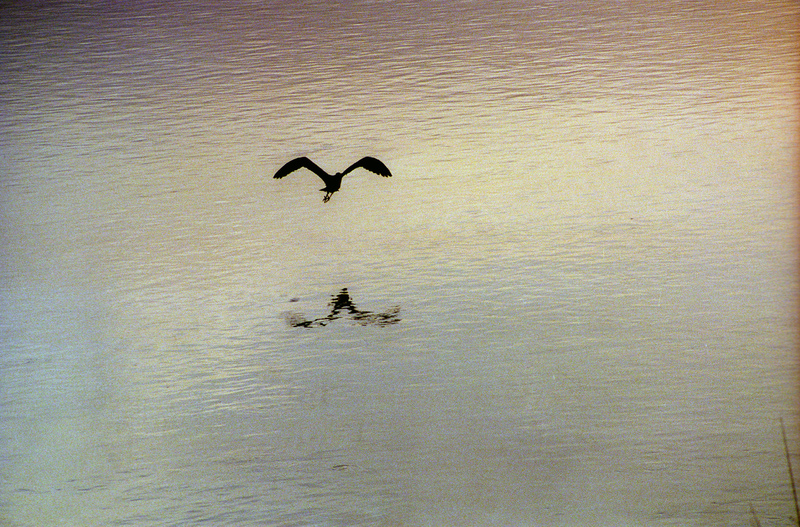
Heron in Flight

The second section is in some ways my favorite; it focuses on the natural world, but with a delightful twist in the character of Heraclitus the heron.  Kohler admits that she may be giving this name to more than one heron.  She writes in “Herons Present and Absent”:

The river without
herons: a diminished
thing, lifeless,
dispirited.
They are my wild
swans, my muse
of absence.

And later in the same poem she returns to uncertainties about the self:

Is it the herons
that have returned
or my ability
to see them?

Some poems are written in short lines like those quoted above.  Others have longer lines with complex syntax.  Most of the poems are long, many in sections, which allows plenty of time for exploring the shifting self.  One of the shorter poems, “The Cup,” captures uncertainty, ambivalence and shift:

This morning, the last of the year, I use my old cup.
The cup that is always there.  Ten days from the solstice:
ten, twelve minutes more light?  Not even that?  I don’t
know.  Cold, I am wrapped in my Guatemalan blanket.
The cold is solid, settled.  My son calls me a sore loser.
That’s it exactly: I ache with losing him.  The cup of losses.
A glitch in my side, an ache, the slow stitchery of a wound
healing or opening.  I’m suspended, detached, unused.
The cup of waiting and the cup of sighs.  How this moment
will be remembered or forgotten depends upon the fact
of morning, on the ice on the creek, on the thin layer of
cloud that screens the horizon’s uniform desolation.
The cup of loneliness and the cup of longing for solitude.
We dream what belongs to the night but the day wakes
echoes of old wars, scarred shadows of scathing blows.
The cup of insecure anxious needing to matter, impress
the self on the world.  In the face of failure, isolation, loss,
we utter variations on a singular theme: I, I, I.  We don’t
want to believe this of our life, though it is ratified by
the minutes of increased light burning on the partially
frozen stream.  The cup of ego, the cup of emptiness.

Every claim to an “I” is a variation; every cup contains a piece of the self.  The weather seems to echo the self, but does not.  Even the night’s dreams and the day’s shadows cannot be sorted out.  Kohler digs deeply into the flux that underlies every claim of identity and offers no answers.  The reading satisfies as the songs of a fellow traveler.  This is not a quick read, but a book to take one’s time with.

Older Entries Newer Entries