Many plants are blooming now. There are still poppies. I expect this area to have more poppies next year. The seeds have no place to go now that the plants have reached the wall.
 This plant, whose name I cannot remember although I bought it, has dutifully bloomed all winter, but not so energetically as it is doing now.
 The apache plume has begun to come out. It’s named for its feathery seed heads, but the white flowers are much more visible.
Most of my gardening is in the back yard, where no one but me has much chance to see it, but this indian hawthorn that came with the house puts on a show for a brief time in spring.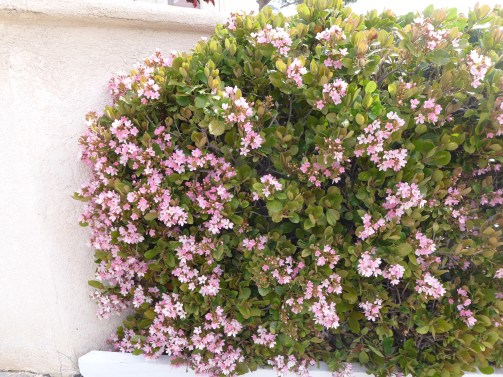
And for an extra touch in the front yard I took the palm branch (it’s plastic) which was delivered from church with other materials to use for worship in holy week, and tied it to my front gate.
It blows nicely in the wind, but it may not be fit to return for reuse next year.


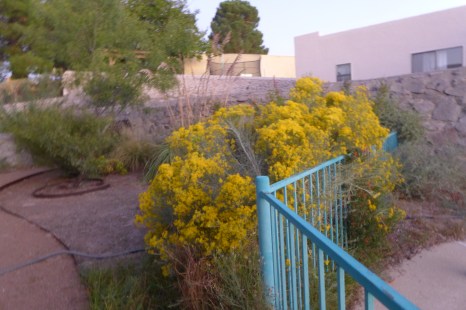
 The coursing water does not always agree. Neither do I. I want to say, “If you want me to stay on the trail, don’t pave it.”
 There’s a section still only graveled along a fence which keeps people from wandering into a conservation area. Except when it doesn’t.
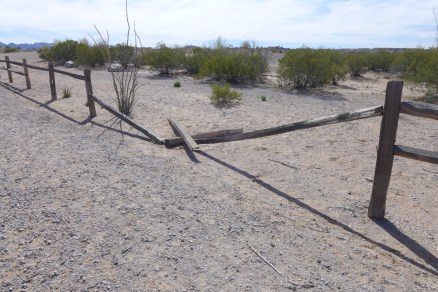 There’s a story here:
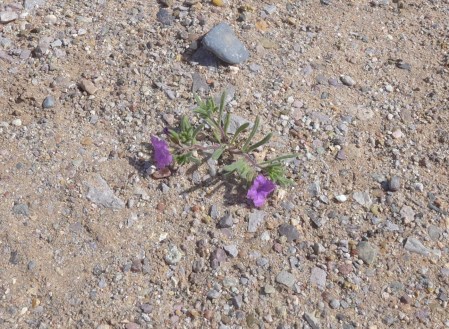 On my recent walk I found the first bit of purple mat “in the wild.” It is already flourishing in the sheltered space of my back yard, where I have been encouraging it for years.
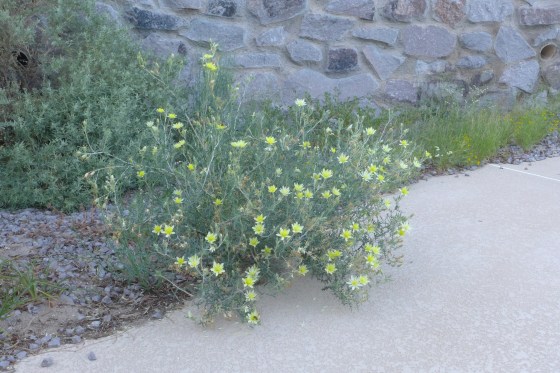 Well, most people call it a weed, but I consider it a wildflower. It’s current popular name is velcro plant; it was formerly called stickleaf. If you pull it up you will find out why. It’s proper name is said to be Mentzelia. This particularly fine specimen is growing at the edge of our pool deck.
 What you see is the top half of the high wall that holds up the ground of the house behind us and a very little of the great mound of leaves which supports these feathery spikes of seed. In the mornings small birds land on the seed heads and weigh them down.
 Weaving the Terrain is a large collection edited by David Meischen and Scott Wiggerman. It contains 211 poems, by many poets—a minority of the contributors have supplied more than one poem. The subject matter ranges across the southwestern states and over many themes. There are plenty of roadrunners, vultures and coyotes, historical moments both familiar and lesser known, and a lot of sand. There are personal stories as well, events that “just happen” to take place in a southwestern locale.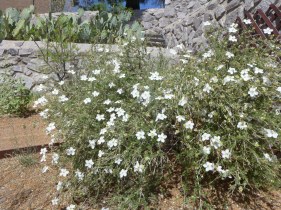

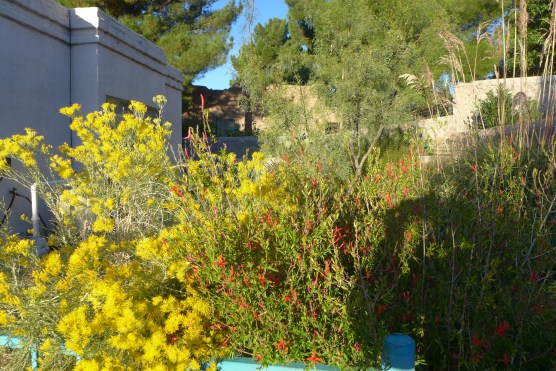 The chamisa and the butterfly bush are flaunting their yellow and red, and yes, fighting for space. In the side yard the volunteer autumn sage is blooming again:
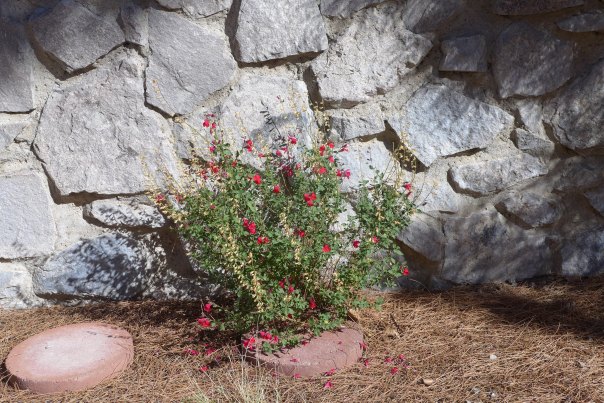 Fortunately, it doesn’t mind in the least that I never got around to deadheading the last set of blooms. As the weather cools I hope to give the garden more attention.
 It’s the child of the largest grass plant I have, shown here in the background, and much too big for the space. I had to pay someone to take it out. But I didn’t waste the plumes.
 An elegant, filmy, look. They lasted several days. I also had some desert globemallow getting out of bounds, so I brought some branches of that in too.
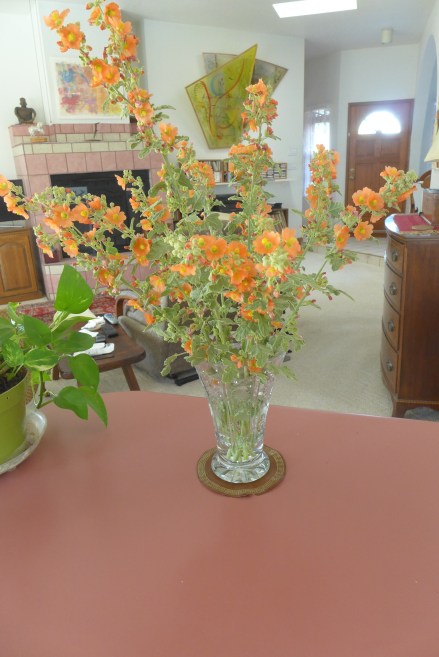 This bouquet was more short-lived, but pleasing while it lasted (I am partial to orange). The globemallow is a short-lived perennial, but it seeds avidly. I have quite a spread of it, third and fourth generation, I think. One of the volunteers decided to lean toward my study window, giving me a bit of bloom to enjoy from my desk.
 It is different every day as the individual flowers fade and new ones open. I like it when a little of my garden can come inside for a bit – or at least “lean in.”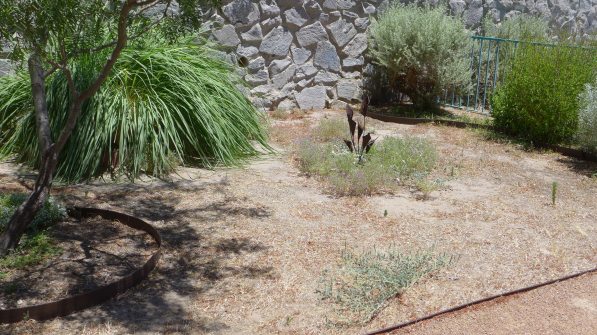
 Purple mat is a small flower which, this year, is here, there and everywhere in my yard, after some years of scarcity.
 The iris came with the house. That is, a few flat leaves showed up in unexpected places. I’ve transplanted and fed them. They seem to like being against the wall. They take much more work than native flowers, and don’t last as long, but they were an accidental gift, so I keep caring for them.
 No, these are not the same poppies I’ve shown before. It’s a good year for them, they keep appearing in new spots.
 freethoughtandmetaphor