Home

The Giant Lizard of Lounsberry Beach: A Fable

Leave a comment

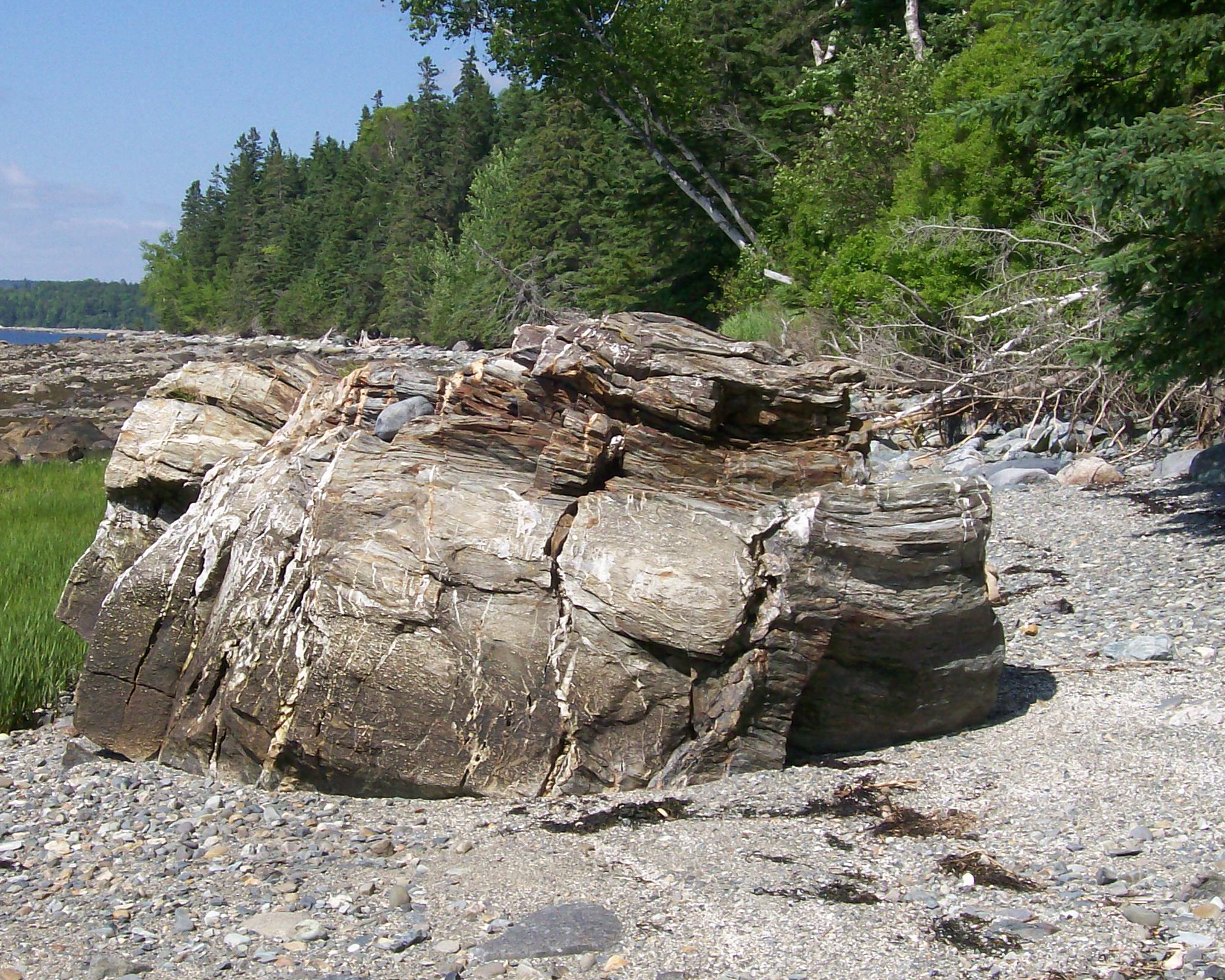
Tree Lizard on Beach

A winter storm in Penobscot Bay had carried the tree lizard far up the beach and left him there.  When the weather calmed, he found himself near stairs and beside a very large rock, the largest in sight.  “Good,” he thought, “he will know.”

“Excuse me,” Lizard said, “ Do those stairs lead somewhere?  To a castle perhaps?”

The rock frowned.  “Castle? No castles around here.”  The rock said no more.  He didn’t care for company, though he was feeling fortunate.  If the lizard had been pushed a few yards closer, his head would be resting on the rock’s shoulder.

“I wonder, then,” Lizard said after a few moments, “What my purpose is.  Who am I here to guard?”

There was a murmur around his feet that grew into snickering, as the small stones chattered to each other.

“Hush!  All of you!” boomed the rock.  “What’s this fuss about?”

There was more murmuring.  “He doesn’t know what he’s here for!” one finally said aloud.
“And you do?” asked the rock, his voice still loud with irritation.

“Yes, we do,” the bold bit of granite said.  “We’re here because God put us here.”

“Hmmph!” was all the rock had to say to that.

“Evidently,” the lizard began, looking down at the stones, “You don’t know the difference between cause and purpose.  I know how I got here; the sea carried me.  My question is, what am I to do now that I am here?”  The stones made no response; the discussion was over their heads.

“I had wished for a castle to guard,” the lizard said.  “I guess that’s not to be.”

The rock knew it was his turn to speak, but he saw no point in developing acquaintance with one who would only be carried away again: if not next winter, in another winter to come.  This intrusion on his beach would be easier to endure, he felt, if conversation was discouraged.  He turned his attention to the water.

At night the lizard bends his branch-forelegs down and rests.  When the high tide comes in, he laps the water.  He was carried by it so long it tastes comforting, like home.  All day he stands, observing sea, sky and the rock-strewn beach, alert for whatever he was put there to do.

The possibility that he is there to inspire a story does not occur to him.

The moral: If you long to be useful, don’t limit your options.

Photos by Ellen Young

Social Justice Then and Now: A Poem

5 Comments

“Social Justice” is a poem in my Paley series, drawing on William Paley’s Natural Theology, published in 1802.  First, a quote from Paley:

Again, there are strong intelligible reasons, why there should exist in human society great disparity of wealth and station.  Not only as these things are acquired in different degrees, but at the first setting out of life.

Now, my response:

Social Justice

Paley never said society
should run like a watch, nor
that it operates as God intended,
efficient as a well-oiled mill, yet
he wanted even revolution to
be rational, restrained: no mobs
dragging out Tory sympathizers,
no armies beating back
impoverished protestors.

I stand at the Federal Building,
restrained by fear, as rational
friends, frustrated by the tick,
tick, tick of same old, same
old injustices, lie across doorways.
Their calculated choice includes
awareness that effects are often
not proportionate to causes,
anything can happen.

This poem is included in Ascent: Five Southwestern Woman Poets.  See Books page.

Thinking About Form, II

Leave a comment

Robert Duncan, The H.D. Book

I don’t recall what review comment spurred me to ask for Robert Duncan’s The H.D. Book for Christmas.  It has been a long read, full of stimulating ideas about poetry and poems.

Duncan has an interesting take on form, shaped by his notion of what the work of poetry is.  The H.D. Book places H. D. in the context of her two colleagues, once close, later moving in different directions, Ezra Pound and William Carlos Williams.  Duncan sees each of these as working in poetry not as a life’s work in the sense of a career, but as life work.  The driving force is this: “that in our concern to redeem, to save or keep alive the wholeness of what we are alive, we discover the work to do.”

Duncan describes the overall work of H.D., Pound and Williams as an organic process: “They move in their work thru phases of growth towards a poetry that spreads in scope as an aged tree spreads its roots and branches, as a man’s experience spreads; . . .”  This organic property appears also in individual poems, the poet committed to the poem until it reaches the shape that belongs to it.

Structure, Duncan writes, “is not additive, but is fulfilled only in the whole work.”

He contrasts the work of Marianne Moore, using “He ‘Digesteth Harde Yron’” as his example:

The number of stanzas is arbitrary.  The poem presents examples of itself, a series that may be “complete” at any point because, otherwise, it is extensible as long as the poet’s rationalizations continue.  The form of the whole in conventional verse does not rest in the fulfillment of or growth of its parts toward the revelation of their “life” but in the illustrations of the taste and arbitration of the poet.

Is Duncan asking too much?  In his desire to lift up H.D. and her work, has he overstated the case?  Or is he simply explaining why it is that the truly great poets are intimidating as well as inimitable?

His approach challenges the reader to take her own creative work with utmost seriousness.

Thinking about Form and Content

Leave a comment

I have long been of two minds – or more―about the relationship of form and content.  Which comes first?  Which, in a poem, becomes primary?  They’re linked, but how?

I’ve found an explanation worth sharing from Paul Horgan and a stunning example of how they can work in satisfying tension from Ellen Bryant Voigt.

Paul Horgan, in Approaches to Writing (rev. 1988) connects form and content organically, saying that the initial impulse (idea) can only become a finished work

if as early as possible it begins to find, in the writer’s imagination, the precisely appropriate from for its fulfillment.
Once that is glimpsed, even incompletely, the subject, the idea, is safe . . .

In other words, the planned form gives the idea (content) staying power in the writer’s mind.

In Kyrie Ellen Bryant Voigt took an unusual subject for poetry, the influenza epidemic of 1918-1919, and combined it with a tight form: a series of sonnets and near sonnets.  The structure is able to carry the confusion, fear, anxiety of the time, as well as a variety of characters and crises, and to keep them in a frame; the contrast increases their power.  I think it must have helped greatly in the composition process as well.  Here is my favorite of the sonnets:

To be brought from the bright schoolyard into the house:
to stand by her bed like an animal stunned in the pen:
against the grid of the quilt, her hand seems
stitched to the cuff of its sleeve―although he wants
most urgently the hand to stroke his head,
although he thinks he could kneel down
that it would need to travel only inches
to brush like a breath his flushed cheek,
he doesn’t stir; all his resolve,
all his resources go to watching her,
her mouth, her hair a pillow of blackened ferns―
he means to match her stillness bone for bone.
Nearby he hears the younger children cry,
and his aunts, like careless thieves, out in the kitchen.

Though there are no end rhymes, this follows the sonnet form of four quatrains of increasing intensity and a final couplet which wraps up the poem in what goes on outside of the boy: all of it painful for the him.  We never learn the boy’s name, but he will appear in other pieces, trying to cope with the changes after his mother’s death.  This is powerful work.

115 Years ago today . . .

Leave a comment

On this date, June 9, 1897, John Emerson Roberts left the Unitarians to go out to lecture on his own.  He had met Robert Ingersoll, that famous agnostic, and they found themselves kindred spirits.  Ingersoll wrote to Roberts, “You are preaching a religion for this world.”  Roberts told a news reporter about Ingersoll, “He is the greatest apostle of liberty and reason and fraternity.”

Both men called themselves agnostics.  What did it mean in their time?  A religious man wrote “We must stand for faith in God as against atheism, and for faith in immortality as against agnosticism.”

Atheism is clear enough as not believing in God.  Isn’t agnosticism simply a refusal to make a claim where one has no knowledge?

In fact, neither Ingersoll nor Roberts ever challenged belief in immortality.  The desire to believe in a future life, even among educated people, was so strong at that time it might have hurt their careers to argue the matter.  Speeches at funerals, even freethinkers’ funerals, left the option open.

Roberts himself had no wish to challenge the belief.  He said in one lecture, give in 1909:

If this life ends all, then nature is the infinite deceiver, the colossal liar,. . . . and though I do not know it to be a fact and cannot prove it, yet I will trust that when the world is old and the sun is cold and the infinite future is unrolled, man shall yet continue conscious, intelligent, aspiring, deathless, having life and having it more abundantly.

Roberts envisions no traditional heaven, but he wants to believe that life goes on, and until science can persuade him it is impossible, as it could not 100 years ago, he chooses to believe that it will.

The science which underlies arguments about belief has changed significantly since Roberts’s time.

My biography, John Emerson Roberts: Kansas City’s “Up-to-date” Freethought Preacher, is available from Amazon, or from the author.  See more on the Books page.

Return, A Poem

5 Comments

This is especially for my writing colleagues who juggle multiple goals, roles, and responsibilities.  In the last scene, picture whatever god, goddess, muse or other comforter helps you get your balance back.

Return

Kitchen utensils return
each to its proper tray
like parents home
from work.  I celebrate
routine, but when
habit takes over,
hares in my head give
quick, thoughtless
answers.  My heart jerks,
a connection breaks.

The burn in the rug,
a dent made in the table
thirty years back
when a two-year-old
discovered a hammer
recall those absent.
I pour a glass of wine for
the kitchen god who sits
at the table with me
late into the night.

“Return” is included in my chapbook, The Map of Longing, (Finishing Line Press, 2009) available on Amazon, or inquire on the Contact page.

Celebrating June

Leave a comment

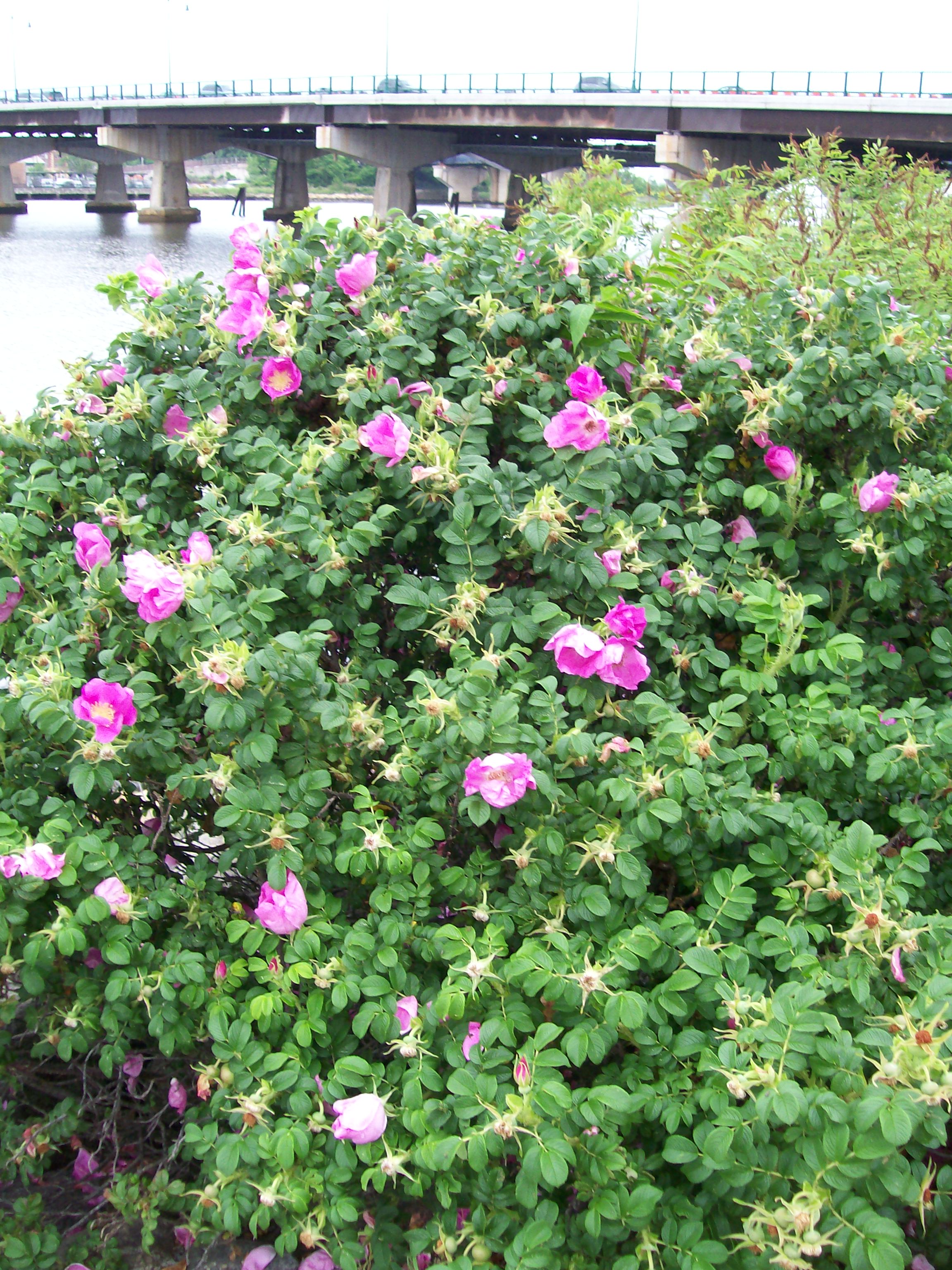
Wild Rose, Neponset River, Quincy, MA

It’s June, and James Russell Lowell’s prelude to The Vision of Sir Launfal comes to mind:

And what is so rare as a day in June?
Then, if ever, come perfect days;
Then heaven tries earth if it be in tune,
And over it softly her warm ear lays:
Whether we look, or whether we listen,
We hear life murmur, or see it glisten;
Every clod feels a stir of might,
An instinct within it that reaches and towers,
And, grasping blindly above it for light,
Climbs to a soul in grass and flowers; . . .

And that is as far as my memorization as a young person went.  I did not know this June as a young person, but I thought I did.  When I came to the clod I pictured the freshly plowed orchard beside my house, ignoring the fact that the plowing happened long before June.  June where I grew up could be hot, uncomfortably so.

This passage celebrates June in New England.  I know that now, because I visit Maine in June.  The fact that the description didn’t fit my experience was no concern to me as a young person.  Without realizing it – until I thought back much later – I put the world of books and words in a separate compartment from the world I lived in.  It did not occur to me that those New England writers which formed so much of my education were trying to convey real experience.  From where I stood, on the west coast, it might as well all be imaginary.

What is your experience in finding the relation between literature and life?

Does Geography Really Shift?

2 Comments

As I prepared for a lecture I will give in the Boston area today on John Emerson Roberts I realized that I need to make a case for why Unitarians in Milton, Massachusetts, should be interested in what happened in Kansas City, Missouri, a hundred years ago.  It’s not a difficult case to make for those who are historically minded, because the events I describe affected the Unitarian denomination as a whole.  The question has reminded me, however, of how different geography appears depending on where you stand.

As a child growing up in California I had in my head a very simple map of the United States.  there was a blue line down the middle: the Mississippi River.  East of this everything was green and lumpy, west of it, all was flat and yellow, until one reached the border of California, whose topography I knew well from the flour and water maps we made in fourth grade.  You don’t have to have seen much of the middle of the country to realize how far off my notions were.  At the very least, I had seriously misplaced the big blue line.

When I moved to the Boston area for college, New England expanded hugely in my mind.  And when we settled in Philadelphia the Mid-Atlantic states were added to my area of familiarity.  The rest of the country shrank in comparison.  I had to remind myself that the 600 miles between Philadelphia and Deer Isle, Maine, were a small part of the country, even though we covered six states.

We are fortunate now to live in Las Cruces, New Mexico, and to travel to Maine by car.  Now I know something of many more states.  We’ve driven past the geographic midpoint of the contiguous forty-eight states in northern Kansas.  We’ve taken different routes across Kansas, Missouri, Illinois, Indian, Ohio and sometimes Kentucky and Tennessee.

The knowledge one gets from being in a place is different from map study and geography tests.  I don’t have to stop and ponder to remember that Nebraska (home of Dorothy Lynch dressing) is north of Kansas, and Iowa, where I followed a piece of the Mormon trail, is north of Missouri. I’ve been there.  It is a big, beautiful and―especially when you avoid the interstates―diverse country.  Yet, what happens in one place can affect all the rest.

You can read about the “Western Controversy” and why it mattered to Unitarians, in my book, John Emerson Roberts: Kansas City’s “Up-to date” Freethought Preacher, available from me through Amazon or via the contact page.

What will the end be?

4 Comments

If you are a booklover as I am, can you imagine a better final end than this?

            Booklover

First editions, clean and primly
jacketed, bore me.  I cherish those
lived in, lived with, a note card or
flower left between pages.

I have pored through such tomes
as if to find in them a future
project, a new idea.  I
can see clearly now my

self on a back shelf in a used
bookstore, loose cover, yellow pages,
among books not classified: is it
history, is it romance, is it

worth the paper it’s printed on?
The seller believes there’s a circle
in hell for those who burn books,
will find a ring in purgatory for

those who cannot discard one.  He
never comes here to dust.  I lean
against another volume, convinced 
there are worse ends than this.

This poem is from my collection in Ascent: Five Southwestern Women Poets (see Books page.)

Surviving the Cruise

Leave a comment

A few years ago my husband and I went on a fancy cruise to Alaska’s Inland Passage.  We’re glad we did, we couldn’t have visited the area any other way, and it was well worth seeing.  But a week was not enough to accustom us to the curious ways of cruise companies.

First comes the financing.  We pay a fee that is supposed to cover everything.  Then come the offers for on-shore excursions.  This is where the cruise line makes much of its money.  We chose only a few of the simplest offers and did well exploring on our own the rest of the time.  No doubt we missed some big sights, but we found many interesting nooks and crannies.

As for the ship, the food was fine, but what else was there to do?  The library was useless.  There was art, jewelry and more to buy, none of which we needed.  The ship got us where we wanted to go.  That, fortunately, was enough.

This past year I have had a similar cruise experience getting my book about John Emerson Roberts published.  I chose to go with a major company because I was stuck on the index, and because I had footnotes, I had to buy a fancy package.

Like Holland America or Carnival Cruise Lines, the directors of my cruise thought they knew what would work best for me. I spent a lot of time saying no.  “No, this is not what I want.”  “No, this isn’t right yet.”  “No, you have the title wrong.”  “No, this is a non-fiction book; don’t use fiction-style page headers.”

At last the book is at the dock.  Then the on-shore offers begin.  The company makes its money, it turns out, on marketing.  “For 2,500 dollars, that’s 20% off . . .” or “This is a $4,000 package but we’ll give it to you for $3,500.”

“This book has a niche market,” I say again and again.  “How will this blanket emailing, this TV ad offer, this one-time New York Times ad, reach my target audience?”  I get no answer.

The first-year payment on the fancy website they created, but did not give me access to, has just run out.  So I abandon the cruise ship and set off on foot with my shipment of books.  The adventure has taken a new turn.

And I start this blog.

Older Entries Newer Entries