Home

Maine Weather

2 Comments

There’s lots of variety to the weather in Maine.  Not usually tornadoes, which we have escaped coming across the country.  It’s also not usually sunny and warm when we arrive about the first of June.  This year it was.  We know it had been raining, because the stream is running strong. (No, you can’t see the motion in a photograph.)

stream

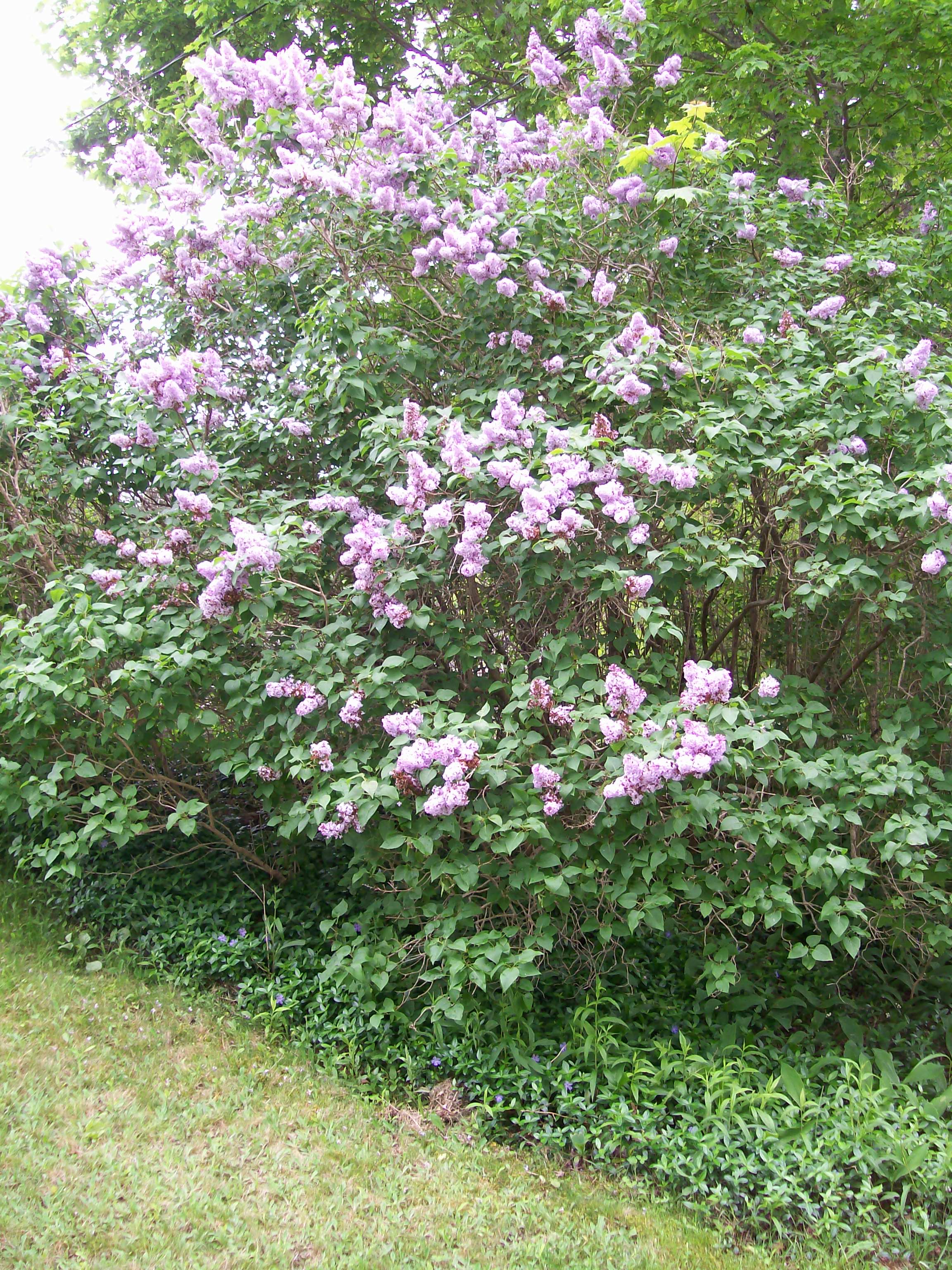
And we know it has been a cold spring, because the lilacs are in their glory.  Most years they are past or fading when we arrive.

lilacs

So many lilacs that the poem by Alfred Noyes starts running through my mind:

Go down to Kew in lilac time, in lilac time, in lilac time
Go down to Kew in lilac time.  It isn’t far from London.
And you shall wander hand in hand . . .

It’s from Noyes’s most quoted poem, “The Barrel Organ.”  I remember more fondly “The Highway Man” who came riding, riding, “When the moon is a ghostly galleon.”  Neither is great poetry, yet they’ve lasted.  They stick in the brain.  I’ve never been to Kew, and as I look at the moon I sometimes wonder which shape Noyes thought looked like a galleon, but how the words stick!

100_0825

A Treat for Both Sides of the Mind

1 Comment

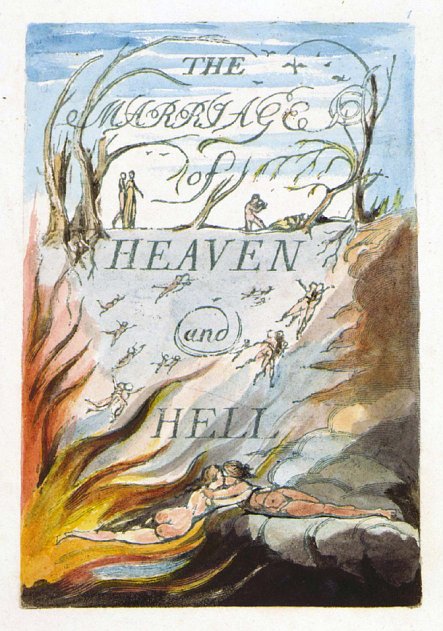
MoH&H_titleWilliam Blake’s The Marriage of Heaven and Hell is a work to delight both the poet and the freethinker.  It is a short book that combines language and art, serious ideas and comedy.

Most of us know Blake, if at all, for his short poems, like “The Tiger”:

Tiger, tiger, burning bright
In the forests of the night

or “The New Jerusalem”

Till we have built Jerusalem
In England’s green and pleasant land.

The latter is an introduction to a long work titled “Milton” though the Milton who appears in this tale is not the actual writer.  “Milton” is forty five pages of tiny script and complex images, telling an equally complex story.

“The Marriage of Heaven and Hell” is shorter, easier to follow, and fascinating for both the ideas and the language.  Blake constructed these books by etching copper plates, printing and then hand coloring each page.  “The Marriage of Heaven and Hell” consists of 27 such pages.  There are nine copies in existence; fortunately reproductions can be found in quite a variety of editions, some very inexpensive.  These editions usually print out the text as well, for those spots where Blake’s script is difficult to interpret.

Blake was a Nonconformist, which means that he was not a member of the Church of England.  He did not fully align with the other nonconformist traditions either.  His little book is partly a tirade against priests, of all times and places, and partly a celebration of creative energies.

What might be called Blake’s thesis statement is found on page 3:

Without Contraries is no progression. Attraction and Repulsion, Reason and Energy, Love and Hate, are necessary to human existence.
From these contraries spring what the religious call Good and Evil. Good is the passive that obeys Reason.  Evil is the active springing from Energy.  Good is Heaven.  Evil is Hell.

It will follow that in this dichotomy, hell is the more interesting place to be.  A few pages later, Blake comments:

The reason Milton wrote in fetters when he wrote of Angels & God, and at liberty when of Devils & Hell is because he was a true Poet and of the Devil’s party without knowing it.

Three pages are given over to “Proverbs of Hell,” a wide range of short statements.  Here are just a few:

In seed time learn, in harvest teach, in winter enjoy.
The road of excess leads to the palace of wisdom.
A fool sees not the same tree that a wise man sees.
No bird soars too high if he soars with his own wings.
You never know what is enough unless you know what is more than enough.

These proverbs, which send the mind going in many different ways are followed by three sections entitled “A Memorable Fancy” in which angels and devils and giants all appear and further commentary against such errors are trying to separate body and soul, or make peace between two classes of humans he calls the Prolific and the Devouring.  By the first he means the creators.  The second are those who only consume because they cannot create.

I have only picked out samples from the book.  To get the sense of the whole, you will need to go read it yourself.  After reading a copy from the library, I bought my own copy from Powell’s for $5.00.

Finding Troy

3 Comments

The Greeks turn up in unexpected places.  Recently I found them in Ray Bradbury’s Zen in the Art of Writing.  I suppose most writers are guilty of seeking out and devouring books about writing.  We read every one that comes to our attention, even though, after about five of them, each may only provide one new idea or trick for keeping at the writing craft.  It was a quotation on a LinkedIn group which brought Bradbury to my attention.  It had been several months since I’d read a good craft book so I tracked down a used copy.

The book is a collection of essays about Bradbury’s own work, his methods, his efforts at teaching.  It is well worth reading although you may, as I did, feel a bit jealous when he speaks of being able to type out a full story in one short sitting.

The Greeks show up not among the Martians and other aliens with whom Bradbury has spent most of his time, but in one of the poems that form a sort of coda to the book, in the form of Troy.  Troy is a symbol of archaeological work, the digging and finding of treasure, as it was when Schliemann excavated there in the late nineteenth century.  For Bradbury it becomes a metaphor for his finding his own unique path in life.  Others tried to dissuade him, but “I knew my Troy.” he says. He had to keep it secret. however.   “I dug when all their backs were turned.” he says, in order to avoid the scorn of those who did not believe.  He concludes the poem speaking about what he found:

One Troy? No, ten!
Ten Troys? No, two times ten!  Three dozen!
And each a richer, finer, brighter cousin!
All in my flesh and blood,
And each one true.
So what’s this mean?
Go dig the Troy in you!

How satisfying that he can stay with and expand that one image, that Troy that has been magical since Homer.  It rings and resonates.

For me, one Greek leads to another, one archaeological site leads to another.  Schliemann, who found Troy, also unearthed gold masks and other riches at Mycenae where Agamemnon ruled.  He went looking for Pylos, the home of Nestor, the wise older advisor of the Iliad.  Like Schliemann, I cannot settle on one site.  But Bradbury does promise many Troys.

There are nine layers at Hissarlik, the site of Troy.  Schliemann was wrong about which was the Homeric Troy.  He thought Priam’s Troy was the second layer; it appears now to have been the sixth.  Layers are also metaphor: the layer of history is overlaid by the layer of excavation in the tales of the place; between what we learn and what happened there is always a big gap, but the set of tales about what was found adds its own layer to the story.

Each of us, Bradbury suggests, has our Troy or series of Troys to find, though we would be wise not to talk too much about them.  Mine is the next poem project; it always takes some searching to find what I’m after.  May you be fortunate in finding your Troy.

Recommendation: Joe Somoza

2 Comments

I Thought of Buying

a new shirt to
walk around in
San Francisco.
But then I thought, “Why not
wear my old shirt
with the warped, stretched
collar and fade spots.”?
I don’t want to “visit”
San Francisco:
I want to live there
for however long
our stay, the way
I’ve lived inside
my green shirt with its
emblem on the pocket
grown more
faded with every washing.
I want to be
a San Franciscan there,
stop at Bob’s for lunch,
next to that tobacco shop on
Polk Street where other
San Franciscans walk by in their
everyday faded wear, wearing
usual faces that might
look in on me
having lunch there
at a booth
beside the window.

This is my favorite poem in Joseph Somoza’s new collection Miraculous.  I like it both for the craft and for the idea, because I too would like to “live” in San Francisco for as long as my visit might last, to be a casual part of it.  He has captured that longing well.

The book is a collection of twenty-five love poems.  Many express love for his wife, Jill, others, like the one above, love for places, still others love of words or love of life.

Here’s one that’s mostly word play:

Ground

The ground, like coffee grounds
spilled on the ground and
ground together with ground by the
rain drop by drop that dropped
down to the ground, pitting it
among twigs, stones, ants, and,
here and there, grass stalks that
don’t stalk and don’t talk, I talk for
them in a presumptuous way
trying to be the sumptuous way they
green the ground green wherever
they are, grown from the ground
up
to where the rain rains
and the sun suns.

And here’s the beginning and end of “When She’s Gone”:

She’s out
shopping, and as often
happens when she’s gone,
corners of the house
begin to fill
with her―the stove
where she left today’s
bean soup warming
for me to watch, . . .

It’s only because she’s
gone that I can
tell you this.
It’s because she’s not
around to talk to
that it occurs to me.

For the rest of this poem, and the other twenty-two, buy the book, which is enhanced by drawings by Louis Ocepek.  His sketches of stray items suit the mood of the poems well.  Miraculous is produced by blurb.com: http://www.blurb.com/b/3809469-miraculous.

Somoza’s latest full length book is Shock of White Hair, published by Sin Fronteras Press and available on Amazon.

What Freethinkers Believe, according to Edith Wilson Roberts

1 Comment

John Emerson Roberts’s third wife, Edith, who, I am sad to admit, is not my great-grandmother, had a second opportunity to speak from her husband’s lectern in March of 1902. This appearance lacked some of the drama, excitement, and newspaper attention of her speech about divorce a year earlier, but the lecture was printed and a copy is preserved in the New York Public Library.  What follows is all from the book, John Emerson Roberts: Kansas City’s “Up-to-date” Freethought Preacher.
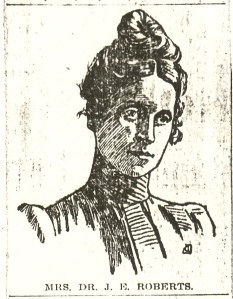
Newspaper drawing of Edith Wilson Roberts

Newspaper drawing of Edith Wilson Roberts

In January,[1902] the Lexington News, the weekly paper of a small town not far from Kansas City, printed an editorial declaring that Roberts was “A Dangerous Man.” The News chastised the Kansas City papers for printing material from Roberts’s lectures, claiming that Christianity was the source of the progress of civilization and that “the belief in a just and merciful God is a stay in time of temptation, a solace in trouble and a prop to virtue” for those who could expect nothing but toil in this life. The editorial goes on to say that the Kansas City papers ought not to be printing speeches designed to deprive people of the comfort of religion. The writer presents the hope of heaven, but no doubt also has in mind the fear of hell, as belief that preserves proper moral conduct and good order in society. He charges that Roberts is a man who wants to “destroy the only settled hope of mankind for the future and who offers nothing in place thereof,” and concludes that those who appreciate his message are very few. . . . .

The opening of the lecture is a description of freethought: “They say our creed is unbelief, and dreamy speculation. This we have the honor to deny. It is not so. We are Free-Thinkers, if you please, but Free-Thinkers with profound convictions.” . . . .


After some comments on negative elements in the Bible Mrs. Roberts presents a list of twenty-four items, each beginning “We believe . . .” which she calls “the doctrines of the Church of This World.” She immediately adds, “Of course my statement is subject to the variation of your individual beliefs, without which variation no church or creed can be honest for all included within it.”

She begins with the importance of intellectual honesty, and then repeats the common quotation from Ingersoll:
We believe that “happiness is the only good, that the place to be happy is here, the time to be happy is now, the way to be happy is to try to make others so.”

Only a few of her twenty-four items touch on the issues Christian creeds focus on, and they are tentative:
We believe that if God is, he is moral, sane, just, wise and kind, and that if there be any service that we can render him, it is by keeping our bodies pure, our minds enlightened, and by serving our fellowman.
We believe that this life properly lived will best fit us for another life, if another life there be.

One set of statements covers her view of the natural order:
We believe that Law governs all things, that it is universal and eternal, and that it executes itself.
We believe in Sequence, the mighty theory of a sufficient cause for every effect.
We believe that there is no forgiveness, no punishment—only consequences; that virtue is its own reward, sin its own misery.
We believe in the law of Progress which Science calls Evolution; that the world was never perfect, but is tending towards perfection.

These crisp and specific statements bear little resemblance to the flowing style Dr. Roberts used. The ideas, however, are the same. He has been referring to laws of nature, cause and effect, the fact that sin has consequences, not punishment, and, especially, progress toward perfection, since his days as a Unitarian.

By far the bulk of Mrs. Roberts’s statements concern behavior, citing the importance of helping the weak, of education, equality, kindness; that no one has a right to be useless, nor has anyone a right to take another’s life. A number of her statements focus on home life and echo the sentiments of her talk on marriage and divorce given the year before:
We believe that [quoting Ingersoll]: “it is as great to be a woman as to be a man, and nothing is greater than the mother of men.”
We believe in the home; that there is no better thing on earth, no fairer paradise in all the skies, than the home where true love dwells.
We believe in the purity of childhood.
We believe the most sacred duty of our human lives is our duty to our children; that we are responsible for those we bring into being.

Following this list, Mrs. Roberts returns to the charges of the Lexington newspaper article, which claims that Roberts’s religion has nothing to offer “the lowly.” She argues the opposite:

But I say unto you—the home of the lowly is as sacred as the home of the rich. The love of the toiler, I ween, is as sweet. The laborer surely knows rapture in watching his children grow; and he may also have the profound satisfaction of working for them and their mother. And if he cannot provide for the wants of his family—if they are hungry, and illy-clothed, and illy-housed—will the heart of the “lowly” man—if he be indeed a man—be comforted by a future heaven? Can future bliss compensate for the anguish of that cry when children go hungry to bed?

It seems unlikely that Mrs. Roberts has been close to the home life of members of the laboring class. She is speaking instead from her own experience, as the mother of two boys, now seven and four, and the step-mother of three other children. She is also immersed in the ethos of the Victorian era with its idealization of children and motherhood, just as her husband and her audience are. In spite of this, her conclusion is valid. The poor man is smart enough to recognize that “future bliss” does not feed his children.

The Warp of History

1 Comment

Perhaps a better title for this reflection would be “How One’s Sense of History Gets Warped.”

The Victorian Era has always had special interest for me, long before I discovered the work of John Emerson Roberts.  As a child, I don’t think I understood the difference between “gilded” and “golden.”  When I heard people discussing the Gilded Age, I thought they spoke of a past universally esteemed better than the present.  As an era of long skirts and fine manners, I thought this must have been a splendid time, when people lived in a special golden light.  Like some ancient writers, I thought the present was flat compared to the past, an age of iron descended from an age of gold.

Currently, I cannot hear the term “Gilded Age” without thinking, if it isn’t said, “and Progressive Era.”  The period from roughly 1877 to 1920 has been labeled and marked off with this double title.  And a golden age it certainly was not.  It was an era of new ideas and inventions, but also one of urban and labor unrest and, in the United States particularly, of fear of immigrant populations.

My sense of the early 1950s was also skewed.  As I looked back on it from the sixties it seemed to have been an era of “returning to normal” after World War II.  I know now that it was not.  It was a new age of consumer goods and suburbs.  Cars and gas were now available and roads were rapidly being expanded.  Factories that had been geared up for war materials were converted to producing consumer goods.  It was also a time of great conformity.  People knew more about people who lived in other places, but that did not lead to appreciation of diversity.  Radio and soon television produced images of the right way to live, the “typical” family, and all the things that family should acquire.

As for a “return to normal” it slowly dawned on me that there had never been a “normal.”  Before World War II had been the Great Depression, before that the “Roaring 20’s” and Prohibition, and before that another war, the first and most disturbing, because unexpected, of the grim and ugly wars that characterized the twentieth century.  In another post I will expand on what I have learned about the cultural shock of World War I, which shattered the widely held belief in an ongoing progress of humanity and its projects, the cultural attitude which John Emerson Roberts held to as long as he was preaching.

As my confusion about “golden” and “gilded” lingered, I thought “normal” might have been back around 1899 or so.  Now I understand that every era in United States history has been one of transition from a past with difficulties toward an unknown future.  Change has been a constant feature and a great many mistakes have been made along the way.

Was it a case of inadequate education that I had these erroneous notions?  I don’t think so.  I think all children are subject to misconceptions, which the text books can’t erase easily, because the adults who write them have forgotten such possibilities.  Was I a child with too much imagination?  I don’t think there is such a thing as too much imagination.  It’s how you learn to use it that counts.  Sorting out these puzzles was an important part of my learning.

A February Recollection

2 Comments

A small almond tree grew in the front yard of my childhood home in California. It was grown not for its nuts but for the white flowers of February, for its elegance in the center of the lawn.  I learned to climb on that tree, but it did not satisfy me for long.

Our house was built on property that was originally part of my grandfather’s lot. His walnut orchard extended behind our house.  He produced a good crop.  The sturdiest trees had a horizontal limb so high off the ground it required jungle gym strength to pull oneself up.  I don’t know if I was really too weak or just too timid; I left those trees to my brothers.

One tree in the middle of the orchard was just my size.  I could climb up and look out, through branches that had not yet leafed out, at the brown plowed ground and the brown bark of the larger trees.  I was a climber, I was a traveler, a champion, as I sat there, safe in the crotch of the runt of the orchard.


First Anniversary

6 Comments

Today, February 8, this blog is one year old.  A year ago I thought it would be quite a challenge to keep going so long.  This is my 102nd post.  Perhaps I am hitting my stride.

The life span of blogs is more like that of cats than humans.  At one year old this blog is past its infancy (It has learned to walk and talk) and adolescence (I’ve learned a variety of techniques and made some long term connections) and is into the stage of young adulthood, finding its on-going role in the world.

Much of this blogging world is still a mystery to me.  I’ve seen some blogs disappear, others go dormant.  Some have thousands of followers, and I can’t figure out how they got there.  My numbers are small in comparison, but I appreciate all who follow, and all who comment.  You have been a wonderful audience.

Sotol on Baylor Canyon Trail

Sotol on Baylor Canyon Trail


I’m moving into my second year of blogging with the expectation of new and better things to come: guest blogging perhaps, and more recommendations, and links with other like-minded blogs.  But I’ll continue to pretend that my mix of freethinking and metaphor is unique, special.  Aren’t we all?  Plants may be fine examples of their species, like this sotol I noticed on a hike in January, but every human being is different.  Thank goodness!  Keep visiting to see what comes next.

Inspiring Blogger Award

4 Comments

I’ve been nominated for the “Very Inspiring Blogger Award.”  This is a real honor because it comes from one whose blog is truly inspiring.  Pat Garcia tells the stories of courageous and neglected heroes of history at http://garciaandwalkon.me/  I would nominate her first if she hadn’t already nominated me.

very-inspiring-blogger-award1

In accepting this award I am supposed to say seven things about myself and nominate fifteen other blogs.

Seven things:
1.  I’m a poet who has not taken a class in poetry since seventh grade.  I have, however, attended lots of workshops.
2.  I’ve only lived in New Mexico for eight years; I’m still in love with desert and mountains.
3. I’m a member and past President of the Sacred Dance Guild.
4.  My favorite color is green.
5.  It took me seventeen years to write my biography, John Emerson Roberts: Kansas City’s “Up-to-date” Freethought Preacher.
6.  To get that project started I earned a Ph. D. in American Religious Studies from Temple University.
7.  My current project is a response in poems to William Paley’s Natural Theology (1802), the publication that made famous the metaphor of God as watchmaker.  My response focuses on how much has changed.

It’s a stretch to find fifteen blogs to nominate when my predecessors have recently nominated many fine blogs that I also follow.  Here are twelve.

The Needy Helper (Lee Davy)  www.needyhelper.com/ Anyone who sets out to read 52 books in 52 weeks inspires me.

Twigs & Stones (http://twigsandstones-poems.blogspot.com/)  Tanka and other short poems.

The One Earth Project (http://leevanham.com/blog/)  Can we live with the reality that we have only one earth’s worth of resources, not five?

Dialogues on exploring the gap (http://explorethegap.wordpress.com/) “Where people of science, religion, faith and spirituality come to talk.”

Digest This (http://www.digest-this.com/)  Addressed to the human constituency.

http://200newmexicopoems.wordpress.com/ A compendium of poems about New Mexico.

Things I Want To Tell My Mother (http://warnerwriting.wordpress.com/)  On memories and dealing with dementia.

http://craighill.net/ Perspectives on news and history from Australia and China.

Ellis Nelson (http://ellisnelson.com/)  Author of Into the Land of Snows.

http://houseboathouse.blogspot.com/#!/ Rose Mary Boehm, a woman of many talents, and a unique way with a website.

Carlos Navarro (http://breadnm.blogspot.com/) A blog supporting Bread for the World in New Mexico.

Lisa Michaels (http://lisa-michaels.com/blog/) Learn how to align your energy with the natural rhythms of the universe.

Coping with the Critic

4 Comments

I have read many books on writing and creativity.  I’ve probably reached the point of diminishing returns, but I keep picking them up, especially when I can get them second hand, because I’ve learned a lot from some of them.  Almost all of these books talk about “the critic.”  This critic may be the internalized voice of others who’ve told you you’re not competent to do what you set out to do.  Or it may be a voice all your own, telling you that nothing you do is measuring up to your own standard.  In either case, one of the early lessons in creativity books is the importance of shutting this voice out when you sit down to write.  There are various methods suggested: breathing meditation, write a letter, . . . .

I have found a different solution.  I promoted my critic to editor.  An editor must have something to criticize, so my critic now happily goes away until I have a draft to share: usually my first typed draft.  Then he comes running in.

At first he didn’t do very well at describing what he saw.  “Humph!” he might say, or “Boring!!”  Bit by bit, he’s picked up useful terms.

“Cliché!”  he says.  I underline the phrase he’s pointed to.

“Action verbs!” he cries.  I circle the “is.”

After such obvious points, he slows down, ponders.  “Why is this in such regular stanzas?” he asks after a bit.  “That’s your default form.  Does that really enact the feeling of the poem?”  My critic has been very pleased with himself since he learned the word “enact.”

“I was resisting it,” I say, noncommittally. “Form can pull against content.”  But I know he won’t accept my argument.

“It’s not strong enough,” he says.

“I’ll try it another way.  Just to see what happens,” I say.  I settle down to revision, and my critic goes off to look for another new term he can use at the next editorial session.  I can work alone now ―at least until he hears the printer start up.

Older Entries Newer Entries