Home

Celebrating June

Leave a comment

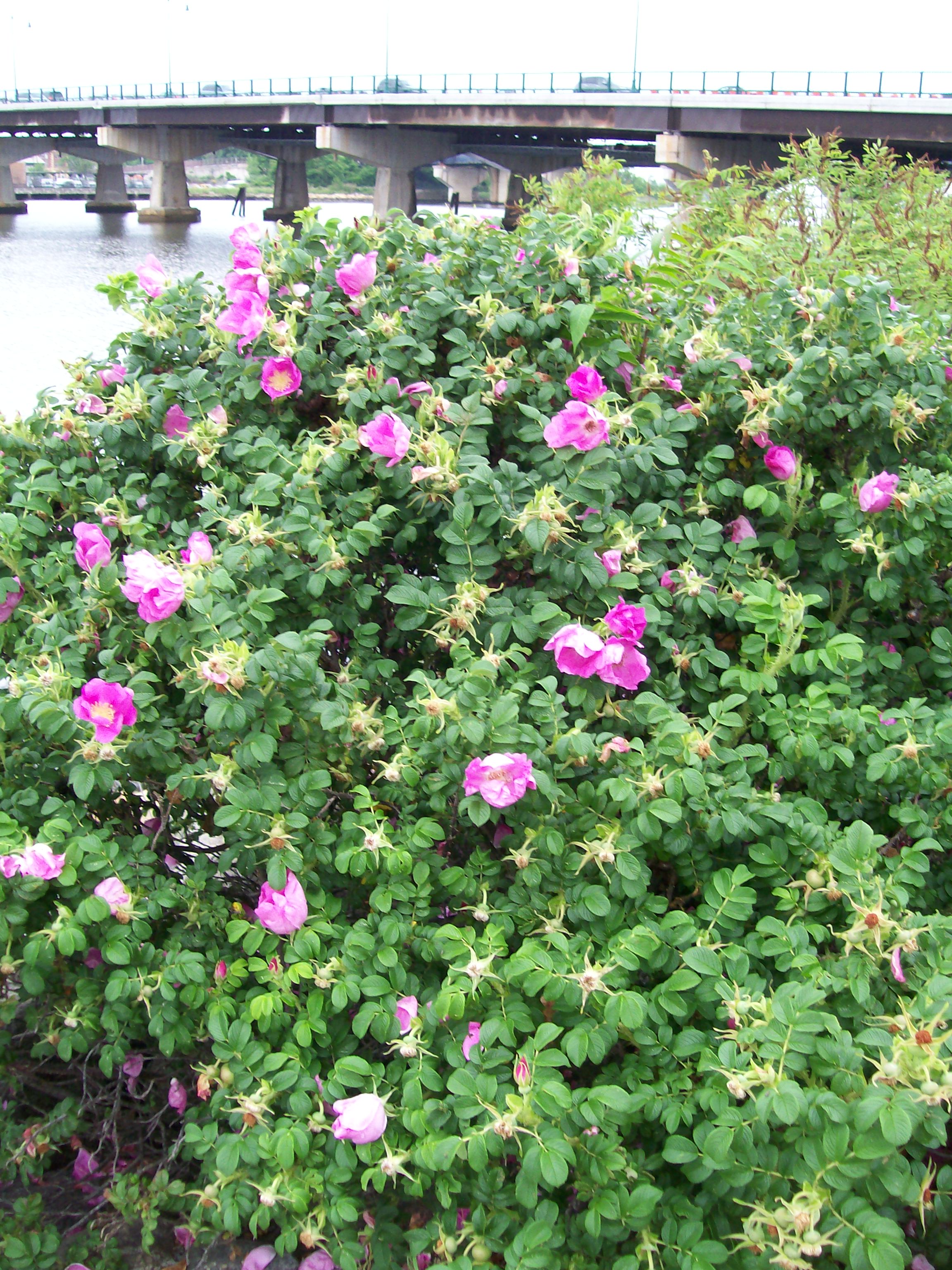
Wild Rose, Neponset River, Quincy, MA

It’s June, and James Russell Lowell’s prelude to The Vision of Sir Launfal comes to mind:

And what is so rare as a day in June?
Then, if ever, come perfect days;
Then heaven tries earth if it be in tune,
And over it softly her warm ear lays:
Whether we look, or whether we listen,
We hear life murmur, or see it glisten;
Every clod feels a stir of might,
An instinct within it that reaches and towers,
And, grasping blindly above it for light,
Climbs to a soul in grass and flowers; . . .

And that is as far as my memorization as a young person went.  I did not know this June as a young person, but I thought I did.  When I came to the clod I pictured the freshly plowed orchard beside my house, ignoring the fact that the plowing happened long before June.  June where I grew up could be hot, uncomfortably so.

This passage celebrates June in New England.  I know that now, because I visit Maine in June.  The fact that the description didn’t fit my experience was no concern to me as a young person.  Without realizing it – until I thought back much later – I put the world of books and words in a separate compartment from the world I lived in.  It did not occur to me that those New England writers which formed so much of my education were trying to convey real experience.  From where I stood, on the west coast, it might as well all be imaginary.

What is your experience in finding the relation between literature and life?
Does Geography Really Shift?

2 Comments

As I prepared for a lecture I will give in the Boston area today on John Emerson Roberts I realized that I need to make a case for why Unitarians in Milton, Massachusetts, should be interested in what happened in Kansas City, Missouri, a hundred years ago.  It’s not a difficult case to make for those who are historically minded, because the events I describe affected the Unitarian denomination as a whole.  The question has reminded me, however, of how different geography appears depending on where you stand.

As a child growing up in California I had in my head a very simple map of the United States.  there was a blue line down the middle: the Mississippi River.  East of this everything was green and lumpy, west of it, all was flat and yellow, until one reached the border of California, whose topography I knew well from the flour and water maps we made in fourth grade.  You don’t have to have seen much of the middle of the country to realize how far off my notions were.  At the very least, I had seriously misplaced the big blue line.

When I moved to the Boston area for college, New England expanded hugely in my mind.  And when we settled in Philadelphia the Mid-Atlantic states were added to my area of familiarity.  The rest of the country shrank in comparison.  I had to remind myself that the 600 miles between Philadelphia and Deer Isle, Maine, were a small part of the country, even though we covered six states.

We are fortunate now to live in Las Cruces, New Mexico, and to travel to Maine by car.  Now I know something of many more states.  We’ve driven past the geographic midpoint of the contiguous forty-eight states in northern Kansas.  We’ve taken different routes across Kansas, Missouri, Illinois, Indian, Ohio and sometimes Kentucky and Tennessee.

The knowledge one gets from being in a place is different from map study and geography tests.  I don’t have to stop and ponder to remember that Nebraska (home of Dorothy Lynch dressing) is north of Kansas, and Iowa, where I followed a piece of the Mormon trail, is north of Missouri. I’ve been there.  It is a big, beautiful and―especially when you avoid the interstates―diverse country.  Yet, what happens in one place can affect all the rest.

You can read about the “Western Controversy” and why it mattered to Unitarians, in my book, John Emerson Roberts: Kansas City’s “Up-to date” Freethought Preacher, available from me through Amazon or via the contact page.

What will the end be?

4 Comments

If you are a booklover as I am, can you imagine a better final end than this?

            Booklover

First editions, clean and primly
jacketed, bore me.  I cherish those
lived in, lived with, a note card or
flower left between pages.

I have pored through such tomes
as if to find in them a future
project, a new idea.  I
can see clearly now my

self on a back shelf in a used
bookstore, loose cover, yellow pages,
among books not classified: is it
history, is it romance, is it

worth the paper it’s printed on?
The seller believes there’s a circle
in hell for those who burn books,
will find a ring in purgatory for

those who cannot discard one.  He
never comes here to dust.  I lean
against another volume, convinced 
there are worse ends than this.

This poem is from my collection in Ascent: Five Southwestern Women Poets (see Books page.)

Surviving the Cruise

Leave a comment

A few years ago my husband and I went on a fancy cruise to Alaska’s Inland Passage.  We’re glad we did, we couldn’t have visited the area any other way, and it was well worth seeing.  But a week was not enough to accustom us to the curious ways of cruise companies.

First comes the financing.  We pay a fee that is supposed to cover everything.  Then come the offers for on-shore excursions.  This is where the cruise line makes much of its money.  We chose only a few of the simplest offers and did well exploring on our own the rest of the time.  No doubt we missed some big sights, but we found many interesting nooks and crannies.

As for the ship, the food was fine, but what else was there to do?  The library was useless.  There was art, jewelry and more to buy, none of which we needed.  The ship got us where we wanted to go.  That, fortunately, was enough.

This past year I have had a similar cruise experience getting my book about John Emerson Roberts published.  I chose to go with a major company because I was stuck on the index, and because I had footnotes, I had to buy a fancy package.

Like Holland America or Carnival Cruise Lines, the directors of my cruise thought they knew what would work best for me. I spent a lot of time saying no.  “No, this is not what I want.”  “No, this isn’t right yet.”  “No, you have the title wrong.”  “No, this is a non-fiction book; don’t use fiction-style page headers.”

At last the book is at the dock.  Then the on-shore offers begin.  The company makes its money, it turns out, on marketing.  “For 2,500 dollars, that’s 20% off . . .” or “This is a $4,000 package but we’ll give it to you for $3,500.”

“This book has a niche market,” I say again and again.  “How will this blanket emailing, this TV ad offer, this one-time New York Times ad, reach my target audience?”  I get no answer.

The first-year payment on the fancy website they created, but did not give me access to, has just run out.  So I abandon the cruise ship and set off on foot with my shipment of books.  The adventure has taken a new turn.

And I start this blog.

If Society Were Child’s Play

Leave a comment

William Paley (see entry on “My Current Obsession”) and William Blake were contemporaries who never met.  They represent opposite views of society, religion and much else.  Picture them as two six inch pieces of wood, a square pillar (Paley, Anglican clergyman) and a round column (Blake, nonconformist and visionary).  I see them lying on a green wall to wall carpet near a wooden box with holes.  The child who plays there has wandered off.

The pillar has been in and out of the box several times.  The column is too wide to fit.

“Square up, man,” the pillar says to the column.  “Then you can join the party.”

The column protests, “I cannot be four-faced, confined to opposites.”

“But see, the holes are square.  This is our proper shape.”

“If all are square, society is too boxed in for me.”

“You’ll end up all alone.”

“I can live with that.  My dreams are different, my desire’s to roll.”

“Don’t be stubborn,” the pillar pleads.  “You’ll find it’s not so bad.”

“The same as not so good,” the column counters.  “I’ve wider visions.”

“It’s just a slice or two . .”

“Or four, I gather.”

“You’re fat!”

“I’m a well-proportioned cylinder, you fence post!  Why blame me if I don’t fit in?  I say the holes are wrong.”

“Your core remains.  You’ll be the same inside.”

“I’d lose my voice, my round cadences.  Better to sing out here than narrow to a sigh.”

“It’s what we’re made for.  You’ll be a part . . .”

“With a splintered heart!  For wholeness, I must keep apart.”


Questions of Scale

Leave a comment

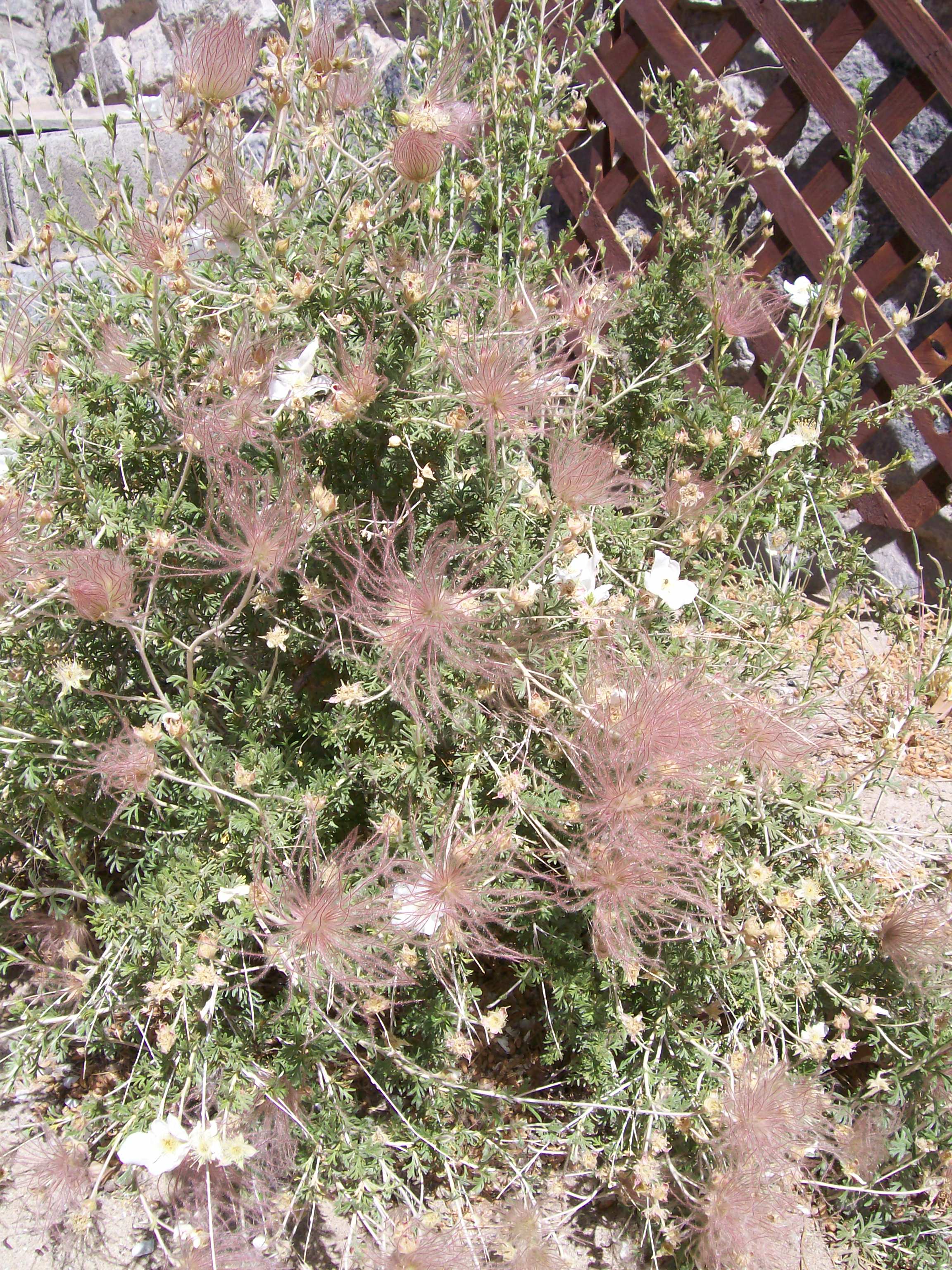
Apache Plume (Fallugia paradoxa, a member of the rose family) has been in bloom in our area recently.  I first learned about Apache Plume in a nature guide at Dripping Springs, a BLM recreation area in the Organ Mountains.  Nothing was in bloom at the time; I could not guess which plant beside the trail the guide referred to.

Reading that the plant was named for the seed plumes, which look like Apache war bonnets, I pictured something grand.  It was at first a disappointment to discover that the five-petalled white flowers are about 1 ½ inches across.  The seed heads are pink plumes of about the same size.  The pink soon turns brown and the seeds are blown away by the wind.  The plant is beautiful in bloom, in the seed stage or, as here, at half and half.  The season is short: for most of the year all one sees are the small clustered leaves on an often straggly plant.

Who first saw a war bonnet in this small, delicate shape?  Was it someone for whom raids by Native tribes were a real and present danger?  Was it someone who recalled such raids as recent and treasured history?

To see the large in the small requires a certain kind of creativity, a talent for comparison across difference.  To see the small in the large may be an even rarer gift―or perhaps it simply is not mine.  The ability to see similarities in things of different scale is the way of metaphor, an important tool for poets and others who seek to see things in fresh ways.

Robert Ingersoll asks “Which Way”

2 Comments

Robert Ingersoll, the most popular lecturer of the nineteenth century, presented a new freethought lecture called “Which Way” in the 1880s.  It brings up some interesting points for our day.

His primary question is threefold “How shall we civilize the world?  How shall we protect, life, liberty, property and reputations?  How shall we do away with crime and poverty?”  There was hope in the late nineteenth century that these questions might find answers.  The events of the last one hundred and thirty years suggest otherwise.

Ingersoll points out the lack of success of “the churches” in answering these questions.  He spends a lot of time on the God portrayed in Genesis.  Did this God advise or instruct his new human beings?  No, he just said “You shall not eat of this tree.”  Did he forgive and comfort when they sinned?  No, he punished them. 

He asks, “Are we to be governed by a Supernatural Being, or are we to govern ourselves?”  The answer is obvious to him. “I take the democratic side,” he says.  That “Supernatural Being” is a figure called on by tyrants and despots, princes and popes, to support the status quo.  

Ingersoll doesn’t go as far as we might today to show how the God those rulers called on to maintain their power was made after their own image.  He doesn’t need to because not just some, but most of his audience had been raised to believe that Genesis is history; that the punishing God is the only option.  In Ingersoll’s day good people still believed that the fear of hell helped to preserve social order.  Ingersoll disagrees: 

There is no reforming power in fear.  You can scare a man, maybe, so bad that he won’t do a thing, but you can’t scare him so bad he won’t want to do it.  There is no reforming power in punishment or brute force.

That’s one lesson we as a community have not learned to this day.  We also have made no progress, perhaps have even gone backward, in this:

You may ask me what I want.  Well, in the first place I want to get theology out of government.  It has no business there.  Man gets his authority from man, and is responsible only to man.  I want to get theology out of politics.  Our ancestors in 1776 retired God from politics, because of the jealousies among the churches, and the result has been splendid for mankind.  I want to get theology out of education.  Teach the children what somebody knows, not what somebody guesses. 

Robert Ingersoll was intensely patriotic.  I believe he would be quite discouraged to see how little progress our nation has made in these matters since his time.  Which way should we turn to find a solution to our present situation?


Introducing My Current Obsession

2 Comments

“Obsession,” one of my poems in Ascent (see Books page) begins:

I’m fixed on this book
like a three-year-old on trucks,
a five-year-old on dinosaurs.  You could
make it my motif, were I young
enough for birthday parties.

The book I refer to is William Paley’s <i>Natural Theology</i>, published in 1802.  This book from a long past era presents nature, particularly the human body, as evidence not merely that there is a God but that this God is wise and good.   The eye, the ear, the joints: each is a sufficient example, in design and practicality, of the skill of the Maker.  While I soon recognized that Paley’s world view was one of fixed order, incompatible with my awareness of evolution and change, his delight in all levels of creation was contagious.

The watch with which Paley begins his discussion is a controlling metaphor: as a watch must have had a maker, so the forms of nature must have been designed.  Paley is drawn to and impressed by all manner of mechanics, of which the watch is just one example.  He equally admires mills, telescopes, the new iron bridge he sees over the Wear River, and other human inventions, especially those in which he finds a parallel to some natural form.

Having spent two years in this man’s company (the man is actually hidden behind the book, but I have come to talk as if this is as a personal acquaintance) I am now in the process of sorting and sifting the pieces that came out of this “time together” to create a book―my book in response to his book.

I have decided that obsession is a good thing for a writer.  Perhaps it is even a necessary thing in the development of one’s art.

May Days

2 Comments

I have a theory about Cinco de Mayo.  I believe its popularity is partly due to its proximity to May 1, the spring cross-quarter day.

Cross quarter days mark the half-way points between solstices and equinoxes, which are also the events which mark our sun-based seasons: winter begins about December 21, on the winter solstice, spring on the equinox in March, and so on.  I’ve made a clumsy sketch of this.

The cross-quarter days, October 31, February 2, May 1 and August 1, midpoints in the sun’s move from equal day/night to longest or shortest day, to equal day/night again, have been celebrated since ancient times.  For some these were the beginnings of seasons, for others a time to move cattle or start crops, for still others a time of purification.

Given the contemporary enthusiasm for Halloween, I’m surprised that I didn’t make the connection for Cinco de Mayo sooner.  Halloween is a multiply corrupted holiday, having begun as Samhain in its Celtic manifestation, and been converted to “All Hallows Eve” by the Christian church, which cannily placed its festivals on traditional dates whenever possible.  Current celebrations ignore both the connection to All Saints Day and the purification and preparation for winter qualities of earlier usage.

The original May Day (Beltane to current Wiccans) was the beginning of summer.  People celebrated fertility with flowers and Maypole, and for herders it included moving herds to their summer pasture.

While Christians have often fretted over confusion with ancient practices, freethinkers should see no problem with celebrating the cycle of the year.  Though we may have no crops to plant or cattle to move, we are still made of the stuff of earth and should be aware of its turning.

But if you missed May 1, enjoy Cinco de Mayo, a festival built on a small battle victory, which happened to fall at a time when our bodies’ link to the earth tells us it’s a time to celebrate.

Word Play: Ramke’s and Mine

Leave a comment

 Bin Ramke’s poems are not easy reading, but I find them fascinating in their particulars.  In “Tendrils” (Theory of Mind: New & Selected Poems, p. 191), he writes:

“Replicate” can be pronounced several different ways―one of these, as an adjective, can refer to an insect wing folded back on itself.  From the Latin plicare, to fold, also replicare, to unfold or to reply.  An answer as an unfolding.  To speak, for instance, to a figure with wings, and then to see the wings begin to unfold, as your answer.  As in, “I love you,” and she unfolds her wings to leave you.

Mid-paragraph I get up to check my own dictionaries, Latin and Oxford English. My dictionary says the Latin verb can also mean unrolling.  What’s the difference between a fold and a roll, I wonder.

Replica comes from the same root: a copy.  So that replicate is also to make a copy of.  Making copies is in Ramke’s poem too.  But I am stuck on folding, unfolding, and why isn’t it also refolding–folding again?

Making a copy neither unfolds nor answers.  Poems do not copy, nor do they give answers.  Poems unfold, but if I said “this poem replicates” you would be thoroughly confused, thus demonstrating that “replicate” no longer carries this third meaning.

This is no way to read a poem; I forget entirely what came before and so am unprepared to pick up the poem after this definitive interruption. (Rupture= break: erupt, disrupt, interrupt).  Is this Ramke’s fault?  I’m the one who went for the dictionary.

The “she” who unfolds her insect wings.  Why does she matter to him?  He doesn’t say.  His language hides her in its many folds.

Language will not stay still.

Older Entries Newer Entries