Home

Happy Birthday, Mr. Ingersoll!

3 Comments

Robert Green Ingersoll was born August 11, 1833, in New York State.  His father was a minister whose calling meant that the family moved frequently to different places.  Robert’s mother died when he was young, leaving two older sisters to “mother” him.

After service in the Civil War, which earned him the nickname “Colonel Bob,” Ingersoll became a successful lawyer, first in Peoria, Illinois, later in Washington, DC and then in New York City.  He first came to national attention as a speaker in 1876 when he made the nomination speech for James G. Blaine at the Republican National Convention.  Blaine lost out to Rutherford B. Hayes, but Ingersoll’s fame as a speaker was set.

Although he was involved with some headline trials, and gave many speeches in support of Republican candidates, Ingersoll’s real contribution to society was in his effort to bring reason to bear on the religious doctrines that flourished in his day.  Ingersoll’s father’s faith had been Calvinist, believing in the fallenness of humanity and God’s election of certain persons while condemning others to an eternal hell.  This strict orthodoxy was being challenged by the time Ingersoll began speaking out, as the churches struggled with developments in science, Biblical criticism, and other research.  In spite of the growing questions, an orthodoxy that focused on the hope of heaven and the fear of hell dominated popular thinking in the second half of the nineteenth century.

A lecture called “What Must We Do To Be Saved” was one of Ingersoll’s successful and repeated challenges to orthodox Christianity.  In this lecture, Ingersoll uses a review of the gospels in the New Testament to make his case.

He focuses first on the Gospel of Matthew.  He finds there the beatitudes (“Blessed are the merciful . . .”), the explanation of the Lord’s Prayer (“For if ye forgive men their trespasses, your Heavenly Father will also forgive you.”), and several other passages which support the idea that it is right behavior, not belief, that God asks of us.  Given the current state of Biblical criticism, however, he felt free to mark as an interpolation anything that did not fit with this developing picture.

Ingersoll went on to review the Gospel of Mark, where he found one text he found offensive; current Biblical scholarship agrees that it is a late addition.  The King James Version of the Bible includes without question the ending to Mark now seen as a pastiche of later interpretation, which includes the statement: “He that believeth and is baptized shall be saved; but he that believeth not shall be damned.”

Dismissing this selection as interpolation, Ingersoll finds Mark and also Luke basically in agreement with Matthew.  He dismisses the whole Gospel of John as written not by those who knew Jesus, but “by the church” and therefore not relevant to his argument.   From this survey Ingersoll concludes that the God of Jesus is merciful to those who show mercy, forgives those who forgive, operates according to the Golden Rule, and would in no circumstances send anyone to everlasting suffering in hell.  He closes the lecture by saying:

The honest man, the good woman, the happy child, have nothing to fear, either in this world or the world to come.
Upon that rock I stand.

“What Must We Do To Be Saved” is one of Ingersoll’s more gentle attacks on orthodoxy.  Sometimes he enlivened it with an introduction on the horrible deeds ascribed to the deity in the Old Testament.  In other lectures he focused on the books of Moses or on the crimes of the church in medieval times.  As he became better known he could expect to fill the largest hall in every city he visited.  He did not always speak on these issues.  People were eager to hear him on topics like Shakespeare, Robert Burns or Lincoln as well.

Ingersoll quickly became a favorite of freethinkers around the country.  He was giving popular credence to their claims and ideas.  After he died in 1899, one follower called Ingersoll “a prophet of the future, the light-bringing herald of the dawn.”  Ingersoll was placed alongside Thomas Paine as a second American freethought hero.

He’s one of my heroes because he did wonderful things with language.  His lectures are fun to read, with their rolling phrases and sly jabs.

For a full description of Ingersoll’s life and lectures, I recommend Frank Smith, Robert G. Ingersoll: A Life (Prometheus, 1990).

Recommendation: Sean Hill’s “Blood Ties and Brown Liquor”

4 Comments

I “discovered” Sean Hill through a poem published in Poetry magazine this past April.  Titled “Bemidji Blues,” it describes snow, shadow, cold and music in the city in which Hill now lives, Bemidji, MN.  The craft of this poem is wonderful―particularly its shape and the way in which he repeats words (in different meanings) as end rhymes―so I went looking for other work by him.

Hill’s first – and so far only – book, Blood Ties and Brown Liquor, (University of Georgia Press, 2008) describes a totally different world, the world in which Hill grew up, the town of Milledgeville, Georgia.  The craft is equally good, involving many different forms, and there are a variety of experiments.  The combination of this craftiness with the serious subject of what it was to be African American in earlier generations, is powerful.

This is the only book of poetry I have read which includes a genealogical chart – of a fictitious family.  Silas Wright and his forebears are a major subject of the book.  However, some of Hill’s actual family are also included, such as his grandmothers and their stories.

A series of six poems titled “b. Nov. 14, 1926: Grandmother poems” appears to draw on actual remembered stories.  Here is one of them:

#1: Ernest and the Plowing Bull

On the farm we growed cotton for sale and corn
greens potatoes peas sweet potatoes and okra to eat―
three milk cows a mule and chickens for eggs and meat.
I had two brothers, in 1921, ’22 and ’26 we was born.
Phineas the oldest Ernest next and I was the baby.
Lived with my mother and father, Inez and Charlie―we called
her Nin―and grandmother and grandfather, Eva and Sam.  Y’all’d
liked Ma Eva. She and Nin they’d go out for the cows and bring em
up to the house so we’d have milk fresh from the teat.
Ernest had a bull.  He broke him to the plow.  Bull named Pete.
He would plow and Ernest could even ride him.
They’d tromp through the yard―Ernest on top―looking to get cool
walk down to the pond and wade into that green brown pool.

I find the contrast of the sonnet form, with full rhyme scheme, the diction and the homey story-telling makes a great combination.  Only a few of the poems have such precise structure, but all combine skill in the form chosen with rich narrative.

One poem which is widely available on the internet, with good reason, is this short poem about Silas Wright learning to write his name.  It is balanced by a poem later in the book about the widowed Silas actually fishing and remembering his wife.

Silas Wright at Age Seven 1914

Silas Wright follows a fish’s wriggle
In the shallows between reeds. He scribes the
Line in his tablet—as much pride in that line
As a man in his son. He almost giggles—
Still he goes on. The next letters come easy.
With this he’ll have more than a mark to bind.
Rambling across the page again and again
In messy rows on it flows until he
Goes a little off the page’s edge. He smiles.
He’s surprised to hear when his mouth opens—
That’s mine.

Silas Fishing 1967

That heron yonder’s
a good fisherman―
patient―will wade
and wait.  But it ain’t
a good day for fishing―
neither of us having
no luck―just minnows
nibbling my bait.
There he goes―up and off
to another pond I suppose―
trailing those long legs, flapping
slow and steady.  I cried and cried
the day Mama died.  And it hurt
me deep when my wife . . . when
Devorah passed.  But I didn’t
shed a tear.  Been near ten years
and here they come
like the drops from
that heron’s feet.

There are many other characters in this book, vividly and gently presented.  They are a delight to know.  But Hill will not let the reader be too comfortable.  He starts the book with a reminder of how much was not right with this world in a brief preview poem titled “Southampton County, Virginia Aubade1831,” which refers to Nat Turner’s insurrection:

Some whites don’t rise with the sun
having departed in the night,
man woman and child, leaving behind none.
The sigh of a broadax mingled
with cricket and frog song.
The mockingbird greets the morning
with many tongues.

I highly recommend this book and will watch for new work by Sean Hill.

Coed College in 1870: Excerpts from my biography

4 Comments

Shurtleff College in Alton, Illinois was founded to develop an educated clergy, like many colleges, including Harvard and Yale.  Unlike Harvard and Yale, Shurtleff decided to admit women in 1869.  It happened because two women, Hasseltine Read, daughter of the College President, and Sarah Ellen Bulkley, daughter of an important professor, campaigned energetically for the opportunity to study.  The innovation was a success.  Two years later a total of twenty-six young women were enrolled in the preparatory school and the college.

The program at Shurtleff was divided into three terms of 13 1/2 weeks each.  Tuition was $8 per term.  College rooms could be rented for $4 per term, but separate arrangements had to be made for board, which was available in various clubs or boarding houses by the week.  Students also had the option of finding both board and lodging with a private family, for which the going rate was $4 or $5 per week.

What did they study?  Each course used one book per term.  Subjects included Latin, Greek, mathematics, and French or German.  There were other courses on Natural Theology and Moral Science.  The course on Moral Science used a text by Francis Wayland.

Wayland understood science . . . as a process of observation, deduction, and classification of elements of a fixed natural world.  He believed the human world of ethics could be similarly organized and he titled his text The Elements of Moral Science.  He began by comparing moral law to Newton’s laws of motion.  The consequences, he argued, were as certain, if not always as immediately obvious, as those of the force of gravity. . . .

Wayland further claimed that human beings were created to choose pleasure over pain, and were also intended to choose long-term over short-term pleasure.  He gave one example specifically aimed at students:

          Thus I am so formed that food is pleasant to me.  This, even if there were no necessity for eating, is a reason why I should eat it.  But I am also formed with a desire for knowledge.  This is a reason why I should study in order to obtain it.  That is, God intended me to derive happiness from both of these sources of gratification.  If, then, I eat in such a manner that I cannot study, or study in such a manner that I cannot eat, in either case I defeat his design concerning me by destroying those sources of happiness with which he has created me.

Wayland had definite ideas about how the material should be taught:

           Let the portion previously assigned for the exercise be so mastered by the pupil, both in plan and illustration, that he will be able to recite it in order and explain the connection of the different parts with each other without the necessity of assistance from his instructor. .
            Let the lesson which was recited on one day be invariably reviewed on the day succeeding.
            As soon as any considerable progress has been made in the work, let review from the beginning be commenced.  This should comprehend for one exercise as much as had been previously recited in two or three days; . . . .

The student who absorbed a whole text in this manner would in theory become able to develop his own ideas in a similar manner.  It is not clear where the student would get his own ideas if he, or his instructor, never challenged the book.

Life at Shurtleff was not all study.  There were two societies, called Alpha Zeta and Sigma Phi, which became coed as soon as the college did.

Each society had its own reading room and gathered its own library.  The two societies were mutually exclusive, since their weekly meetings were held at the same time, Friday evenings, but activities were similar: they held debates, invited guest speakers and arranged musical presentations.  Each held an annual Exhibition, scheduled so that members of the other society could attend.
Alpha Zeta’s Semi-Centennial History, published in 1898, noted the “advance” in the musical offerings brought about by the “advent of the young ladies.  As with most college organizations, not all activities were cultural.  Parties for holidays such as Valentine’s Day and Halloween were popular events, and there were boat rides in spring and fall and coasting and skating parties in the winter.

It might be supposed that Justus Bulkley would have favored admitting women to Shurtleff because, of his nine children, only five, all girls, lived to adulthood.

He justified the inclusion of women in the program, however, by pointing out that educated young women would make better helpmeets for pastor husbands, thereby enhancing the men’s ministry.  Coeducation also gave women more opportunity to find those husbands.  In 1873, shortly after her graduation, Sarah Ellen Bulkley married Charles Brockway Roberts; . . . .  John Emerson Roberts would marry Frances Newell Bulkley in 1878.

These excerpts are from Chapter 2 of my biography, John Emerson Roberts: Kansas City’s “Up-to-date” Freethought Preacher.  See Books page for more information.

Two copies of the book are being offered as a Goodreads giveaway ending August 8: http://www.goodreads.com


Celebrate the Early Harvest!

1 Comment

Wheel of the Year

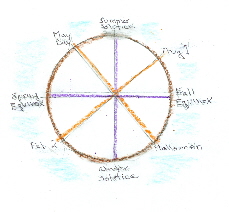
We’ve come to another “cross-quarter day,” the midpoint in the quarter of the year from the summer solstice to the fall equinox.  I know this as “Lammas,” a contraction of “Lady Mass” or some other special mass, evidence of the Christian church’s propensity for covering a festival with one of its own.  This syncretic approach disappeared with the reformations, both Catholic and Protestant, when distinctions and exclusions became the norm.  (The feast day for Mary, mother of our Lord, is August 15, not August 1, so the connection is uncertain.)

Lammas celebrates the early harvest, the wheat harvest.  In Pennsylvania, at the beginning of August I would be counting the weeks, then days, until Labor Day, when I expected the heat, or at least the  humidity, to be gone.

Whether the heat bothers you or not, this cross-quarter day, in the northern hemisphere, also marks the point at which the lessening of daylight becomes noticeable.  The evenings are getting shorter.  We are six weeks past the solstice, that wonderful long evening, and the sine curve of the year’s cycle has speeded up.  This used to be troubling to me because I was steeped in an abstract rationalism that treated days as calendar boxes, and named fall, defined as after the equinox, as the time when the days are “supposed” to get shorter.  My “book-learning” confused me.  To expect the universe to follow such rules, to be other than it is―that is what’s contrary to reason.

With its hot weather, shorter days and the imminent start of school all at once, August has sometimes seemed like the worst of all possible seasons; a sense of loss sets in.  But the farmer’s market is full of wonderful produce.  In Maine, it’s the season of corn and blueberries.  In southern New Mexico, it’s time to gather the eggplant, zucchini and tomatoes for a freezer full of ratatouille to serve over pasta.  And local peaches are ripe. Enjoy this first harvest season!

Worship: a Poem

1 Comment

This poem begins as a literal description, which can also be taken as metaphor.  The end is meant to include all who participate in the dance of life.

Worship

The floor is cold as barefoot
dancers take their stations,
red-ribboned for Pentecost,
the church’s birthday.

Be there! the teacher cried
at each new step.  Her students
stretch to get there.  The need to be
on the right foot, in the right place
pushes them past balance.
Cross front, cross back,
they coil into the grapevine,
a twisting line of ordinary saints.

Light through windows splashes
mottled rainbows round us.
That we are right
where God wants us,
there is no proof.

This poem was first published in Christian Century, May 27, 1992.

Trying too hard to be “right” is something I struggled with for many years.  It so often backfires as we “push past balance.”  Dance has helped me keep, or regain, my balance.  Sacred dance fits in many other traditions besides Christian.  Go to http://www.sacreddanceguild.org to learn more.

Dance This Poem!

2 Comments

The Sacred Dance Guild holds its biennial Festival in Holland, Michigan this week.  In honor of this event, I am posting a poem I had published back in 1984 in alive now!, a small devotional magazine.  The poem was later danced at the ordination of a friend.

The Proper Turning

The proper turning
from the world to God
is a conspicuous somersault
half joyful leap, half fall.
Power tumbles, selfish
interests spill, desires
turn upside down,
a very public mess.

Laughter dances round.
Is it delight or scorn?
No matter to the acrobat
who’s newly joined the troupe―
the company of artists
who proclaim the names of God.

At the time of writing, I had no idea how many names of God there are: the number is beyond counting.  Dance, movement, gesture, can convey some of them in ways no words can.

Although the somersault in this poem could be metaphorical, actual movement in worship is a wonderful thing.  The Sacred Dance Guild gave me an excuse to dance again after no lessons since I was a teenager.  Most of the people I’ve met who dance in church are free spirits, liberated, as if keeping their bodies limber did the same for their minds.

Dance also proved to be a good balance for my writing.  Most writers have some physical work or hobby or habit to balance all the sitting and head work.  I recommend dance if you’d like to try something new; sacred dance is for all ages, genders and levels of ability.

www.sacreddanceguild.org

Haiku, “Rules,” and a Recommendation

3 Comments

Haiku, that Japanese form which took hold in English about 50 years ago and has continued to be of interest to many, is a great example of the role of “rules” in poetry.

I particularly like a haiku posted recently on the blog, Five Reflections:

soft subtle mantra
hoes the garden of the mind
new poem blossoms

I was delighted by the contrast between the mantra described as “soft subtle” and the hardness of a hoe.  But then my inner critic sounded alarms:  “the ____ of the ____” the critic complained.  “Couldn’t he have avoided at least one of those empty words?”

I keep my critic busy checking my own work for unnecessary cases of “the” and “of the.”  But was he (or is my inner critic a she?) right to complain in this case?

There are two schools of thought about haiku, those who insist on a 5-7-5 syllable structure and those who argue for shorter, tighter lines.  The 5-7-5 imitates the Japanese form.  But the second party asserts that those Japanese “syllables” are not all words, some are signals of other kinds, so the 5-7-5 structure is a poor substitute.

The Haiku Society of America takes no official position on this question.  Their definition a haiku reads: A haiku is a short poem that uses imagistic language to convey the essence of an experience of nature or the season intuitively linked to the human condition.  I have noticed, however, that the winners in their annual contests are more often of the shorter style.

I had a workshop with a person of the “shorter is better” school.  He ruthlessly cut down my already short attempts.  I was persuaded that he knew what he was talking about.

Now, I’m not so sure.  “the garden of the mind” has a gentle flow to it that appeals to me.

On the other hand, does this haiku fulfill the Haiku Society’s definition that it “convey the essence of an experience of nature or the season”?  “The garden of the mind” is completely metaphor.  No actual garden, no hoe.  What should I make of this?

My favorite of the haiku I have so far seen on Five Reflections is this one:

sea smoke illusion
ancient seafarer ghost ship
grandpa’s story time

What I like best about this poem is the turn in the last line: the misty sea scene is suddenly transposed to an indoor scene, warm and cozy, where “grandpa” tells his story.  I didn’t even notice at first that this poem has nary a “the” nor an “of.”  This poet knows what he is doing, which further confirms my suspicion that sometimes those “lesser” words are the right ones for the flow and mood of the poem.

In summary, the following, sometimes contradictory, “rules” are apparently made to be broken by skillful haiku writers:
“Always use a three line construction of 5-7-5 syllables.”
“Don’t waste syllables on lesser words like “the.”
“Start with or focus on nature.”
As one who finds haiku challenging to write, I’ll take these “rules” as suggestions, refusing to be bound by them.

To read more at Five Reflections, click on the link in the blogroll in the column to the right of this post.  Enjoy!


The Story Begins: Excerpts

2 Comments

        In 1869, John Emerson Roberts ran away from home. He was sixteen. His father had just died in the Michigan Asylum for the Insane inKalamazoo. His two elder brothers had left home, leaving him to be the man of the family for his mother and four younger siblings. Perhaps this was more responsibility than he was ready to bear. Many years later, Dr. Roberts told a newspaper interviewer that his plan was to go toNew Orleansand become a sailor.

This action is the first indication of John Roberts’s individuality and courage.  He was born in 1853 in Ohio, where his father was a Baptist minister.  His mother had strong religious roots going back to her grandfather who was a Congregational minister in Connecticut.  John’s family moved every few years, following his father’s calls to different churches, until they settled  in Michigan in 1857.  John grew up as a farm boy outside Battle Creek.

Mental illness was not well understood in the 1860s.  John’s father was diagnosed with melancholia (severe depression) in 1864, but was only admitted to the hospital in 1869, when the facility expanded.  Two primary theories about melancholia were that it was hereditary, in which case it could not be entirely prevented, and that it was caused by too much “brain work,” for which the remedy was physical labor.  John was a thinking person, as his later career would demonstrate, so he may have feared that he was susceptible to his father’s illness.

            The life of a sailor would both free John from the constraints of religion and reduce the risk of developing a disease that was believed to be caused by too much thinking and not enough physical activity. To his sixteen-year-old mind in 1869, it appeared to be a good solution to the frustrations of his situation as he headed south toward the Mississippi River. The action also shows his curiosity and readiness to try something new.

Excerpts from the first chapter of John Emerson Roberts: Kansas City’s “Up-to-date” Freethought Preacher.  See more on the Books page.  Or go to www.goodreads.com for a giveaway which ends on August 8.

Thanks to All My Readers

2 Comments

This is the first anniversary of the publication of my biography, John Emerson Roberts: Kansas City’s “Up-to-date” Freethought Preacher.  I’m celebrating, first by saying thank you to all who have read it, are reading it, or are reading about it (along with other things) on this blog.

I’m also celebrating by offering two free copies on Goodreads, one of the places I first made connections beyond my existing circles.  If you’re interested, go to www.goodreads.com and check out their giveaways.

The book’s “launch” was a soft one.  Xlibris is good at fast turnaround.  They kept me moving to the next stage of production when I thought I’d have more time to prepare for marketing.  Suddenly the book was done, while I was on vacation, and they wouldn’t wait until the date I wanted to start publicity.  They sent out press releases – to whom I could not figure out from the data base they sent me – three weeks before I was ready.

I know about book signings, presentations, emails and post cards and went at those steps eagerly.  But this book is a niche item.  It appeals to people interested in freethought, history, and/or Kansas City.  We are a relatively small group.  Yet I know I have not gotten the word out to all of those who would enjoy reading the book.

I didn’t know what to do next.  I looked up freethought groups, religious historians, regional libraries and sent a variety of letters, announcements and sample copies.  “You need to market on line,” people said.

Xlibris wants to do marketing for its authors.  They set up a website for the book as part of my production package, but I have no access to it.  They will happily provide additional services, many at more than the cost of production.

“How will you target the niche this book is intended for?”  I asked.

“Librarians,” they answered.  “We will put an ad in their journal and send out emails to librarians across the country.  For you, a $500 discount on the price.”

“No, thank you,” I said.

“New York Times Book Review,” they suggested.  It must be nice to see your book as one of eight on a full page Xlibris ad in the New York Times, but there’s no room for any of the words I’ve carefully crafted to explain why it’s a good story. [See my Books page, if you haven’t already.]

I felt I was very considerate not to laugh out loud at the Xlibris salesman who suggested television ads.  Was he going to survey freethought historians before deciding where to place those ads?  I thought not.

I’ve learned a lot this year, connecting on social media, getting advice from many sources, sending out more letters, creating this blog.  As a “platform” this is still a bit wobbly, but I progress.  If you can’t find your niche, you make one, right?

Such was the beginning of my non-fiction book in the world.  Next time, I’ll turn to the beginnings of the story IN the book – for those of you who haven’t read it yet.

Road Tripping

3 Comments

We are on the road again.  Each year we drive across the country from Las Cruces, NM, to Maine and back.  Ten years ago we would have made no reservations and looked for a place to stop as we went.  We’ve minimized the adventure since then.  We’ve chosen one hotel chain which gives us what we want: nice towels, a box, not a pocket pack, of tissues, continental breakfast and internet connection―and every so often we get a free night.  But there are still unexpected experiences.

I was staring out the window of our hotel in Quincy, Massachusetts, when a very long red trailer truck appeared.  I watched as it was maneuvered, with the help of several people around it, into parking along the back edge of the lot.  All I could read from my window were the words “75th Anniversary” at the front and “Meals on Wheels” at the back.  What appeared to be an enormous granite rock was strapped in between them.

75th Anniversary of Meals on Wheels?  This did not seem likely.  I went over to investigate.

The truck is the 72 foot long project of the Idaho Potato Commission, called The Famous Idaho Potato Tour.  It’s the Commission’s 75th anniversary.  The “rock” represents a giant potato: one that would take 10,000 years to grow, were nature capable of doing that.

Famous Idaho Potato Tour Truck

Famous Idaho Potato Tour? I conclude that it is the potato, not the tour that is famous.  But if Idaho potatoes are already famous, why all the publicity?

An Idaho potato in the hand gives pleasure: solid, attractive in its usefulness, it is a good base for a healthy meal.  The Idaho Potato Commission seems to have caught a serious case of the “more is always better” syndrome and gone over the top.  It’s marketing supersized.  I found the Famous Idaho Potato Tour Truck at once charming and disturbing.  Why pretend a potato could grow so long, so large?  Why not demonstrate how real potatoes grow?  That “giant spud” still looks like imitation granite to me.

The four crew members must be having a great time traveling the country, though it’s a mighty long rig to handle.  Wouldn’t it have been enough, and saved a little gas, if it were 60 feet long instead of 72?    In the month since I saw it the truck has moved south into Georgia and Alabama.  Then it will be heading west.  For more information check their website: http://www.bigidahopotato.com.  They may be coming to a parking lot near you.

Older Entries Newer Entries